Take a stroll down Berlin’s Unter den Linden avenue, heading towards the Brandenburg Gate, and history will ambush you. First, you pass by the Willy Brandt Forum, paying homage to the German chancellor who from 1969 to 1974 invented Ostpolitik, Germany’s overture to the East and to the Soviet Union. You also pass near Russisches Haus, a German-Russian cultural centre currently commemorating the 70th anniversary of the end of what the Russians call the great patriotic war. A short walk away, the beautiful modern glass dome built on top of the Reichstag building comes as a reminder that it was only 15 years ago that the German parliament moved from Bonn to Berlin – shifting Europe’s centre of gravity eastwards.
German power is now mostly seen in economic terms. Given its 20th century past, the dream of simply being a bigger Switzerland still holds a strong appeal to the German public: a country without any serious external security concerns, focused on prosperity and wellbeing.
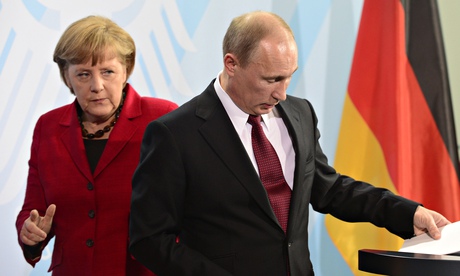
And yet recently Angela Merkel has put her country on a new course. She is redefining German power. This is not happening via grand speeches, but through concrete steps and sometimes discreet messages. And it is happening as a result of circumstances, not because of a comprehensively pre-prepared plan. Last year, in quick succession, war broke out in Ukraine, populist and extremist parties made strong gains in European elections, and the Greek conundrum returned to the eurozone. Because of all these crises, Merkel has been reappraising what her country should be doing as Europe’s powerhouse.
Take the Greek issue. The reason why Germany recently decided to give Greece a reprieve (if only for four months) by pursuing EU financial aid is not just that Alexis Tsipras backed down on most of his earlier demands. It is because Germany saw a larger strategic question beyond the immediate financial issue.
The reasoning goes like this: if Greece falls out of the eurozone, not just the common currency but the whole European project will be weakened. It would be a signal of disintegration at a time when geopolitical threats are graver than ever. Berlin paid close attention to the way Tsipras cosied up to Vladimir Putin’s Russia after his election, and to how he sent one of his ministers to Moscow, possibly in the hope of leveraging Russian financial support against Brussels’s offer. When the German chancellor recently warned that Russia might start eyeing up the Balkans next, she may not just have had Serbia, but also Greece, in mind.
Strategic Angela is also visible when it comes to confronting populist political forces in Europe. She has taken a clear stand against Pegida, the anti-Muslim movement in Germany now trying to spread elsewhere in Europe. She is especially worried about the growth of France’s Front National. German officials have been asking their French counterparts how they intend to block the rise of Marine Le Pen, who wants to pull France out of the euro if she comes to power one day.
The European commission recently granted France a two-year extension to bring its budget within EU rules. This gives the French government some slack in terms of cutting down public expenditure – a gift at a time when the Front National thrives on the middle class sense of being mistreated. French officials privately admit that German concerns about the ascent of the far-right in France played no small part in the Brussels decision.
I have heard similar comments about how Germany sees the threat of “Brexit” – a British exit from Europe. Sources close to the Merkel point out that her message to David Cameron has been a strong warning, along the lines of “don’t play games with European politics”.
Countering Europe’s fragmentation has become the key objective in Merkel’s third term. She has become obsessed with forging European unity. This was clear on Ukraine as well as Greece. It is the reason why she was quite glad to have President Hollande of France by her side when negotiating with Putin in Minsk. If Germany had gone it alone, her critics would have wasted no time evoking the ghost of the Ribbentrop-Molotov pact, with Germany and Russia carving up eastern Europe. On Greece, perhaps Merkel’s “unifying” task was made easier by the many provocations from within the Tsipras team, including its frequent references to Nazi war crimes. None of them went down too well in Paris or Rome, the capitals that Yanis Varoufakis, the Greek finance minister, visited in search of allies.
As strategic positions go, this new German assertiveness is still full of paradoxes. No doubt Merkel wasn’t quite expecting to find herself in such a position when she first got elected. One close observer of the chancellor, who has known Merkel since the start of her political career, told me Merkel would have much preferred to spend her successive terms in office concentrating on domestic issues such as industrial policy. But the fallout from the economic crisis and Russia’s threatening behaviour has pushed her into an altogether different role.
Those – and they are many – who see Germany as responsible for the economic austerity measures that have fuelled Euroscepticism and the rise of radical parties will emphasise the irony of Germany scrambling to fix problems that have come about as a consequence of its own policies. Others will ask how European Germany’s thinking really is, for example when accepting to sideline Poland during the Ukraine crisis.
But the bottom line is that Germany is no longer the country that has frequently been portrayed: a nation so obsessed with export markets and globalisation that it might be a more suitable fit for the Brics club of emerging global economies, somehow turning its back on Europe. One sign of the shift is that the German government has recently indicated it is thinking of increasing its defence budget by 2017.
Checkpoint Charlie, the old border crossing between East and West Berlin, was once a symbol for Europe’s division, and hence Germany’s constraints. Visit now, and you see only a tourist site. Sitting in a nearby restaurant, Joschka Fischer, the former foreign minister, tells me that in spite of her many flaws, the chancellor is indeed carving out a new sense of German responsibility for Europe’s internal and external affairs.
Whether that will be palatable to an inward-looking German public is another question that Merkel will continue to grapple with. “This is a new role for Germany,” Fischer says, “and the country is not yet accustomed to it.”