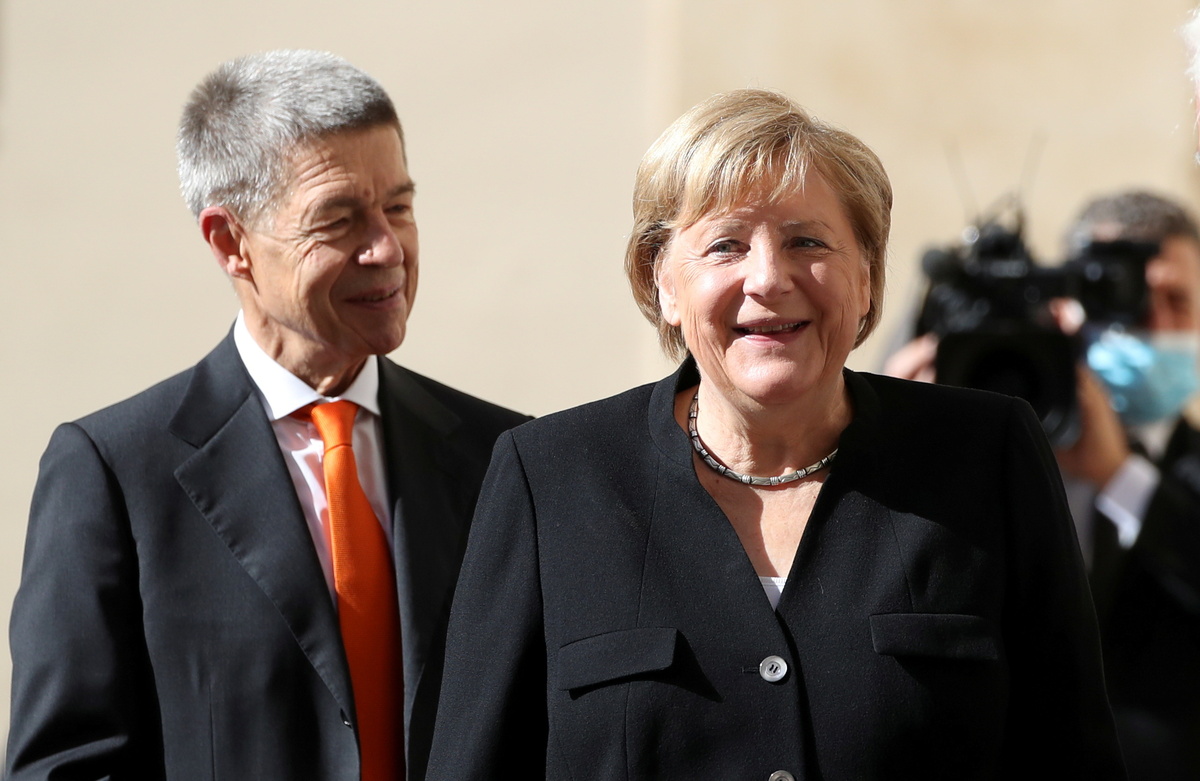
Joachim Sauer, Chancellor Angela Merkel's academic husband, has blamed his compatriots' "laziness and complacency" for Germany's comparatively low vaccination rate, saying public rejection of science has never been as visible as now.
Sauer, who until his retirement in 2017 was professor of quantum chemistry at Berlin's Humboldt University and seen as one of the field's top researchers, has been reticent to discuss politics throughout his wife's 16-year tenure.
He has been reluctant to play the role of political spouse, declining to accompany her on most trips and largely limiting his public commentary to his own scientific research and his passion for the composer Richard Wagner.
But in Italy this week to be inducted into the Italian Academy of Sciences in Turin, he briefly addressed the issue that has dominated his wife's final two years in office.
"It's astonishing that a third of the population is not following scientific evidence," he told La Repubblica, as reported by its German partner newspaper Die Welt on Tuesday.
"Partly that's down to a certain German laziness and complacency. The other group is people ... who are reacting ideologically to what they think of as a vaccine dictatorship."
The fourth wave of the coronavirus pandemic is the severest yet in Germany, with hospitals overflowing with the unvaccinated and initial vaccinations wearing off.
Some 68% of Germans have been fully vaccinated, lagging the proportions in Britain and France, let alone global leaders such as Portugal and Singapore.
Many health policy experts blame misinformation about the supposed danger posed by vaccines for the gap. For Sauer, the gap underscores the importance of attracting more young people to scientific careers.
"Science is important, and it would be good if more young people devoted themselves to it," he said.
(Reporting by Thomas Escritt; Editing by Mark Potter)