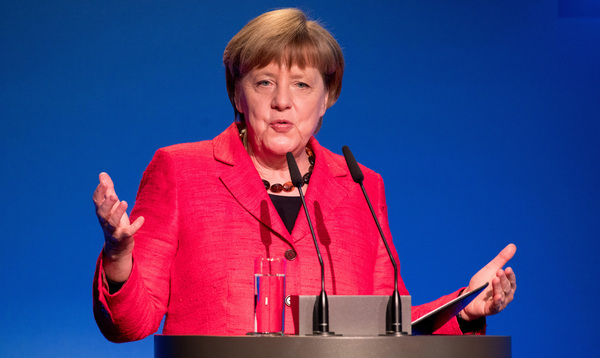
DRESDEN, Germany �� German Chancellor Angela Merkel outlined her post-election agenda Saturday, saying she'll seek a coalition with the Free Democratic Party and Greens.
Thirteen days after an election in which support for her Christian Democratic Union-led bloc to its lowest level since 1949, Merkel faced criticism of her policies and style by delegates at a CDU youth convention who said she's straying from the party's conservative roots and demanded that she rejuvenate her Cabinet.
While polls suggest that Merkel retains broad support among her bloc's supporters, the contentious meeting in Dresden Saturday points to the forces facing the chancellor as she seeks to build a fourth-term government. Before that, she needs to settle a resurgent conflict with her Bavarian sister party over limits on migration.
"This might seem like squaring the circle, but with a bit of goodwill it should be possible," Merkel said of calls by Bavaria's Christian Social Union party for an upper limit on migration, which she again rejected during her speech in Dresden. And "it's clear that difficult negotiations lie ahead" with the FDP and Greens, she said.
Support for Merkel's bloc declined in the Sept. 24 election by almost 9 percentage points, to 32.9 percent. That leaves Germany's biggest political grouping dependent on allying with two smaller parties after the Social Democrats fell to 20.5 percent and said they're ending their coalition with Merkel. A date for starting coalition talks hasn't been set.
"The SPD isn't in a position to govern at the national level for the foreseeable future," Merkel said.
Several delegates blamed Merkel for helping foment the rise of the anti-immigration Alternative for Germany, or AfD, with her open-borders stance during Europe's refugee crisis, which sent more than 1 million refugees to Germany in 2015 and 2016. The AfD won 12.6 percent of the vote, becoming the first far-right party to enter the Bundestag, or lower house, since the immediate aftermath of World War II.
The election was "a crushing defeat" for the CDU-CSU bloc, Hans Reichhart, a Bavarian delegate, told Merkel during an open-floor debate after her speech. A delegate who urged Merkel to resign was booed.
The chancellor gave little ground, including on the refugee issue, which she acknowledged was polarizing Germany and wouldn't go away anytime soon. Taking up a demand by the youth organization, she pledged to put any coalition contract with the Greens and the pro-market Free Democrats to a vote by a party convention.