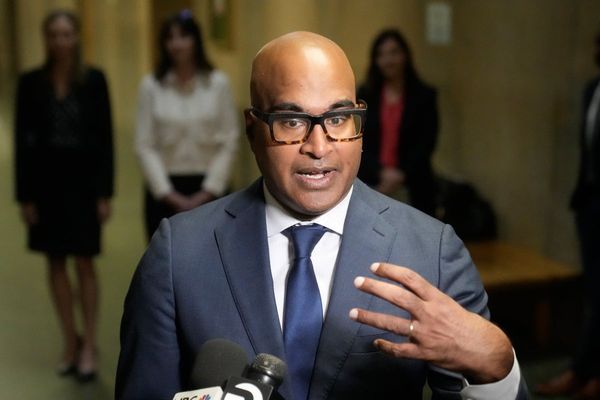
Tidjane Thiam, the former Prudential chief now running Credit Suisse, won’t be thanked by his counterparts at Deutsche Bank for saying so at this moment, but he is correct: big European banks are “not really investable” and the industry is in a “very fragile situation”.
Look at the share prices to see that investors agree. In the old pre-crisis days, banks traded at a premium to their book value on the reasonable assumption that the business of lending would tend to increase profits over time. These days discounts to book value are the norm for big banks.
Low interest rates, accompanied by piles of government debt trading at negative yields, has made lending fundamentally less profitable. Banks can shed staff and overheads, but that is not a cost-free process. Meanwhile, mergers – essentially grander cost-cutting exercises – are more or less forbidden because the world can’t stand more institutions that are too big too fail. The position is a mess. Put another way, big banks used to run on obscene levels of leverage and haven’t found a new model to allow them to plod through the era of near-zero interest rates.
That is why it is wrong to regard the crisis at Deutsche as merely a standoff with the US Department of Justice over the size of the penalty for mis-selling mortgage-backed securities in 2005-07. Yes, a demand for $14bn (£10.8bn) – or possibly even half that sum – would probably trigger a need for more capital, as analysts say. But investors can also see that Deutsche is years behind even its peers in adapting to the new world.
UBS rallied around its asset management division; Barclays sold its asset manager, shed many of its continental European business and is getting out of Africa. Deutsche, by contrast, has tried cutting costs but has not radically changed shape. Even now, the co-chief executive, John Cryan, talks about a restructuring that will take five years, a timescale that looks far too relaxed if he finds himself pleading with his shareholders to give him more capital at short notice.
It is still quite possible that the DoJ’s demand could fall from $14bn to $4bn, which would allow everybody to breathe more easily. But, given what’s at stake, it would be amazing if German chancellor Angela Merkel and her officials are not working on contingency plans for Deutsche. She has to deny all such suggestions, of course, because there is no point fuelling the sense of crisis. But this crisis in confidence in European banks, with Deutsche at the centre, has been brewing for at least 12 months. If the German government and Frankfurt regulators weren’t paying attention, they weren’t doing their job.
Germans won’t sit around in game of pass the parcel
German companies still do the simpler business of delivering parcels well, which is why Royal Mail’s share price fell 3% on news that Deutsche Post, owner of DHL, is buying UK Mail for £243m. Deutsche Post is a €33bn (£28.6bn) titan and won’t be returning to the UK parcels industry simply to sit on UK Mail’s 4% share of the market. It will want to grow.
The timing is cute from Deutsche Post’s point of view. It has waited for UK Mail to overcome teething problems at its new automated sorting centre. It is paying 43% more than UK Mail’s share price on Tuesday but well below the all-time high.
From UK Mail’s point of view, you can understand why chairman Peter Kane, who started the business in 1971 as a taxi firm in Harrow, has decided to sell. Amazon, which is building an in-house delivery operation, is gradually become a competitor rather than a customer for the industry.
For Royal Mail, the game won’t change overnight. It is still the dominant player and internet shopping in the UK is still booming. But 3% off its share price looks about right: Deutsche Post has very deep pockets.
When any excuse for a thumbs-down will do
Get ready for the European lobbying event of the year. The proposed £24bn merger between the London Stock Exchange Group and Deutsche Börse has been sent to Brussels for a full competition inquiry. Almost every EU finance ministry will have an opinion.
Let’s hope somebody throws a large spanner in the works. This deal looks highly dangerous for the City of London if it encourages financial business to flow out of the UK, a risk that can only be assessed properly once the terms of Brexit are settled. The commission is worried about pan-European competition, not the UK’s national interest, but any grounds for a thumbs-down will do.