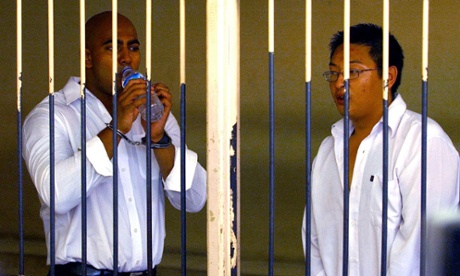
If you are condemned to death in Indonesia, by law you are given “the freedom to choose” from three options: you can sit, lie or stand. Another cruel freedom will be made available to you: the choice of wearing a blindfold or keeping your eyes open. The apron, a cloth draped over the torso with a target on it, is mandatory.
20 soldiers who have undergone appropriate psychological counselling will fire the shots. This will most likely happen at night, on a deserted beach or plantation. If you are still alive at the end, the regulations allow for a shot to be fired at point blank range into your temple, at a point just above your ear.
The story of how I became involved in the Bali Nine case is not that complex.
I studied law and practised for a couple of years. Between that training and my liberal Catholic upbringing I formed a few unshakeable beliefs: reform and rehabilitation should be a primary aim of the penal system, people have the ability to change, the state should not kill. One night in April 2005, I saw some grainy footage air on Channel 10 news that chilled me. It was nine young Australians arrested in Indonesia on suspicion of drug smuggling. Packets of heroin were taped to their bodies, under their garish Hawaiian shirts. It seemed certain, at some point, they would face the death penalty.
Melbourne, the most liberal city in Australia, has a strong and active community of death penalty activists. Barry Jones famously campaigned in 1967 against the execution of Ronald Ryan; it’s not uncommon for young law students to assist in death penalty cases in Texas and Louisiana during their university holidays.
Reprieve Australia was formed in Melbourne by a group of lawyers, including barrister Richard Bourke, who in 2001 returned from a stint in the deep south of the US working on capital cases. He was profoundly moved by the work he saw happening on death row there and wanted make provisions for Australians interested in death penalty work to intern on US cases. Bourke has since relocated full-time to Louisiana where he runs a capital assistance centre, and has worked on hundreds of cases involving the death penalty.
I joined Reprieve in 2009. Before meetings – usually held in the boardroom of some high-end law firm – five of us would meet at Benitos on Little Collins Street to talk about the Bali Nine. By early 2011 the appeals of Myuran Sukumaran and Andrew Chan were exhausted – except for the final PK – a final appeal to the Supreme Court, known as a Peninjauan Kembali.
Indonesia was showing no appetite for execution but what if … what if …
Advocates needed to be ready. We contacted the legal team who had been working on the case for a number of years, who – along with the families of Andrew Chan and Myuran Sukumaran, gave us the go ahead to form a campaign group. We had no money but we found a volunteer graphic designer and a web developer, we came up with a name - the Mercy Campaign – and drafted a petition asking for clemency. Our design used the green – Kerobokan green, we came to call it – that covered the prison bars and walls.
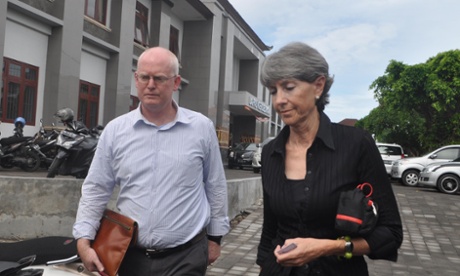
The lawyers at the Melbourne bar have a traditional commitment to social justice, human rights and pro bono work. From time to time death penalty briefs involving Australians crossed the desks of Melbourne barristers, like Julian McMahon and Lex Lasry, who acted for 25-year-old Van Nguyen, the Australian hanged in Singapore in 2005.
By September 2006, Lex was a judge and Julian had assembled a team from the top echelons of Melbourne’s legal world (initially Lex was among them, before his appointment), to work on the Bali Nine case pro bono. They came to the case after a number of verdicts that were disastrous for Myuran and Andrew: a February 2006 district court trial where they were sentenced to death, and failed appeals in April and August 2006. At each step their death sentences were affirmed.
In our Mercy Campaign meetings the lawyers spoke of “the boys”. There is no one more vulnerable than a prisoner, particularly a prisoner on death row, and their protectors were fierce. But the notoriety of the Bali Nine, and the money that could be made from them – selling stories from the jail or writing books – brought out the crazies, exploiters and parasites nonetheless.
Then there was the pastoral care. Many of the legal team were visiting Andrew and Myuran in their spare time, or raising money amongst colleagues to buy computers or checking in with their families. Julian brought in books to the prison for Myuran to read – Dante and Milton included. At one of our meetings he urged me to read the work of Thomas Merton, a Trappist monk, social activist and mystic.
While the media were labelling the two men as “enforcers” and drug lords who enjoyed lifting weights and practising jiu jitsu, Julian and the others saw submerged hinterlands; potential and depth that might be realised if they channelled time and energy into art, religion, study, or prisoner education, English lessons for other prisoners, cooking classes, computer skills.
Anything instead of the empty hours, the aimless drift through the units of time that make up a sentence. Myuran and Andrew’s constructive pursuits led to a transformation. Last week, prime minister Tony Abbott described them as “reformed characters” who had helped to rehabilitate other prisoners.
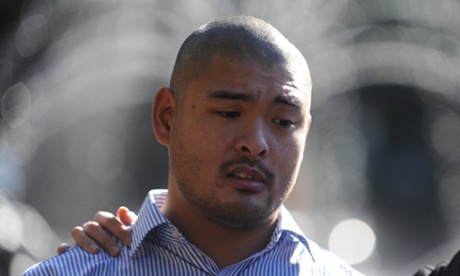
In 2011 I travelled to Sydney with Matt Goldberg, a Mercy Campaign co-founder, to meet Myuran and Andrew’s family members. Michael Chan, Andrew’s brother, picked us up from the station in a work break (he was working two jobs to make extra money to travel to Bali) and we drove back to his childhood home. He was an easygoing guy with a broad Aussie accent, who seemed unfazed to have two nervous strangers from Melbourne in his car.
We pulled into a neat suburban house filled with family photos and the smell of food cooking. The Chans for many years ran Chinese take-away shops around Sydney. They greeted us warmly and plied us with food, with conversation passing mostly through Michael due to their limited English. Sitting on their couch eating dimsum I was struck by a sense of horror: who are we to walk into these people’s homes and say we can help their son. What if we can’t?
The following day Sydney’s streets were flushed with a summer storm. We met Myuran’s mother Raji at a cafe near her work. My impression of her was a woman so full of sadness that it almost seemed to physically spill from her. My immediate impulse was to comfort her somehow. She was gracious, kind, eager to help us, forlorn, despairing, confused and immensely stressed. When the rain cleared we went to leave and she mentioned it was her birthday, but would not be a happy birthday until all her children were home together.
Mark Davis from SBS met Matt and I in Darlinghurst and said we could use whatever footage we wanted from his recent story filmed in Kerobokan. He liked the guys, could see the positive work they were doing in the prison and wanted to help. His Dateline story aired and we immediately got 10,000 signatures on the petition. One scene haunted me. It was filmed at night, Julian was in the back seat of the car, talking about the execution. His spoke slowly, his voice flat, the lights of Kerobokan falling behind him, the sky behind the palm trees darkening. He was talking about Myuran and Andrew being taken at night, transferred to another island, maybe off Java, where they will be blindfolded and tied to tree and shot in the chest.
Over the next two years we met people connected to the case who wanted to help in various ways. There are people associated with church groups who make regular trips to Bali. Mary, an activist from country Victoria, approached artist Ben Quilty requesting he visit Myuran. Academics with specialities in Indonesia contributed their expertise.
A group of actors from Bondi staged a play about drug smuggling called Bondi Dreaming. They had been over to Bali and met the guys in jail, forming friendships with Myuran and Andrew. They made a Mercy Campaign film that featured cast members from Home and Away and members of Andrew and Myuran’s family. When half a dozen of us met in the lounge room of the producer’s house in Bellevue Hill while they filmed Raji, it felt like no one was breathing. They were getting her to repeat the words “mother” then “mercy.” The words came out soft and thick with sadness.
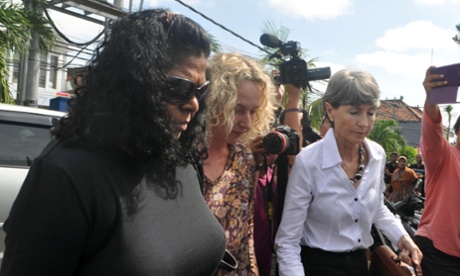
The years rolled on. We continued to meet with Julian semi-regularly in his chambers for updates, usually in the late afternoon, when court was over. He would tell us how the guys were doing and give us the details of any developments in Indonesia on broader issues of the death penalty. We traded articles from the Jakarta Post, or promising analysis on Indonesian human rights from the Lowy Institute.
We were all watching Indonesian president Susilo Bambang Yudhoyono closely. What was he saying on this or that? Which way was the wind blowing?
Apart from the Bali bombers in 2008 Indonesia had performed no executions. In 2012 when Indonesian maids in Saudi Arabia were sentenced to death for murder, there was a national outcry in Indonesia. Ambassadors were recalled, and frantic attempts at clemency were made. It boded well for a change in Indonesia, that the death penalty would go the way of the Catherine Wheel – a relic from another time.
I began reading the Indonesian English-language press regularly and in 2014 Matt and I started taking Indonesian language lessons. Reprieve Australia got serious about Asia and began sending volunteers to work on capital cases there in conjunction with local lawyers, assisting anyone of any nationality facing the death penalty. Work was still going on in the US, but we were now looking towards Asia.
One day, Michael Chan came to get me for lunch. I was in Ubud and Michael was staying near the prison with some of Andrew’s supporters from church. There is no food in the prison, so Michael spent most of his morning shopping, then cooking and bringing food in to Andrew, mostly of the western comfort variety – meat, potatoes, roasts. He was not visiting that afternoon, so we drove up the steep hills outside Ubud, where the air was thin and the traffic crawled with tourist buses.
We parked at the edge of a volcano and got a buffet lunch, which Michael insisted on paying for. We sat outside and he told me about the early days after the arrest when everything was confusing and horrible. Michael relocated to Bali for 11 months of that first year, running around, trying to organise food, looking after his brother’s welfare, fending off the media. The weight dropped off him because he walked everywhere in the wet heat, having no idea otherwise how to get around, not realising that most westerners in Bali get a driver.
I wonder what it must be like to be Michael Chan, the stoic older brother. You’re going along with your life, then all of a sudden, everything changes and you are plunged into a strange world, moving back and forth to Bali. An inverse sort of tourism; instead of arriving in paradise, you are doomed, over and over, to re-enter your brother’s particular version of hell. Maybe you get used to it.
Now Chan has a regular driver, and had been up this particular volcano many times. I have a regular driver too, a young Balinese guy called Mus. He drove me to the prison the next day, One Direction and Katy Perry blaring.
Mus seemed both nervous and exhilarated by this assignment. He had heard about this place – wasn’t Schapelle in there? – but had never had cause to visit. The prison, sitting on a main road, was a squat, ugly building with barbed wire looping the perimeter. Families sat in the waiting area, sweltering outside until their numbers were called. It’s there I met Chin, Myuran’s younger brother, an intelligent, lovely guy who had the sad, dark eyes of a Goya painting. We got takeaway coffees for ourselves and Myuran, then surrendered our passports and bags and entered Kerobokan.
Myuran was on the other side of the gate, dressed in a button-down long sleeved shirt and shorts. I handed him his latte and stepped into the prison. He showed me the art room that he helped set up with the permission of the governor. Some prisoners, a couple of women and a man sat on the floor by easels working quietly at their paintings.
Myuran’s art was on the walls. You could chart the progress of his painting with your eye: from the almost naive art of a frangipani flower, to more complex portraits, using thick paint. Ben Quilty’s influence is everywhere, but not exclusively. Myuran had painted the prison governor, the Indonesian president, and Australian politicians – including Julie Bishop. It was as if the act of painting powerful people conveyed some of his hope and desperation – like he was painting his way to mercy.
But the atmosphere in the art room was otherwise surprisingly light. We talked about what was going on in Australia: Manus Island, the upcoming election, Australia’s relationship with Indonesia. It was the sort of conversation you have with a fellow Radio National listener.
Andrew loped in, wearing singlet and shorts. He was friendly, quick to laugh and was grateful for the rugby league magazines I had brought over from Sydney. He rolled them up and put them in the back of his shorts. They fell about laughing when I told them a ridiculous story about the sex healer I had interviewed in Bali, and they had a few funny stories of their own about the characters that had passed through the jail. The place was rough, prone to flooding and cramped, but it was their home and there was a community of people there, who in their own way supported each other.
Myuran looked stricken when I brought up any possibility that they might be moved to another jail or that the art room was temporary. He had fortified it against flooding. It was his thing – it gave his life and others purpose. Andrew was more focussed on the church and the kitchen. Both were busy, they had a schedule.
It helps, said Myuran, as it’s not good to spend too much time idle, thinking. Later Chin and I went to Burger King for lunch and he told me about the moment when the family found out that Myuran was sentenced to death. It hadn’t even been really raised as a possibility before. The shock of it was absolute and still ongoing.
All of them – all the family members – had the look of deeply bewildered people. Their facial expressions had now set: how did we get here? I went back to the prison a couple of days later with books and food, but the guards said no more visitors. A dozen of us, mostly Indonesians, were turned away.
I left the gifts with the guards but feel unexpectedly fretful. I lingered at the gates, in case the guards changed their mind. I wanted to go back in and see them again.
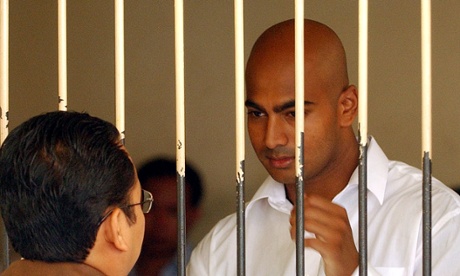
In July 2014 Joko Jokowi Widodo, the heavy metal loving Jakarta governor, was elected on a wave of popular support. Indonesian watchers, eagerly hoping for progress on human rights, were to be disappointed. During a public lecture in Yogyakarta on 10 December Jokowi emphasised that the government would not be merciful in dealing with narcotics-related crime.
He advised he would reject requests for clemency for 64 drug traffickers currently on death row. Then, on Thursday 8 January, Myuran’s appeal for clemency was rejected. The legal team found out after reading about it in the Herald Sun.
10 days later, on 18 January, Indonesia killed six prisoners in the first round of executions. International pressure from the Brazilian and Dutch governments – whose citizens were condemned – did not sway Jokowi. There was no last minute reprieve.
Meanwhile the president indicated that Myuran and Andrew would be killed together. Andrew has not had his clemency rejected. We held out hope that the announcement would never happen, that there would be an indefinite delay. After all, Tony Abbott, Julie Bishop and leaders of the Labor party have come out strongly against capital punishment in the week of the executions. Abbott says “mercy should be the cornerstone of every justice system”.
On 22 January Andrew’s clemency application was rejected.
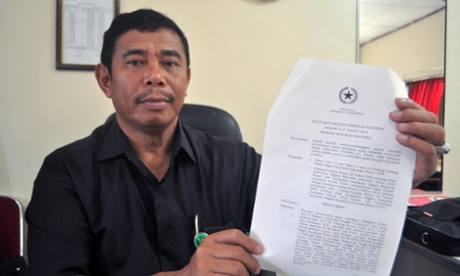
Things in life move fast and slow. And so it was with this. The campaign and efforts to save the men became infused with a furious energy. Matt and I called in more volunteers and on the Australia Day long weekend set up a sort of moving war room, in legal offices and barristers chambers around the Melbourne CBD.
Our servers were crashing from the traffic of those wanting to sign our petition. Volunteers worked late into the night fortifying our systems and back-ups were created. In around a week almost 100,000 extra people signed our petition. Jokowi’s favourite grindcore band, Napalm Death, came out in support, urging their fans to sign the petition.
In the meantime Ben Quilty had returned from Kerobokan where he had visited and painted with Myuran. He returned charged with purpose. Gathering a cohort of high profile Australians – a diverse bunch, from Asher Keddie to Alan Jones – he created the I Stand for Mercy video. In under a week he organised for a candlelight vigil to be held in Martin Place, with high profile acts supporting the plea for mercy.
The legal team were also in a race against darker forces. The best and only hope – the lodgement of the PK, a final appeal to the Supreme Court, was frustrated by the requirement that Myuran and Andrew be present when the document was filed. Even then, they were concerned that the PK’s reliance on extensive evidence that Myuran and Andrew had been rehabilitated would not be accepted.
On Wednesday night rumours were circulating. The attorney general said they were both on a “list”, that they would be next. At one level, we are all condemned. None of us live forever but the grace of our situation is that we never know really, precisely, when that time will come. We can live suspended in an unending moment of present time.
There are many circles of hell in Andrew and Myuran’s situation, but to me, this is one of the worst: the fixing of the time and place of your death, the 72 hours notice period, the families’ final separation from their healthy sons, the knock on the cell in the night, the transport to the place, the blindfold and apron, the final decision to sit, lie or stand.