More than 3,000 merchant shipping companies have been sent Arabic placards to distribute to their crews, so frequently have merchant ships been called upon to rescue Arabic-speaking migrants in the Mediterranean.
Placards with the Arabic and French translations of “If you are sick then we will try to help you but we are not doctors” and “Wi-Fi is not available” are among a set of 12 signs that have been been supplied by the world’s largest shipping association, the International Chamber of Shipping (ICS), along with advice on how to deal with a migrant rescue.
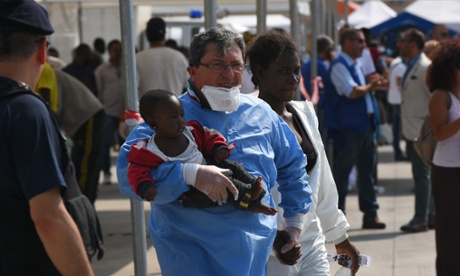
170,000 migrants were rescued from the seas between Italy and Libya in 2014, and over 70,000 have been saved so far this year. Merchant ships have played a key role in the rescue operations.
According to the Italian coastguard, more than 250 merchant boats were diverted from their commercial activity in 2014 to save more than 42,000 people – roughly a quarter of the total. When full-scale European rescue missions were suspended in the first few months of this year, the proportion of migrants saved by merchant ships rose to a third. At least two of the biggest migrant shipwrecks so far this year were dealt with at first by commercial crews, with one crew-member filming part of a rescue operation to give a sense of the challenges his colleagues face.
“Merchant ships do an incredible job,” Captain Paolo Cafaro, one of the Italian coastguards in charge of coordinating rescues off the coast of Libya, told the Guardian earlier this year.
Faced with this increased pressure, the ICS issued extensive guidance this week on how ill-equipped cargo ships, often with a crew of just a dozen, can rescue leaking fishing boats crammed with up to 700 people. The handbook advises captains on how to treat refugees “as humanely as the design and limitations of the ship and the capability of the crew allow”, and advocates “keeping family groups together, separating different cultural/ethnic groups and, so far as possible, not accommodating too many people in any one space or area”.

At the request of several captains with prior experience of Mediterranean migrant rescues, the booklet includes several placards translating key information such as: “Food and water will be provided but there are limited supplies. Please be patient.”
The ICS secretary-general, Peter Hinchliffe, predicted ships would stick to the shipping lanes that take them into contact with migration routes from Libya, but said crews are nevertheless struggling to deal with the sudden change to their working practices.
“It’s a longstanding tradition, enshrined in maritime law, that people in distress at sea will be rescued,” Hinchliffe said. “However the current circumstances are stretching the ability of merchant ships to meet the growing need.
“There’s a world of difference between a ship with a crew of 20 rescuing another merchant ship or yacht with a similar crew – and the situation at the moment where merchant ships with limited crews are rescuing boats of 300 or more.”
Hinchliffe said European governments were still too reliant on merchant ships, most of which lack the adequate medical expertise and food supplies to deal with huge numbers of migrants. “The Italian coastguard has been first class, the provision of Italian military ships has been first class, and the provision of military ships by countries like the UK has been good,” said Hinchliffe. “But there hasn’t been much in the way of boosting capability. We need to make sure there are more coastguard ships available in the right places with the right medical facilities.”