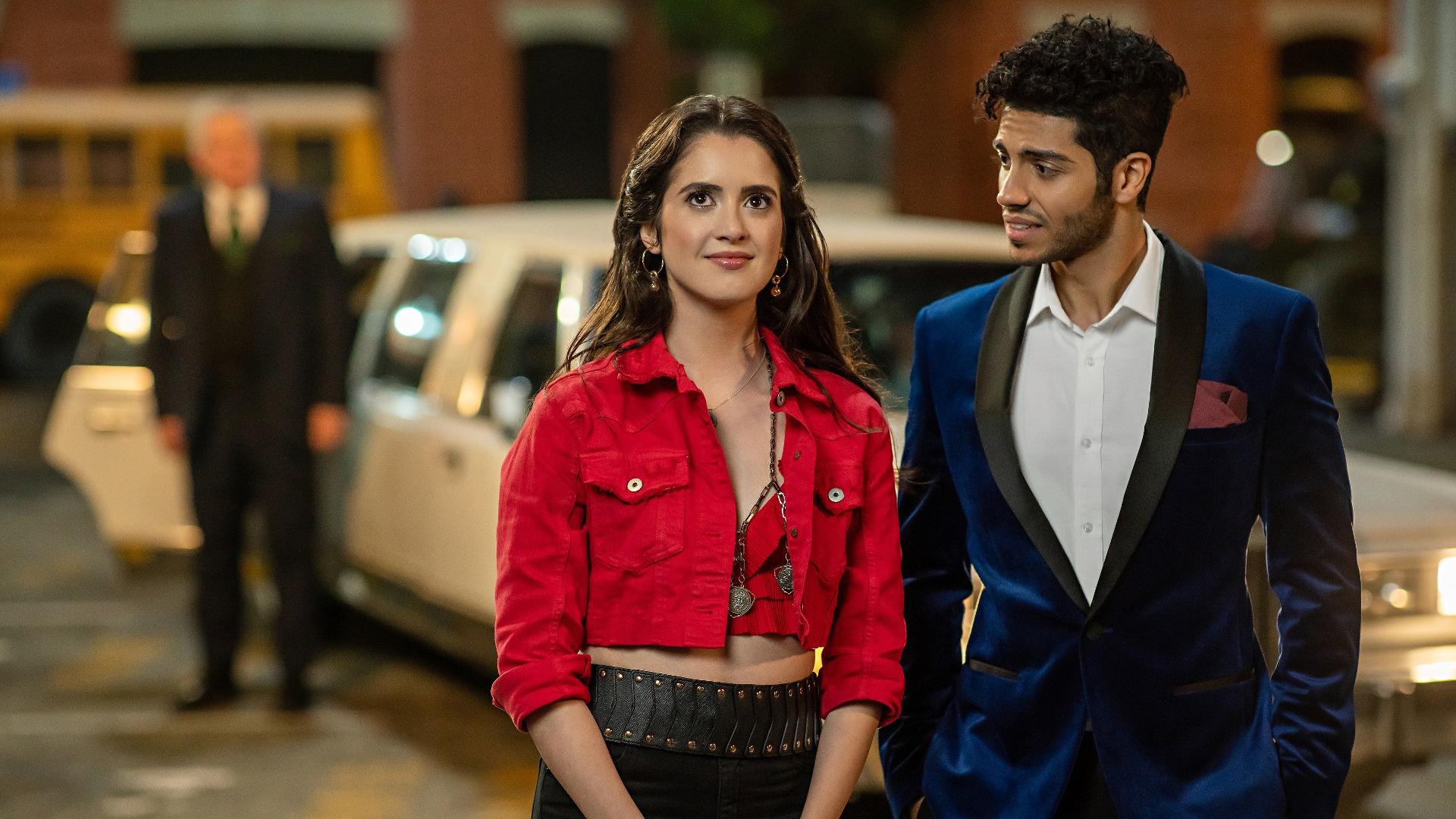
On its face, The Royal Treatment is little different than most fairy-tale style Netflix rom coms. It has a screenplay seemingly written by a Mad Libs book and a production that looks professional enough but mostly coasts on the charms of its protagonists. As I (and many others) have noted over the last four years, Netflix has taken smart advantage of Hollywood’s relative rom-com vacuum, crafting original films (like Set It Up) and new-to-you-adaptations (like The Kissing Booth) which can successful approximate the once standard theatrical sub-genre. They’ve even made in-roads in the holiday rom-com sandbox, offering both G-rated (The Christmas Prince) and R-rated (Holidate) approximations of what has become Hallmark’s singular specialty. However, what makes The Royal Treatment stand out is that it stars Mena Massoud. You might remember him from Disney's live-action Aladdin.
Massoud plays a spoiled but decent heir yearning to escape from the chains of royal pageantry. Former Disney Channel star Laura Marano plays a self-assured and ambitious hairdresser who ends up with a lucrative contract to style an upcoming royal wedding. Izzie isn’t a “street rat,” but she could certainly use the money as her long-suffering family salon could use some costly repairs (and a better landlord). The notion of a blue-collar woman spending a week galivanting around royalty along with the “rich dude begins to care about others and eventually finds romance with someone beneath his social station” variable makes this a mix of Aladdin and Pretty Woman. Certain visual and narrative cues, including a charismatic, street-smart leading lady with curly brown hair and an affinity for red, assures us that the comparisons are not accidental.
The Royal Treatment, which has been Netlfix’s most-watched movie since its debut on Thursday, is a refreshing example of audiences, intentionally or not, practicing what they preach. Disney sold Aladdin as a demographically specific event movie for folks yearning to see a mega-budget musical romance starring actors who looked like Massoud, Naomi Scott, Nasim Pederad and Marwan Kenzari. That Will Smith played the Genie as essentially a reprisal of the title character in Hitch was a huge commercial bonus, especially overseas, and the film earned $353 million domestic and $1.053 billion worldwide in summer 2019. However, by late 2019, Massoud was claiming that he hadn’t received a single post-Aladdin audition. Meanwhile, even with a sequel theoretically in development, Disney had green-lit a Disney+ spin-off starring Billy Magnussen's Prince Anders, the film’s only major white character.
For the record, this doesn’t make Disney the villain, although their quasi-habit of selling big movies (like Beauty and the Beast) as representational milestones and then giving the white dudes (like Luke Evans’ Gaston) their own spin-offs doesn’t quite pass the smell test. However, it’s easy to get upset when a major “not a white guy” actor doesn’t seem to get the same boost off a massive smash hit as his or her peers. But it’s not that much harder, at least it shouldn’t be, to “stan” your favorites by watching the films and television shows they do make. If you liked Massoud in Aladdin and/or were outraged on his behalf over the apparent lack of career boost, The Royal Treatment is a fine example of Massoud getting a lead role sans any ethnic requirement.
If you loved John Boyega in Star Wars and/or think he got a raw deal from Finn’s trilogy arc, watching Pacific Rim: Uprising, Attack the Block, Detroit and the dynamite “Red White and Blue” episode of Steve McQueen’s terrific Small Axe miniseries (available for $0.00 to Amazon Prime subscribers) can’t hurt. If you’re displeased by how Ray Fisher’s role as Cyborg in Joss Whedon’s theatrical cut of Justice League mostly ended up on the cutting room floor (along with allegations of off-screen mistreatment), he’s rather good in the stand-alone third season of HBO’s True Detective. He’s rock-solid in ABC’s just-concluded six-part, murder-of-Emmett Till miniseries Women of the Movement. I talk a lot about “voting with your wallet,” but sometimes it’s just voting with your time, especially for the non-franchise projects and non-IP films and shows.
It’s not activism, but strong initial ratings for The Royal Treatment makes it a lot more likely that Massoud will get another Netflix movie than if no one had watched. If you liked Aladdin (another film that almost entirely relied on the charisma and chemistry of its heroic leads), well, this is how star power is supposed to work. In the proverbial olden days, Hugh Jackman would win fans from playing Wolverine in X-Men and at least some of them would follow him to Swordfish and Kate and Leopold. Now, in a theatrical industry almost entirely predicated on IP and marquee characters, Chris Hemsworth can’t open an envelope outside of the MCU. Meanwhile, starring in Star Wars: The Force Awakens and Spider-Man: Homecoming doesn’t mean a damn thing to Daisy Ridley and Tom Holland’s Chaos Walking.
I’m not trying to oversell this movie, which does however win points for balancing out certain tropes (like the fact that royal wedding jitters are mutually and that his bride-to-be isn’t remotely villainous) and making sure the HEA leaves behind little collateral damage. If you like Massoud and/or Marano, you’ll like the movie, which (again) is what star power is supposed to be about. Back when actors and actresses were the brands or the franchises, audiences went to an Adam Sandler farce, a Tom Hanks drama, a Harrion Ford actioner or a Julia Roberts rom com because they liked seeing those actors in those genres. That star+concept hook has shifted to streaming. It’s easy to complain online about Massoud being denied opportunities. It’s only slightly harder to complain only *and* endorse the opportunities he does receive.