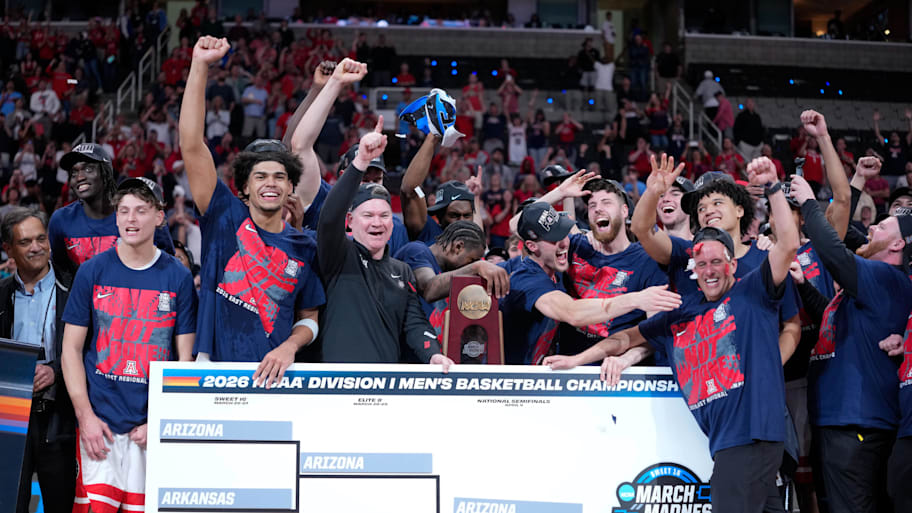
Ladies and gentlemen, we’ve arrived at two of the greatest words in sports: Final Four. After a fun batch of Elite Eight games that delivered an all-time March moment with UConn’s incredible buzzer-beating win over Duke, the stage is set in Indianapolis, and the cast—Arizona, Illinois, Michigan and UConn—has been chosen. All that’s left is for the basketball to tip off and the action—or drama, if you will—to begin.
Before that happens, it's time to survey the landscape and see how each team measures up based on their performances in the tourney as a whole.
No. 1 Arizona (West No. 1 seed)
Actual NCAA seed ranking: No. 2 overall
Average NCAA tournament point differential: 20.5 points
Upcoming game: Saturday vs. No. 1 Michigan at 8:49 p.m. ET on TBS/truTV/HBO Max
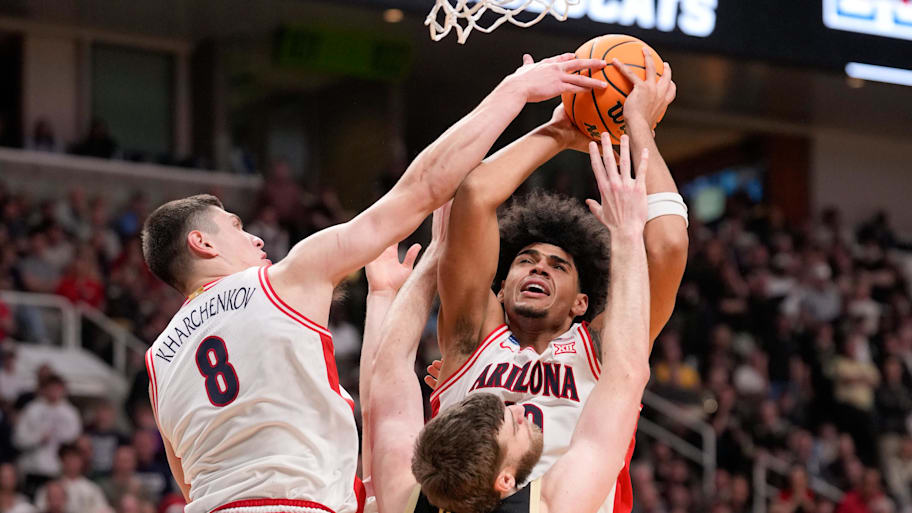
Arizona had not trailed in the NCAA tournament until it faced a real test against Purdue in the Elite Eight, and found themselves down by seven points entering the locker room at halftime. The second half was the Wildcats at their very best. They wore down the Boilermakers with their physicality, put the clamps on them defensively with their length and relentlessly attacked the interior for high percentage shots or a foul drawn. The Wildcats play a beautiful brand of basketball, turning off the water for opponents defensively, then microwaving defense into instant offense in transition on the other end.
Arizona has had a different leading scorer in each of their last three NCAA tournament wins and, when they're at their best, the scoring can come from as many as seven different players. In Jaden Bradley and Motiejus Krivas, the Wildcats have defensive anchors on the perimeter and in the paint. They have do-it-all forwards in Ivan Kharchenkov and Koa Peat, as well as a three-level scorer in Brayden Burries.
Arizona has all the pieces necessary for a title and looks like the team to beat entering Indianapolis.
No. 2 Michigan (Midwest No. 1 seed)
Actual NCAA seed ranking: No. 3 overall
Average NCAA tournament point differential: 22.5 points
Upcoming game: Saturday vs. No. 1 Arizona at 8:49 p.m. ET on TBS/truTV/HBO Max
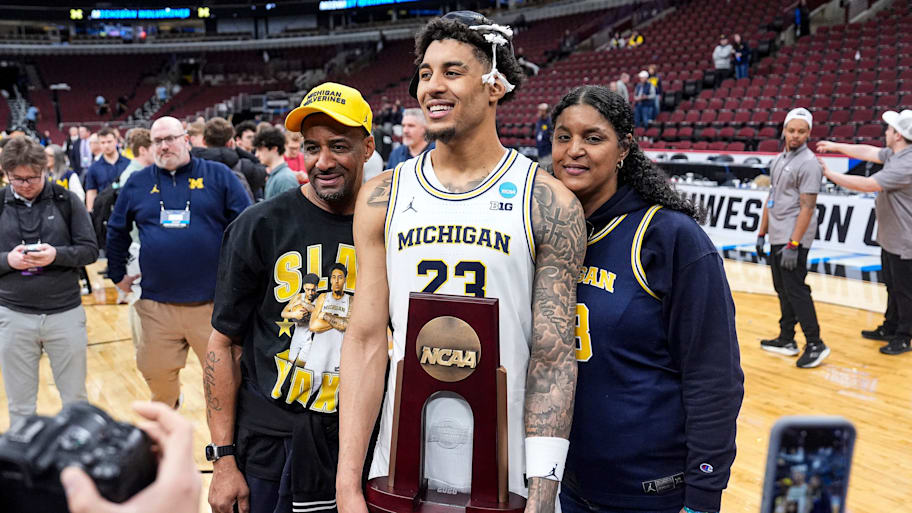
Michigan has used its overwhelming size in the frontcourt to pulverize opponents in the NCAA tournament, as evidenced by the fact that no Final Four team has won their four March Madness games by a bigger margin than the Wolverines. Arguably no player in the country is playing better right now than star forward Yaxel Lendeborg, who, if you take away a quiet game against No. 16 seed Howard, has averaged 25.0 points, 8.3 rebounds, 4.3 assists and 3.3 three pointers made per game in Michigan’s last three wins. 7' 3" center Aday Mara has controlled the paint to the tune of 2.8 blocks per game. With backup point guard L.J. Cason out for the tourney due to injury, the Wolverines have needed big games out of starter Elliot Cadeau. The junior guard has been more than up to the task, handing out 33 assists compared to seven turnovers in the tournament while knocking down 40% of his three-point attempts.
Cason’s absence also cast some doubt on the Michigan bench, but the likes of Trey McKenney and Roddy Gayle Jr. have been electrifying scorers for the second unit all tournament long, giving Dusty May some punch when the starters need a breather. Few teams can dominate the glass, defend at every level and catch fire from three quite like the Wolverines. And they're a flat-out nightmare to guard in transition.
But the contributions they’ve gotten from their bench make this squad truly scary entering the Final Four and a dream matchup against Arizona for viewers.
No. 3 Illinois (South No. 3 seed)
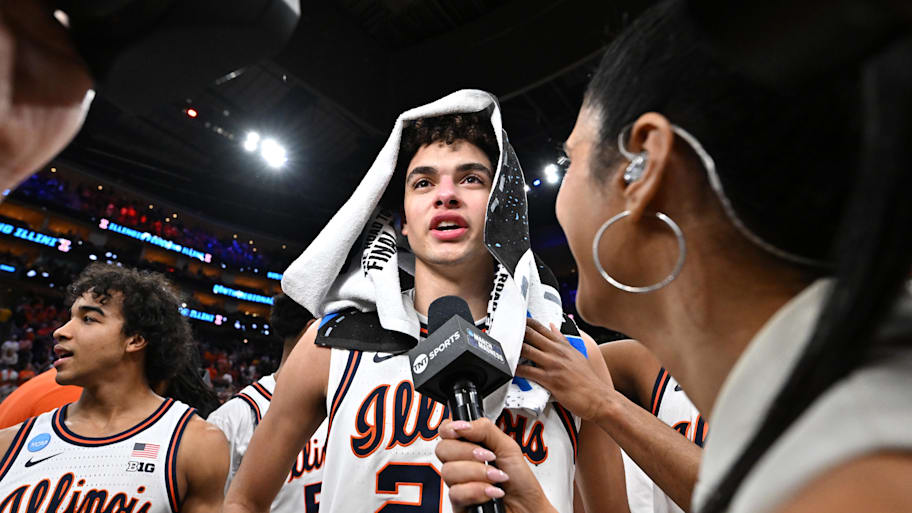
Actual NCAA seed ranking: No. 10 overall
Average NCAA tournament point differential: 19.5 points
Upcoming game: Saturday vs. No. 2 UConn at 6:09 p.m. ET on TBS/truTV/HBO Max
One could certainly argue that Illinois had the easiest path to Indianapolis, as they faced No. 11 seed VCU in the second round and ninth-seeded Iowa in the Elite Eight. That would be doing a disservice to those teams—especially Iowa—and completely ignores just how well the Fighting Illini are playing right now.
All season long, Illinois leaned on its high-octane offense led by potential NBA draft lottery pick Keaton Wagler, and was merely a passable team defensively. While the Fighting Illini exploded for 105 points in their first round win over Penn, it's been the program’s defense that has surprisingly been the calling card in the majority of their March Madness victories. Illinois has held opponents to an average of 59.8 points per game, the lowest of each of the Final Four teams, and has forced each of their last three opponents to shoot below 40% from the field.
The formula for Brad Underwood’s Fighting Illini has been simple: Force opponents to grind out offensive possessions and use their elite length—as many as seven players are 6' 6" or taller—to contest every shot. Then, crash the glass using one of the nation’s tallest lineups.
On the offensive end of the floor, arguably no team can match the Illini’s ability to space the floor with three-point shooters at every turn, from 6' 2" guard Kylan Boswell all the way up to 7' 1" center Tomislav Ivisic. And while Illinois’s offense has been streaky in the tournament, their ability to crash the offensive glass better than any Final Four team has helped them put additional pressure on opposing defenses by creating extra possessions.
This team is just a load to play against right now. If Underwood and his staff can get this offense humming in Indianapolis like it was earlier in the year, then the Illini could be poised to win its first-ever national championship.
No. 4 UConn (East No. 2 seed)
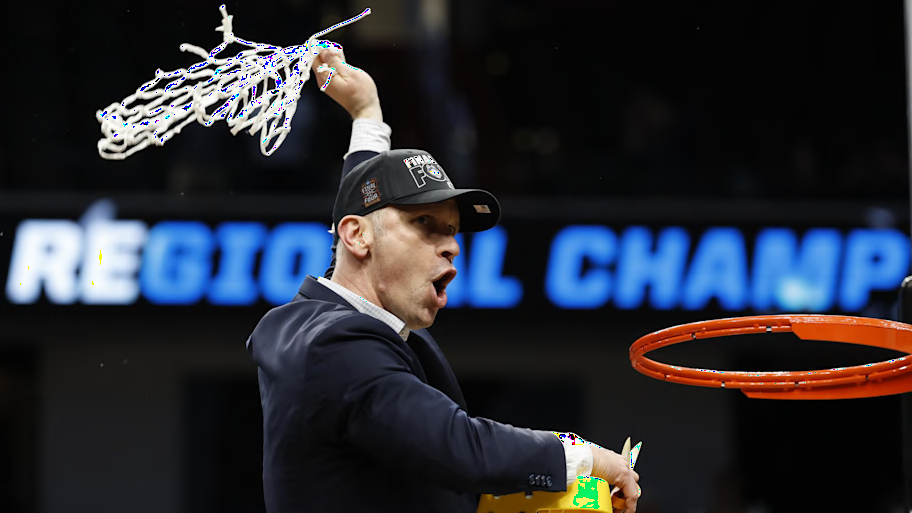
Actual NCAA seed ranking: No. 6 overall
Average NCAA tournament point differential: 8.0
Upcoming game: Saturday vs. No. 3 Illinois at 6:09 p.m. ET on TBS/truTV/HBO Max
While it’s true that UConn has been less dominant than its Final Four peers, it’s also true that no Final Four team has faced a tougher path to Indianapolis than the Huskies. UConn was the only Final Four team to defeat two teams (Michigan State and Duke) ranked inside the top 10 of KenPom's adjusted efficiency in the NCAA tournament.
There’s a lot to like about the Huskies entering the Final Four. No big man is playing better right now than Huskies center Tarris Reed Jr., who is averaging 21.8 points, 13.5 rebounds, 3.0 assists, 2.3 blocks and 1.0 steal per game in four tourney wins. Forward Alex Karaban can light it up from three-point range and carries with him the experience of already winning two national championships with UConn. The Huskies have a defensive stopper on the perimeter in Silas Demary Jr., as well as three-level scorers in Solo Ball (though he has really struggled in the tournament) and Braylon Mullins, who hit an all-time March Madness shot just before the buzzer to beat Duke.
More: The 25 Best Men’s College Basketball Coaches of the Past 25 Years
One big reason to like the Huskies over every team remaining in the field? They have the advantage at coach, as Dan Hurley is one of just 16 coaches to win multiple national championships and is 17–1 in his last 18 NCAA tournament games. Simply put, Hurley has thrived in the bright lights of the Final Four before and his experience and toughness have clearly left an imprint on his team. Look no further than the Huskies’ improbable comeback victory against Duke after being down by 15 points at halftime if you want to see the measure of this team.
They may look like the weakest of the three teams entering the Final Four, but count out UConn at your own risk.
More March Madness From Sports Illustrated
Listen to SI’s college sports podcast, Others Receiving Votes, below or on Apple and Spotify. Watch the show on the SI College YouTube channel.
- The 25 Best Men’s NCAA Tournament Buzzer Beaters of the Past 25 Years
- Dan Hurley Explains Away Headbutt, But Referee Roger Ayers Won’t Call Final Four
- The 25 Best Men’s College Basketball Coaches of the Past 25 Years
- SI:AM | The Women’s Final Four Is Running It Back
This article was originally published on www.si.com as Men’s Final Four Power Rankings: Where Arizona, Michigan, UConn, Illinois Land.