A dandelion sun traverses a low arc across the pale blue sky. Its radiating heat warms my skin, but lacks purchase on the still cold air and glances off the ground. The autumn has been warm and long, but our planet’s tilt now denies our star the angle and time to hold off winter. Thick white frost survives all day where it is shielded from the slanting fingers of sunlight. The quietness is intermittently punctured by the juddering scream of a large combustion engine careering around Rockingham Speedway, six miles distant.
The grey stone spire, a tall, sharply pointed witch’s hat, is the standout landmark in the gently undulating landscape of sprouting beans, oilseed rape and sheep fields. The parish church, dedicated to the Virgin Mary, sits on the uphill side of the village, next to the remains of a 13th-century stone ringwork fortress.
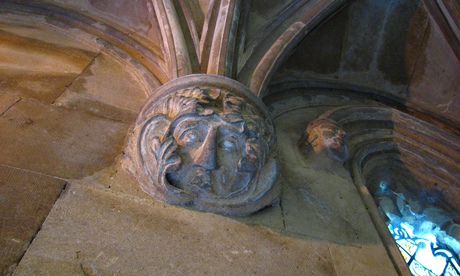
Although some elements of the church were there in the 14th century, it was almost completely rebuilt in 1847 in a fine and elaborate gothic style. It is bedecked with expressive heads and winged gargoyles, and several green men are secreted around the interior of church. Five I am familiar with: one on an arch stop, another on a misericord under a chair, a small one in the rood screen and two acting as window stops. Today the quirky, narrow porch at the front of the church (used as a cleaning cupboard) is open and I find two more stone carved green men tucked into the gloomy eaves; one has a worried expression and is hiding behind his foliage and the second appears mournful.
Green men are an enigma; most of these fellas are probably Victorian, so what did their creators think they were making – traditional decorations, a nod to pagan beliefs, an echo of Robin Hood or symbols to ward off witches and spirits? Where did the tradition come from and what did they represent? Perhaps we will never know, but they are wonderfully beguiling.