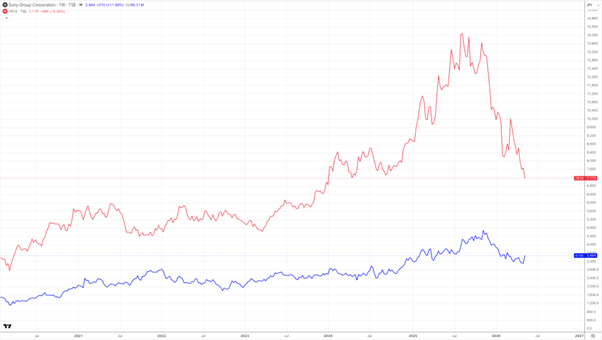
The contrasting performance of Nintendo and Sony after the publication of their financial forecasts has become one of the clearest signals of structural changes in the game console market. The 7% drop in Nintendo's capitalization, alongside a 10% increase in Sony shares, reflects not so much differences in the companies' current financial results as a shift in investors' perception of the sustainability of their business models amid memory shortages, rising component costs, and yen weakness visible on the USD JPY chart. In effect, the market is starting to evaluate console manufacturers not through device sales alone, but through their ability to adapt to a new cycle of limited supply and hardware infrastructure inflation.
Nintendo seems to be the most vulnerable in this situation. The company's decision to raise prices for the Switch 2 less than a year and a half after the console's launch was a de facto recognition that the previous model of aggressively expanding the user base through relatively affordable hardware is becoming harder to sustain in the face of rising costs. At the same time, the forecast for a decline in sales to 16.5 million devices in the current fiscal year turned out to be particularly alarming for investors, since the second year of a console's lifecycle is traditionally associated with accelerating demand rather than weakening momentum.
Additional pressure comes from Nintendo's near-total dependence on the gaming segment. Unlike Sony, which can offset weakness in certain areas with profits from semiconductors, film, and services, Nintendo remains significantly more sensitive to any fluctuations in demand for consoles and gaming software. The lack of expected major game releases for the Switch 2 only adds to this imbalance. Rising prices combined with a decrease in the content attractiveness create the risk of a slow-down in user base growth precisely when the console was supposed to enter its phase of maximum monetization.
The company's financial indicators confirm this trend. Nintendo already estimates the negative effect of rising component prices and tariffs at about $638 million, and the projected 27% decline in net profit demonstrates how quickly hardware inflation is beginning to erode business margins. At the same time, price increases are becoming a necessary measure to protect profitability rather than a tool for expanding revenue. That is why investors perceived the rise in Switch 2 prices more as a sign of structural supply chain problems than as evidence of the company's confidence in demand.
Against this backdrop, Sony's position looks much more stable, despite similar pressure from the memory market. The company explicitly admits that it will plan PlayStation 5 production volumes based on the availability of memory at reasonable prices, highlighting the scale of the shortage. However, unlike Nintendo, Sony is already at a later stage of the console lifecycle, which means it has more flexibility to redistribute costs and maintain profitability. Moreover, the 12% increase in operating profit at the gaming division, along with expectations for further profit growth even amid lower revenue, demonstrates the company's shift in focus from expanding hardware sales to improving the efficiency of the PlayStation ecosystem.
Sony's revenue structure plays a key role here. A significant share of profit is increasingly generated not by consoles themselves, but through the PlayStation Network service model and related digital sales. This makes it relatively easier for the company to transfer the increase in memory costs to end users while preserving margins. Even a two-fold increase in PlayStation 5 prices in less than a year has not triggered the same negative investor reaction as Nintendo’s move, because the market views Sony as a more diversified infrastructure platform rather than solely as a gaming hardware manufacturer.
Sony's presence in related technology segments is becoming an additional source of resilience. The joint venture with TSMC to produce image sensors and the growing profits in the semiconductor business allow the company to partially participate in the same infrastructure cycle that is simultaneously creating memory shortages for game consoles. Thus, Sony finds itself in a stronger position within the current component market imbalance. The company is suffering from rising memory prices, but it is also benefiting from broader technology demand.
Collectively, these developments reflect a deeper transformation of the gaming industry. The console market is becoming increasingly dependent not only on content quality or user demand, but also on the state of global semiconductor infrastructure. Rising memory prices, limited production capacity, and pressure from the AI industry are gradually changing the very economics of gaming devices, turning consoles from relatively mass-market consumer products into increasingly capital-intensive technology commodities.
That's why the current gap in dynamics between Nintendo and Sony goes far beyond the differences between the two companies. It demonstrates how, in conditions of component scarcity, diversified ecosystems with developed service models and access to infrastructure assets gain an advantage. The longer the memory market remains under pressure from AI and data centers, the more pronounced the disparity will become between companies that can absorb rising costs and those whose business model remains critically dependent on massive hardware sales — a divergence that could help the former emerge as stronger market movers.