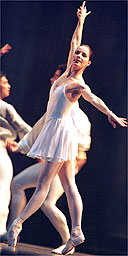
Antony Tudor was 66 when he choreographed The Leaves Are Fading, and the ballet seems a long way from the intemperate passions and dark visionary quirks of his radical youth. It is about an older woman gently reliving her past, and it is couched in the most decorous classical idiom. Yet as the woman's memories melt and merge, and girls and boys mature into lovers, the ballet's steps (choreographed to an arrangement of music by Dvorak) evoke a far greater range than their pretty surface suggests. The exacting detail of Tudor's imagination articulates a subtext of shivery expectancy, of fear and hunger, of powerfully coloured ecstasy that make this far more than a nostalgic watercolour. The Royal's dancers performing it for the first time on Saturday serve the ballet's complexity well.
It is especially hard to imagine Johan Kobborg and Alina Cojocaru being bettered in the climactic pas de deux - with Kobborg transfigured and a little dangerous within the courtly confines of his desire, and Cojocaru a bright scrap of passion. The lovely paradox of her dancing - speed and lightness combined with implacable force - works amazingly to the ballet's advantage, pushing the choreography to a point where it seems the emotion cannot survive beyond the moment, and we sense the betrayal or burnout that must follow.
This ballet - a long overdue addition to the Royal's Tudor repertoire - sets the tone for the whole programme, the theme of which is memory. The evening closes with Ashton's Marguerite and Armand (Sylvie Guillem once again reliving Marguerite's grand amour) and it opens with a 1995 ballet by Australian choreographer Stephen Baynes.
Beyond Bach is set to an arrangement of that composer's greatest hits, and aims to show how the past inhabits the present within the canon of classical dance and music. In order to flag up this conceit, the stage is designed as a retro-baroque interior (somewhere between a cathedral and Versailles) and characters in period dress wander between the 26 neoclassical dancers.
But the trouble with Bach is that his music is already saturated with its own brilliant ideas. The cleverer Baynes tries to be, the more crowded and clunky his work becomes. As a project it is misconceived, which is a shame since the choreography does contain nuggets of real promise. The central sextet concentrates on partnering that is both musical and sensuous and the closing group dances have a textural brightness that serves rather than obscures the music. The choreography for Jonathan Cope and Darcey Bussell could also have been written for them, with the latter especially looking as if her dance motor was purring on the richest fuel.
· In rep until February 9. Box office: 020-7304 4000.