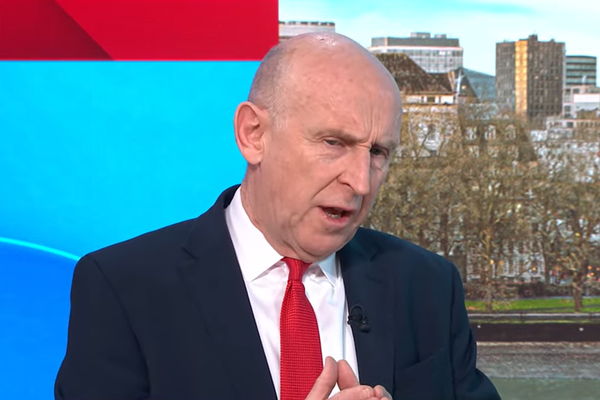
Culture secretary John Whittingdale has declared himself in favour of curtailing the BBC’s online news service in order to avoid it intruding on turf traditionally trodden by local and regional newspapers.
In an interview on Monday, he said there was “a strong case for the BBC to look at their online provision... If they are going to provide news content that looks like newspapers - that’s where I think newspapers are entitled to express concern.”
Forget the irony of him choosing a BBC platform, Radio 4’s Media Show, to make this statement and think instead about its implications.
The minister, who has ordered a “fundamental” review of the size and scope of the BBC ahead of next year’s charter renewal, is implying that the corporation should turn its back on the digital revolution.
This is not to say that newspaper publishers do not have a point about the need to find an accommodation with the BBC. See it instead as a disturbing lack of understanding by Whittingdale about the media landscape of the future.
We are facing an apparently contradictory situation of both fragmentation and convergence. The former is obvious: there is a proliferation of TV channels and a host of online start-ups plus the increasing use of social media platforms.
Then there is the convergence. Through a single screen of choice, whether it be located in the corner of a room, on a desk, on a lap, on a handheld device, websites offer a range of material - video, photographs and text.
The BBC is not responsible for this revolutionary disruption. It responded to it and did so, incidentally, way before newspaper publishers cottoned on to the fact that newsprint would be supplanted by the screen.
Its news division was quick to recognise that it could supplement its TV and radio output with text reports from its correspondents and, in so doing, created a huge online department. It has since ventured, more controversially, into long-form journalism, with features and interviews.
In justification the BBC points to the fact that it is fulfilling its public service remit, as laid down by the royal charter. It has made intelligent and prudent use of its journalistic staff by providing written as well and visual and audio content.
There cannot be any doubt that the resulting giant website has offered unexpectedly strong competition to newspapers but its critics tend to overlook the main reason for it building a big audience: people, meaning licence fee payers, choose the BBC because they see it as a trustworthy news provider.
This fact appears to escape both Whittingdale and newspaper publishers as they seek to curb the BBC’s output. But in fairness to the minister it is also possible to view his statement as a political ploy to bring about a sensible compromise.
No-one could possibly want a situation in which Britain is served by a single news supplier, so the maintenance of a commercial sector is desirable. Several publishers have developed better digital offerings in the past couple of years. One of the reasons for Trinity Mirror’s recent acquisition of Local World is its determination to invest further in online products.
Consolidation in the regional newspaper industry, allowing for greater economies of scale and an improved revenue pot, will enable more resources to be devoted to the kind of digital innovation that is necessary to attract audiences (and, of course, advertisers).
Although newspaper websites have improved the quality and range of their output, not least by adding more and more video material, they would benefit from linking arms with the BBC at local and regional level.
Working together on news output would be far more productive than their current engagement in a kind of low-level - and increasingly high-profile - warfare.
They have each commissioned “independent” research that “proves” their opposing positions are correct. The BBC’s study in February 2105, Future of News, argued that local newspaper publishing was “one of the biggest market failures in news in the last decade”,
Through its trade body, the National Media Association (NMA), publishers hit back with a report produced by the business management consultancy, Oliver & Ohibaum, UK news provision at a crossroads. It contended that there was no market failure and that plurality in news provision was sustainable and desirable.
Nine days ago, research commissioned by the BBC Trust on the BBC’s market impact stated that there was “no clear evidence” of the BBC’s online offering “crowding out” local newspapers.
And so it goes... for every ding a dong, every plus a minus, every positive a negative. This tit-for-tat argument, in which every “independent” report comes up with the answer favoured by its commissioner is not getting us anywhere.
For a genuinely neutral observer, it makes it increasingly difficult to see both sides of the argument. I want to see the BBC’s news machine preserved, which also means its online offering.
And I want to see local newspapers able to do what they do best by producing content for communities across Britain that enables citizens to be fully informed about life in their areas, whether it be politics, crime, football, entertainment events, or matters of human interest.
Some home truths have to be swallowed by each side in this dispute. Publishers need to acknowledge that in countries where there is no equivalent to the BBC newspapers are suffering, often a great deal worse than in the UK. So the BBC should not be cast as the villain of the piece. There are many other reasons for print decline.
But the BBC needs to accept that it must avoid monopolising the news field and, in so doing, has to realise that perception in this matter is as important as reality. It should rethink the wisdom of running long-form journalism and must refine its domestic news reach to allow publishers to drink from its well.
As for the government, Whittingdale needs to understand that he cannot turn back the technological clock. The BBC cannot simply abandon its online commitment.
It is no longer an analogue world with words here and pictures there, or text here and video there. Successful websites must be multi-media outlets because that’s what the public now expect.
If Whittingdale wants to do something positive (and I’m not one of those who believe otherwise) then he should be pro-active and host a series of summits in order to hammer out a sensible compromise between publishers and the BBC. That really would be a public service.