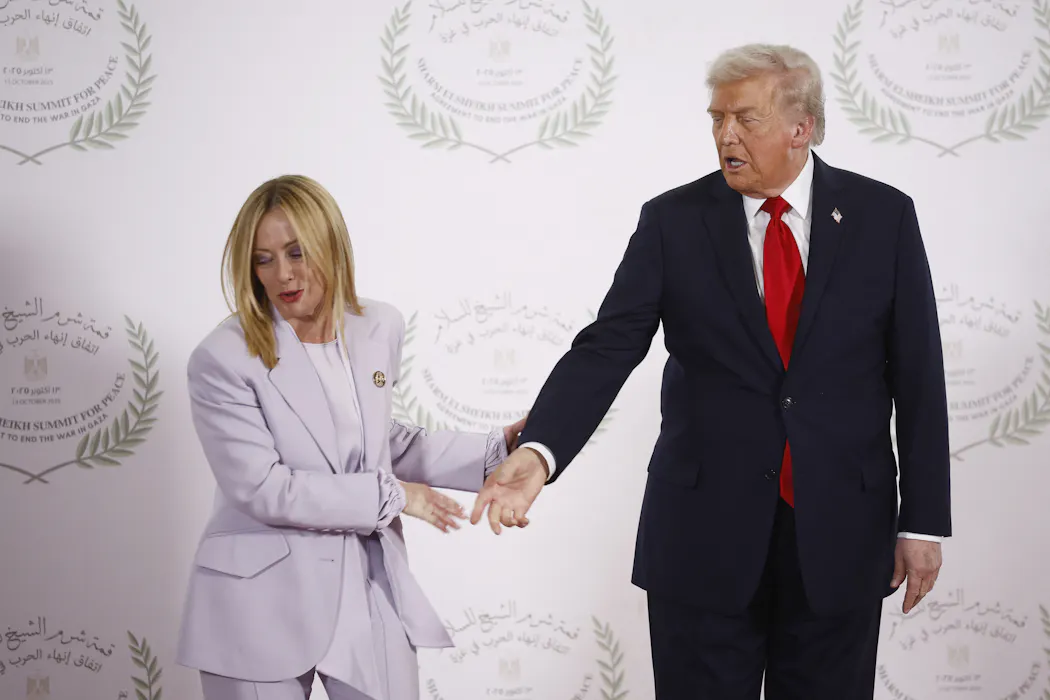
As recently as October 2025, U.S. President Donald Trump was heaping praise on Giorgia Meloni, telling the Italian prime minister how “beautiful” she was.
But what once looked like a political romance based on equal parts ideological alignment and strategic convenience is now reading like a classic breakup story.
In an interview on April 14, 2026, Trump lashed out at his former European ally. “I thought she was brave, but I was wrong,” he told Italian daily Corriere della Sera.
The unraveling of the once-cozy relationship is not just personal or rhetorical. As a scholar of European politics, history and culture, I believe it signals something far more consequential: the collapse of a fragile middle ground between Europe and a United States increasingly demanding loyalty rather than partnership.
Irreconcilable differences
When Trump returned to the White House in January 2025, Meloni was widely seen as his most natural ally in Western Europe and, for a time, the only one willing to embrace that role so openly. She was, for example, the sole European Union leader to attend his inauguration.
Both leaders rose to power on right-wing populist platforms, campaigning on anti-immigration policies, skepticism toward liberal institutions and traditional values – particularly over gender. Their alignment appeared not only strategic, but deeply rooted in a shared political language.
The ensuing fracture did not happen overnight. Rather, it unfolded through a series of disagreements that exposed deeper incompatibilities despite ideological overlaps.
First came policy fissures: Greenland, which Trump floated buying the Danish-administered territory and threatened allies who resisted; tariffs, deployed as blunt political leverage against Europe; and NATO spending, with pressure on European members to pump more money into defense that verged on ultimatums.
On all three, Meloni did not begin in outright opposition, but her position shifted as Trump’s demands grew more coercive. Increasingly, Meloni aligned herself more visibly with EU partners.
The war in Ukraine exposed more cracks in the transatlantic relationship. Meloni’s position here is particularly revealing. While she initially campaigned with a degree of skepticism toward deeper involvement in Ukraine, once in office she aligned firmly with NATO and EU support for Kyiv. Trump, by contrast, has signaled a willingness to scale back or even withdraw U.S. support.
But the real tipping point appears to be Iran. Trump’s apparent expectation that his allies would fall in line, including militarily, found few friends in Europe.
Trump rebuked Meloni for refusing to provide Italian air bases for U.S. use and for declining to send forces to help secure the Strait of Hormuz.
From bridge to break
The Meloni-Trump split is more than a policy disagreement, however. It is a clash of political realities.
Meloni had spent the early months of Trump’s second term positioning herself as a bridge between Washington and Brussels. The premise was simple: As a right-wing leader fluent in both European institutionalism and transatlantic conservatism, Meloni could mediate between two diverging worlds.
For a time, that appeared to work. Meloni presented herself as an interlocutor able to engage Trump without fully alienating Brussels, who could reassure Europe without openly confronting Washington.
But that balance has proved increasingly fragile.
Trump’s unpredictability, coupled with his declining popularity across Europe, has made him less of an asset and more of a liability to ideologically aligned politicians on the continent.
His failure to inform allies in advance about key military decisions – laid bare when Italian Defense Minister Guido Crosetto was in Dubai during the initial Iran strikes and had to be extracted on a military flight – offered a vivid illustration of how little coordination now underpins transatlantic relations.
For European governments, the message was unmistakable: Even close U.S. partners can be left exposed, reacting after the fact rather than shaping events.
Recent polling has found that a vast majority of Italians oppose Trump’s war in Iran and likewise have a negative view of the president himself. Nearly 80% of respondents view his handling of the Iran conflict negatively, and just 12% of Italians have a favorable view of Trump.
Trump’s promotion of an AI-generated image portraying him as Jesus and his attacks on the Pope have likely only hurt his popularity more in a country where roughly two-thirds of the population identifies as Catholic.
Making new friends
For Meloni, the timing of the “breakup” with Trump is domestically convenient. The Italian prime minister faces mounting pressures in the shape of a lost referendum on constitutional reforms and upcoming electoral challenges.
Aligning too closely with an increasingly unpopular Trump risks becoming politically costly. Meanwhile, his attack on the Pope has presented Meloni with an opportunity to reposition herself as a defender of cultural and religious legitimacy.
In this sense, Meloni’s distancing from Trump is strategic.
It also comes amid Meloni’s growing alignment with European leaders – especially Germany’s Friedrich Merz, but also, to a lesser extent, Emmanuel Macron and Keir Starmer of France and the United Kingdom, respectively.
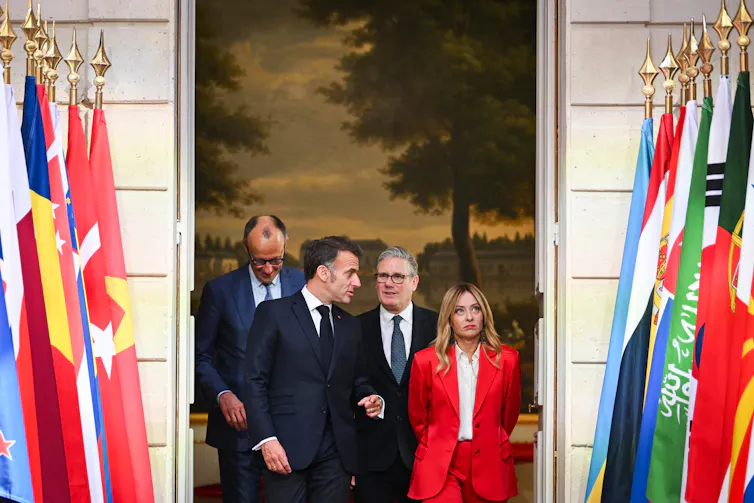
Faced with mounting external pressures, European leaders are increasingly adopting a “bigger tent” approach, prioritizing cohesion over division in the bloc. In this configuration, Meloni, Macron, Merz and Starmer increasingly resemble a kind of geopolitical quartet – a modern-day D'Artagnan and her “three musketeers,” if you will – bound by shared necessity.
If Meloni was once a transatlantic bridge, she is now helping build something else entirely alongside her fellow EU leaders.
What does Meloni gain, and lose?
The benefits of this distancing are clear. Domestically, it allows Meloni to shed a potentially toxic association and reposition herself within a more stable European framework. Internationally, it strengthens her credibility among EU leaders seeking cohesion in the face of external unpredictability.
But the distancing from Trump is not without risks. If Meloni’s original political value was found in her ability to serve as a link between Washington and Brussels, that role is now compromised.
Meanwhile, the deeper story here is not about two leaders falling out. It is about the disappearance of the space that once allowed the relationships to function. The EU and Washington are heading in different political directions – a fact that puts stress on any figure who believes they can serve as a bridge.
Right-wing European leaders who once served as Trump’s “whisperers” within the EU – notably Hungary’s Viktor Orban – have lost influence within the bloc.
What is emerging instead is a more cautious, internally driven Europe, where the old role of individual leader as transatlantic broker is increasingly difficult to sustain.
Meloni’s “breakup” with Trump is, in this sense, less a rupture than a realignment. It reflects a Europe that is beginning – albeit hesitantly and unevenly – to imagine itself as a political actor in its own right.

Julia Khrebtan-Hörhager does not work for, consult, own shares in or receive funding from any company or organization that would benefit from this article, and has disclosed no relevant affiliations beyond their academic appointment.
This article was originally published on The Conversation. Read the original article.