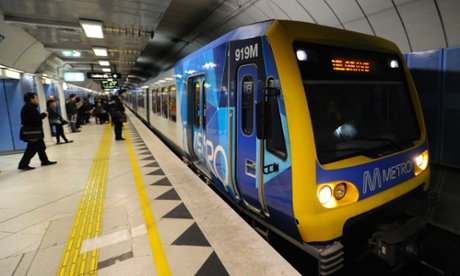
The Victorian premier, Daniel Andrews, has revived Melbourne’s stagnant Metro rail tunnel project, having scrapped the former government’s plans for the East West Link cross-city road tunnel.
On Monday, Andrews announced that $40m in funding from Labor’s $300m election commitment towards the Melbourne Metro had been fast-tracked ahead of the May budget. It would be used to establish a Melbourne Metro authority to oversee immediate planning work, he said.
But with an estimated cost of between $9bn and 11bn, the project will require significant funding from private investors and the federal government.
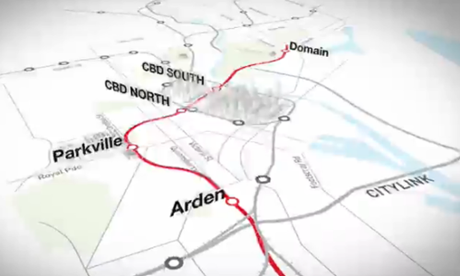
The revised plan includes five new underground stations at Arden, Parkville, CBD North, CBD South and Domain, effectively providing a second city loop. The project also links passengers to the University of Melbourne and hospital precincts, and to the business districts in Parkville and on St Kilda Road.
Tony Abbott has previously said $3bn in federal funding allocated to the East West Link could not be redirected to other projects.
But Andrews said he was confident the prime minister would allocate one third of the funding required for the revived Melbourne Metro.
“We’re going to keep talking to Canberra, and I hope the government can be convinced a transformative project is something they can be partners with us on,” he said.
“The PM needs to understand there was an election held here last year and we need to respect what the people want. Things are very fluid in Canberra, and this project has a life well beyond the next election.”
Andrews said construction was expected to begin in 2018 and be complete by 2026, allowing 20,000 extra passengers during the morning and afternoon peaks.
While the previous Victorian Coalition government announced before the 2010 election it would build the Melbourne Metro, it placed those plans on the back burner as the East West Link toll road took priority.
Plans for the project were significantly altered throughout the Coalition’s three-year term.
One of the key reasons the former premier, Denis Napthine, was reluctant to build the railway was that it would require one of the city’s main roads, Swanston Street, to be dug up, dividing the city while the underground section was under construction.
But Andrews said “no matter what route we choose, there will be disruption”.
“This is a very big project,” he said.
Communities would be consulted and the business case for the project would be made public, he said.
Opposition spokesman Matthew Guy said it was unclear how the government intended to fund the project given the federal government was yet to come to the table.
“He’s announced 0.4% of the funding, enough for 38 metres of track,” Guy said. “It is quite astounding when the premier of any state comes out and tells his population he’s going to build a new railway, but he just hasn’t worked out how on earth it’s going to be paid for.
Despite the government’s claims it would provide five new stations, the opposition said CBD North was merely an extension of Melbourne Central station, while CBD South extended Flinders Street station.
“Victorians have every right to be very, very sceptical of the premier’s announcement when he comes out and announces $40m for planning works but still can’t answer basic questions about how it’s going to be paid for,” Guy said.
The chief executive of the Victorian Employers’ Chamber of Commerce and Industry, Mark Stone, said the project would create 3,500 jobs, but it would be important to ensure minimal disruption to surrounding businesses during construction.
“More trains running from more stations will significantly improve Melbourne’s public transport system and support Victoria’s economic growth,” he said.