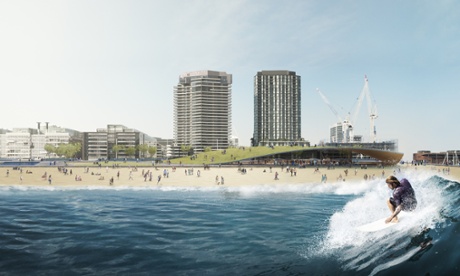
The best city stories from around the web this week share news of a proposed floating pool in Melbourne for surfing, a project in the Brazilian city of Pelotas encouraging bus passengers to talk to one another and an app that hopes to improve cycling in Glasgow.
We’d love to hear your responses to these stories and any others you’ve read recently, both at Guardian Cities and elsewhere: share your thoughts in the comments below.
Surf’s up
Architects in Melbourne have designed a floating pool that would allow people to go surfing – right in the middle of the city. The new floating “public park” would be built in the city’s post-industrial Docklands neighbourhood. While the idea echoes the floating +POOL in New York as well as the proposals for the Thames Baths, this pool would actually generate waves big enough to surf on.
“This really allows people to reimagine water in cities,” the project’s architect, Damian Rogers, said. And to have a bit of fun too, we presume.
Next stop: friendship
Ever wanted to strike up a conversation with that person sitting next to you on the bus, but not really known how? Well, a project in Brazil may be to the rescue.
Buses used to be places of social interaction, but now we’re more likely to stare into our smartphones than chat to a stranger. As Pop-Up City reports, Feeding Friendships is a project to introduce stickers on buses in Pelotas that encourage passengers to meet the person in the next seat, in order to prompt friendships and social interaction between strangers.
The stickers are equipped with post-its that have themes of conversation written on them and can be used to start off the chitchat – just in case you’re stuck on what to say.
Private parks
Thomas Heatherwick’s proposed Garden Bridge in London has generated a lot of debate, and as Oliver Wainwright recently wrote, the architect has now designed another park-on-water in New York – named Pier 55 – for the billionaire Barry Diller.
Writing in the New York Times, David Callahan sharply challenges this culture of billionaire-funded urban parks, explaining how Pier 55, along with the High Line, is representative of “how private wealth is remaking the city’s public spaces”.
Callahan traces the culture of this “parks philanthropy” in the Big Apple, explaining that one result is that the city’s more affluent areas have better open spaces and playgrounds, while other parks not funded by billionaires have fallen into disrepair. Callahan’s argument is simply that all New Yorkers should have equal access to good public parks – which, happily, is an aspiration shared by the city’s new parks commissioner, Mitchell Silver.
DIY cities
Is a DIY, user-generated city possible? According to Justin McGuirk in Uncube magazine, it is a fact of life for the global south, where communities build their own homes in informal settlements. McGuirk tells us that across the planet, squatters build more housing than all the governments and developers put together. Could other cities look to this as inspiration?
Yet while people can build themselves homes, it’s another matter to create transport networks and other vital urban infrastructure. These require government involvement. “Cities of the north desire and would benefit from more citizen agency, while the cities of the south desperately need more government support,” he writes. “In other words, there is such a thing as too much of the so-called “bottom-up” impulse we tend to romanticise, and not enough of the “top-down” intervention we tend to vilify.”
Better cycling in Glasgow? There’s an app for that
If you’re a cyclist in Glasgow, here’s a bit of good news. As CityMetric reports, Glasgow city council have launched a new app that collects data on how the city’s streets are used by cyclists, in order to improve the urban cycling experience.
There is one objection, however. “Measuring how people use existing infrastructure can only tell you that their chosen route is better than the alternatives: there’s no way of indicating that the route is actually dangerous, long-winded and will otherwise make your daily commute hellish.” Perhaps the council could add some public consultations to explore the idea of new and improved routes to get around the city.
What do you think about Melbourne’s plans? Are privately-funded parks affecting your city? Share your thoughts in the comments below
.jpg?w=600)