Meiji University began integrating services at its two manga libraries this spring in an effort to preserve Japan's world-renowned manga culture.
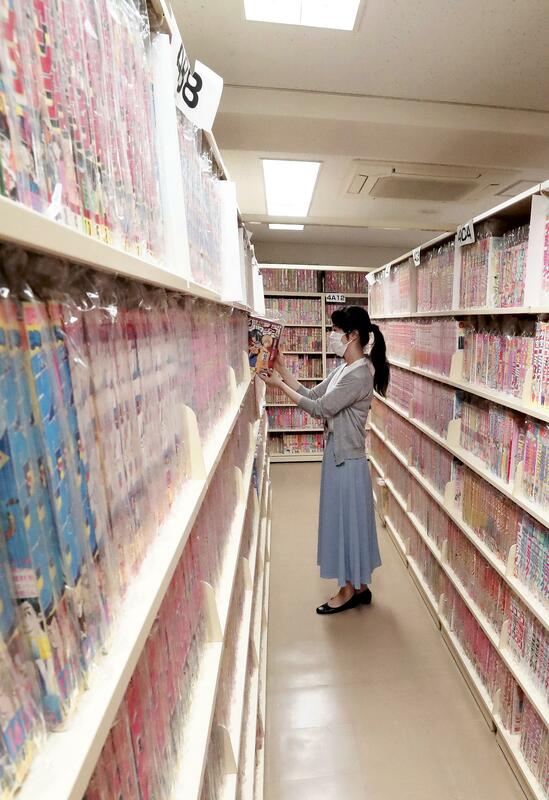
The facility, which has a total of about 410,000 items, boasts one of the largest collections of books in Japan.
In addition to making the facility a center for cultural research, the university plans to develop a repository for such items as original artwork to promote the preservation of manga-related materials.
The Yoshihiro Yonezawa Memorial Library of Manga and Subcultures, which opened in 2009 at the Surugadai Campus of Meiji University in Chiyoda Ward, Tokyo, houses about 140,000 items donated by the family of manga critic Yoshihiro Yonezawa, who died in 2006.
The library contains a large collection of manga magazines such as Weekly Shonen Magazine and Ribon, which have been published since the mid-1950s, as well as dojinshi self-published comics.
The university's Contemporary Manga Library in Shinjuku Ward was relocated in March to the seven-story building that houses the Yonezawa memorial library.
The Contemporary Manga Library has a collection of about 270,000 items from the collection of Toshio Naiki, the proprietor of a book and comic rental shop in Tokyo who died in 2012.
About 10,000 items from Naiki's collection were rented manga magazines, published from the mid-1950s to mid-1970s, including some early works by mangaka Tetsuya Chiba, 82, the creator of the boxing manga "Ashita no Joe" (Tomorrow's Joe).
This spring, Meiji University integrated the reading rooms and counter services of the two libraries and began to operate them as one facility with a combined collection surpassing that of the Kyoto International Manga Museum in Kyoto, which has about 300,000 items.
The Tokyo facility is considered to have a collection comparable in scale to the National Diet Library. However, the National Diet Library's collection does not include such items as dojinshi.
"The integration has increased convenience and the value of the facility as a research base," said Akiko Orito, manager at the university's Library Management Office.
The collections will keep their original names and the items will not be combined, as it is also important to know "who collected the materials and how," according to Orito.
Members of the public need to register to use the library. The fee for a day member is 330 yen for visitors 18 or over, and 110 yen for those under 18. Admission for pre-schoolers is free.
"I am thankful that the collections are here because I can look at books and magazines that I wouldn't be able to find at any used book stores," said a company employee in Tokyo who was visiting the facility for work-related research.
-- Pride of the world
Japanese manga, anime and games are popular around the world. At the opening ceremony of the Tokyo Olympics, manga speech balloons were used on the placards of each country and music from the Dragon Quest game series was played.
In 2009, Meiji University announced plans to build one of the world's largest research facilities to protect and further develop Japanese pop culture, and the combined collection of the two libraries are considered to be a pilot for the initiative.
The lack of sufficient management of manga publications and original drawings is also thought to be behind the scheme.
In 2018, original sketches of Osamu Tezuka's "Astro Boy" were auctioned in Paris and sold to a European collector for about 270,000, euros about 35 million yen. It is said that the more valuable the work, the more likely it is to be sold abroad.
"There are few facilities to which manga creators or their families can donate artwork if they can no longer look after them, and in some cases, they have been forced to dispose of them or sell them overseas," said Kaichiro Morikawa, an associate professor at Meiji University and a scholar on contemporary Japanese culture. "Once they are lost, it is difficult to utilize them for research or as cultural resources."
Read more from The Japan News at https://japannews.yomiuri.co.jp/