A Suffolk falconry expert has earned $2.3 million from military contracts with the US Pentagon to help protect the lives of their highly trained pilots and fighter jets.
Keith Mutton’s birds of prey are favourites among families at country shows, but they have also provided him with a lucrative source of income courtesy of grateful generals in the US military.
According to an analysis of US Department of Defense spending with British companies over the past seven years, his Phoenix Bird Control Services firm has been paid $2.3 million.
Phoenix's task is to avert multi-million dollar bird damage to US fighter aircraft taking off and landing at RAF bases in Suffolk and Gloucestershire.
The military refers to this as BASH - Bird Aircraft Strike Hazard.
A single starling flying into a jet engine can set fire to it and potentially wreck the plane. To earn his income, Mr Mutton would drive his van across airbases in Lakenheath and Mildenhall and ensure his birds swoop along the runways and scare off other birds.
Phoenix lost the Suffolk contracts at the end of 2015 after the Defense Department changed its contracting award standards from “best value” to “lowest technically acceptable cost”. The company continues to work for the USAF at RAF Fairford in Gloucestershire.
The findings form part of a far larger analysis of Pentagon spending by the Bureau of Investigative Journalism, which trawled through 11 million transaction records for 2009-15 and which had a total value of $2.3 trillion.
Mr Mutton’s company was among the most unusual UK beneficiaries.
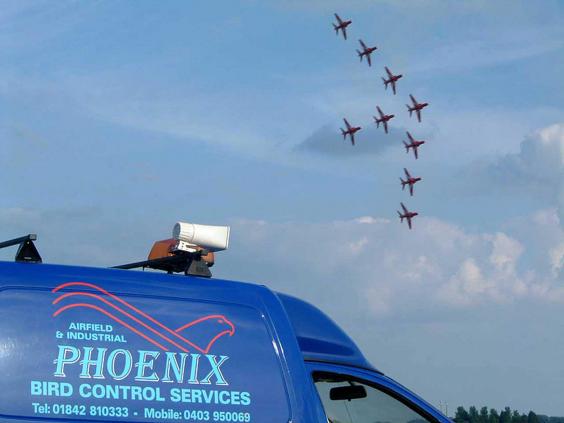
He and his employees rear and train predators, including hawks, falcons and owls. A well-trained predator can scatter up to 5,000 other birds, according to an article published by military news service Stars and Stripes.
The firm also worked at the US airbase at Manas, Kyrgyzstan, a major transit point for military flights to Afghanistan. The difference in temperature and altitude from Suffolk required a period of
acclimatisation for the birds, according to Alan Marenghi, who runs Phoenix Bird Control alongside Mr Mutton.
Their work is well-known and the company is often called upon for advice by other firms around Europe, but a figure on the company’s earnings from the US has never been previously published.
When not undertaking runway sweeps they have performed at Center Parcs and airshows around the country.
Mr Marenghi described working for the Pentagon as “always a positive experience”.
“As a British firm we never felt at a disadvantage competing for US military work in the UK,” he said, although American rules governing small businesses made it difficult for Phoenix to secure contracts in the US.