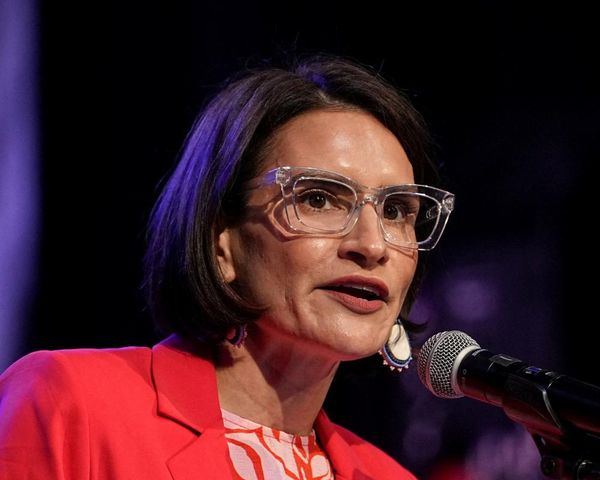
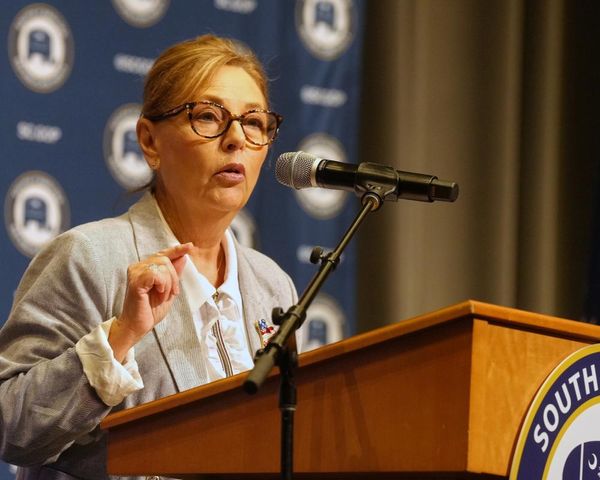
Texas has not elected a Democratic governor in more than three decades. But Gina Hinojosa, a Latina civil rights attorney, former school board president, and longtime state lawmaker, is mounting an unexpectedly competitive challenge to Republican Gov. Greg Abbott, with some of the latest polls showing the race within the margin of error.
Hinojosa, 52, is attempting something no Texas Democrat has accomplished since Ann Richards won the governorship in 1990. Republicans have controlled the governor's mansion since George W. Bush defeated Richards in 1994, and Abbott, who was first elected in 2014, is now seeking a historic fourth term.
Yet the latest numbers suggest Hinojosa cannot simply be dismissed in a state long considered safely Republican at the statewide level.
A Texas A&M Bush School and ReconMR poll released in August found Abbott leading Hinojosa by only one percentage point, 46% to 45%, among likely voters. The survey of 619 likely Texas voters carried a margin of error of plus or minus 4.7 percentage points, meaning the contest was statistically tied. In June, the same polling operation showed Abbott ahead by six points.
A Fox News poll conducted July 23-27 produced a similarly close result, putting Abbott only one point ahead of Hinojosa. The survey included more than 1,000 registered Texas voters and had a margin of error of approximately three percentage points.
Another recent survey, conducted by Texas Public Opinion Research from July 15-17, showed Abbott at 45% and Hinojosa at 42%. The three-point difference was within the poll's 3.4-point margin of error. The survey included 1,048 likely voters.
That poll contained another encouraging sign for Hinojosa: her campaign said she was leading among Latino voters, Black voters, independents and moderates.
"Texans are ready for change, and my plan is simple: save public schools, put money in your pocket, and end the Greg Abbott Corruption Tax," Hinojosa said after the results were released.
"While Abbott still focuses on lining the pockets of his billionaire buddies and data center donors, I'm traveling the state hearing from Republicans, Independents, and Democrats that are ready to rebuild the American Dream in Texas," she added.
Hinojosa was born in McAllen and raised in Brownsville, in the Rio Grande Valley. She attended the University of Texas at Austin before earning a law degree from George Washington University and working as a civil rights and labor attorney.
Her entry into electoral politics came through public education. After becoming involved in a fight over the proposed closure of her son's elementary school, she won a seat on the Austin Independent School District Board of Trustees and later became its president. She was elected to the Texas House in 2016 and has represented her Austin district since 2017.
In March, Hinojosa won the Democratic gubernatorial primary, setting up the November confrontation with Abbott. Reuters described her at the time as a longtime Texas legislator who had served for nearly a decade in the state House.
Her campaign has centered heavily on affordability and public education. In July, Hinojosa proposed using $17 billion from Texas' rainy day fund to send $1,500 payments to every household in the state, arguing that Texans should directly benefit from money accumulated by the government.
She has also attacked Abbott over school vouchers and the expansion of massive AI data centers, calling for a moratorium on new projects amid concerns about their demands on Texas' electricity grid and water supply.
But Hinojosa has attempted to frame her campaign around something larger than a traditional Democratic-versus-Republican contest.
"I am not running to be the Governor for Democrats," she told delegates at the Texas Democratic Convention in June. "I am running to be Governor for the people of Texas. For all the people of Texas."
Later in the speech, she distilled the election into a question that has become central to her populist campaign message: "Are we going to be a Texas by and for the people? Or is this great state the billionaires' world, and the rest of us just live here?"
Hinojosa nevertheless faces formidable obstacles. Abbott has the advantages of incumbency, statewide name recognition, and a massive fundraising operation. Recent reporting by the Houston Chronicle put Abbott's campaign resources at roughly $67 million compared with about $3 million for Hinojosa.
And history remains perhaps the biggest obstacle of all. Democrats have not only failed to win the governor's mansion since Richards. They have gone more than three decades without winning any statewide election in Texas.
Hinojosa argues that the political environment is changing.
"The American Dream is ours for the taking because Texas is a world economic powerhouse, and it is the people of Texas who built that power," she said at the Democratic convention. "But the thing about power: no one is going to give it to us. We have to take it back."
With Abbott at 46% and Hinojosa at 45% in one of the newest polls, Democrats now have at least some evidence that a race once expected to be another comfortable Republican victory could become competitive.
Hinojosa would need to overcome Texas' Republican lean, Abbott's enormous financial advantage and more than 30 years of Democratic defeats to pull it off. But if she does, the daughter of South Texas would not simply become the state's next governor. She would end one of the longest Republican winning streaks in Texas politics.