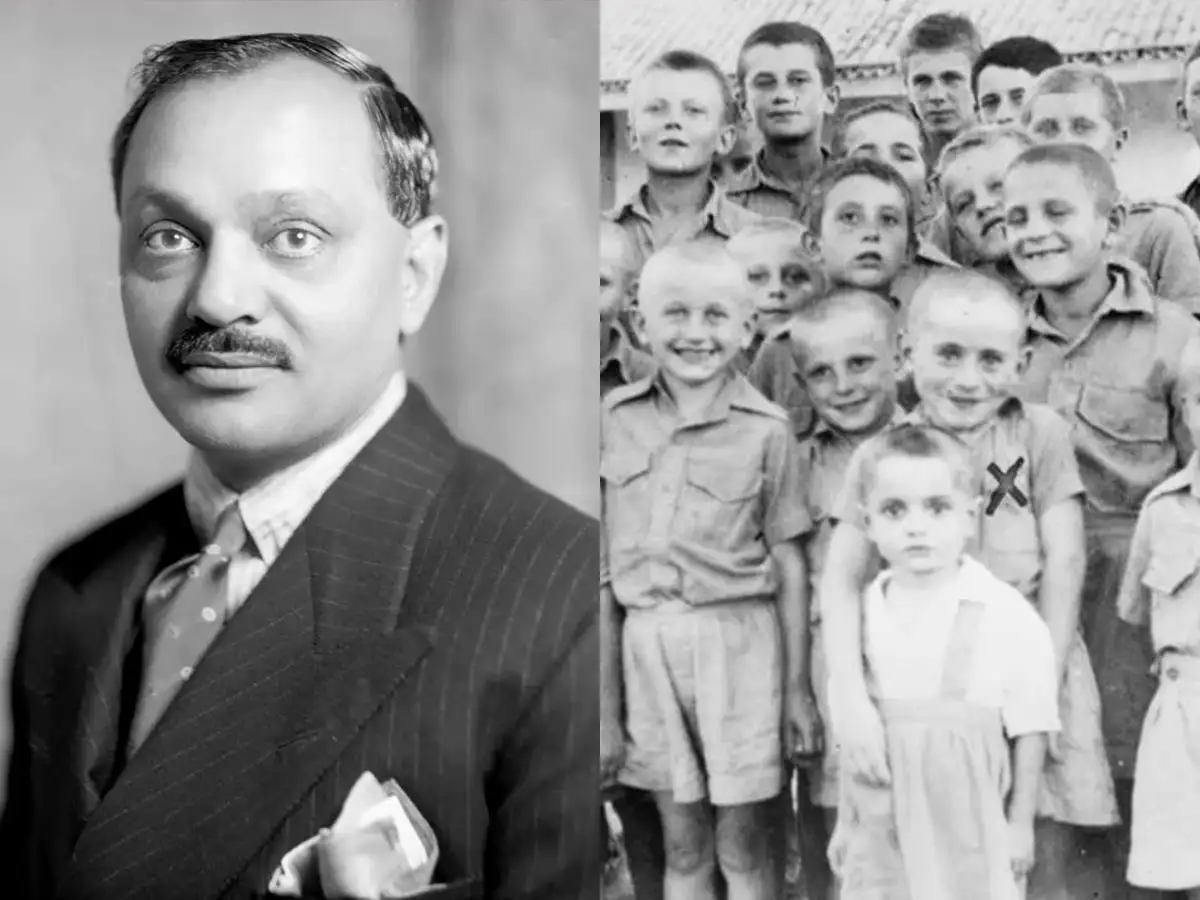
Meet Digvijaysinhji Ranjitsinhji Jadeja, the Maharaja of Nawanagar, who in 1942 sheltered nearly 1,000 Polish children fleeing the horrors of World War II, told them they were no longer orphans, and asked them to call him Bapu.
The story, largely unknown outside Poland and the Jewish diaspora, has resurfaced in recent years as a rare and remarkable chapter of Indian humanitarian history.
Who Was Maharaja Digvijaysinhji Ranjitsinhji Jadeja?
Digvijaysinhji Ranjitsinhji Jadeja ruled the princely state of Nawanagar, in present-day Jamnagar in Gujarat, from April 1933 to February 1948. He was the nephew and successor of Ranjitsinhji, the celebrated cricketer who played for England. But it is not cricket that defined his legacy.
He is remembered today by a different name entirely: Jam Sahib, the King of Jam, and by Polish survivors of World War II, simply as Bapu.
What Happened to Polish Children During World War II?
Germany invaded Poland on 1 September 1939, triggering one of the largest refugee crises of the 20th century. In the years that followed, an estimated 6 million Poles lost their lives, 3 million of them Jewish. Many Poles fled eastward into Soviet territory, where they were initially detained. When Nazi Germany invaded the Soviet Union in June 1941, these prisoners were released.
Among them were roughly 18,000 children, many of them orphans, whose parents had been killed, imprisoned, or lost to the chaos of war. Polish humanitarian organisations scrambled to move these children to safety, routing caravans eastward through Iran and onward toward India.
How Did the Maharaja Save Polish Children?
In 1942, as these children made their way through Soviet territories and the Middle East, Jam Sahib stepped in with an offer that required no negotiation and came with no conditions.
He established a dedicated settlement for the children at Balachadi, near Jamnagar, and provided them with food, shelter, medical care, and schooling conducted in the Polish language. Survivor accounts recorded that when the children arrived, the Maharaja told them directly: "You are no longer orphans. You are now Nawanagaris," formally absorbing them into his kingdom as his subjects.
He asked them to call him Bapu, the Gujarati word for father. By most accounts, they did.
The children remained at Balachadi until the end of the war in 1945. They were taught Polish language, culture, and history throughout their stay, so that wherever they went next, they would carry their identity with them. After the war ended, the children dispersed across the world, settling in Poland, the United Kingdom, Australia, and elsewhere.
Why Is the Jam Sahib Called the 'Good Maharaja'?
The title comes from Poland itself. Fifty years after his death, the Polish Parliament passed a resolution honouring Jam Sahib for his role in sheltering Polish children and refugees during the Second World War.
Warsaw named a square after him, the Good Maharaja's Square, with a memorial marking his contribution. A sculpture of Jam Sahib was also installed in Nevatim, Israel, by the Jewish American Society for Historic Preservation.
During India's Prime Minister Narendra Modi's visit to Israel in February 2026, the story was brought up as an example of the depth of India's historical relationship with the Jewish people, one that predates formal diplomatic ties and is rooted in moments like this.
Where Is Balachadi, the Camp That Sheltered Polish Children?
Balachadi is a coastal village near Jamnagar in Gujarat. During the war years, it housed the settlement Jam Sahib built for the Polish children, complete with living quarters, a school, a medical facility, and open grounds. Today it carries little visible trace of that history, though efforts by Polish and Indian historians have worked to document and preserve the memory of what happened there.
(With TOI inputs)