Who knew the New York Yankees cared so much about $6m?
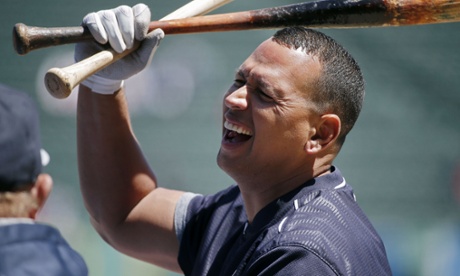
They don’t, of course – not really. It’s not the money but the principle of the matter that has led baseball’s richest and most storied franchise to publicly decline to pay slugger Alex Rodriguez the $6m bonus written into his contract for matching Willie Mays’ 660 career home runs. They’re not even being particularly coy as to why: sources within the New York front office leaked that they’d be refusing to pay Rodriguez for the milestone as soon as he was reinstated by the team, and the fight loomed on the horizon throughout Rodriguez’s generally strong spring training and into Opening Day.
Then the regular season started, and Rodriguez forced the issue. He had hit .243/.371/.541 in 89 PA going into Sunday’s action, with 6 home runs in just 22 games played. The sixth of those home runs, the blast that tied Mays’s career record, came at Fenway Park on Friday night against the rival Red Sox. And despite the somewhat manufactured nature of that rivalry, which has been far more hype than heat since, oh, the later part of last decade, Sox fans gave it to Rodriguez lustily in his first appearance at the plate, just before the Yankees icon took reliever Junichi Tazawa deep over the Green Monster.
That kicked off a night of odd, muted, carefully-worded celebrations. The Yankees, after all, had already decided they weren’t going to pay the bonus. They did so way in advance of when they would actually be required to make that decision. The language in Rodriguez’s contract reads as follows, per USA Today: “It’s the sole discretion of the New York Yankees to determine whether each of these milestones is commercially marketable as the home-run chase,’’ according to the contract. “The Yankees have the right, but not the obligation, to determine whether it’s a commercially marketable milestone.’’
The Yankees appear to have worked backwards: they first asserted they weren’t going to pay the bonus, then set about making the milestone unmarketable. They’ve not been so uncouth as to try and completely ignore the historical significance of the event – at least not on the team’s Twitter account – but you won’t find them selling T-shirts or hats like they did for any of Derek Jeter’s milestones, or the ridiculous amount of purchasable nonsense you can still find surrounding the Year of Mariano in the MLB.com Store. It is, in essence, a self-fulfilling prophecy: what does it take for something to be unmarketable? Well, mainly it takes an adamant refusal to market it. There can be good reasons not to try to sell something to fans and there can be bad reasons, but those reasons aren’t ever just out there in a state of nature, immutable dictates that alternately tie or free the hands of the actors involved. They reflect choices, and the Yankees have made theirs.
To their credit, in an odd way, the Yankees are quite up-front about that. Yankees GM Brian Cashman has been very candid as to the language of the contract, and that the decision not to pay Rodriguez represents an executive choice that’s the exclusive right of his organization to exercise for whatever reason they see fit. Via ESPN: “We have the right but not the obligation to do something, and that’s it,” said Yankees general manager Brian Cashman before Saturday’s Yankees-Red Sox game at Fenway Park. “We’re going to follow the contract as we follow all contracts, so there is no dispute, from our perspective.”
If the reported language of the contract is correct, the Yankees appear to be on sure ground here, even if their actions come off as a bit petulant. After all, you’d think that a Yankees team that desperately needs to make the playoffs to avoid a third straight embarrassing season wouldn’t actively antagonize their best hitter, who also happens to be the man whose 2009 postseason brought them their only World Series victory in the last decade and a half. But the current Yankees regime, especially at the levels above Brian Cashman, has proven itself nothing if not tone-deaf and petty.
There is one bright side, however, to what would otherwise be little more than another chance for Yankees haters to snack on the team’s bumbling. The MLB Players Association has indicated that it will support Rodriguez in any attempt he makes to recover the $6m, and in any future attempts to recover similar awards for tying the records of the three men remaining ahead of him on the all-time home run leaderboard: Babe Ruth, Hank Aaron, and Barry Bonds.
This is important because the relationship between Rodriguez and his union has been frosty at best recently. The MLBPA essentially threw Rodriguez to the wolves in his attempts to resist being banned from the sport following the Biogenesis scandal. That forced Rodriguez to construct his own defense, part of which involved suing the MLBPA along with MLB itself. Rodriguez has never been popular among his fellow players – at least those who weren’t also team-mates – and it seemed for a time that disdain was informing the union’s treatment of one of the game’s stars. That’s not how unions are supposed to work, of course. Not liking a union member is insufficient grounds to deny him the full force and protection of membership. To act otherwise is to fundamentally undermine the purpose of having a union in the first place.
A healthy relationship between the MLBPA and Rodriguez is necessary not just because it’s what Rodriguez is owed by paying dues – it’s important because one of the primary tactics that management has used throughout history to break unions has been to turn union members on each other. During the last lockout, the NFL broke the NFLPA under the disastrously incompetent leadership of DeMaurice Smith by playing on the tensions between veteran players and rookies. MLB tried to do much of the same thing in their last round of negotiations with the MLBPA, to less success – but the general goal is always to get the players with less to see the players with more as their enemies, instead of the management that’s compromised on a system that merely pays most players less than what they’re worth, instead of all of them.
Will Rodriguez get his $6m? In the end, I doubt it. But I also think that’s less important, in the grand scheme of things, than him fighting for it – and doing so with the full backing of his union. In the ridiculously lucrative world of professional baseball, the money isn’t really important to any of the parties involved; what’s important is the fight.