I meet Meera Syal in one of the brief pauses for breath in her polymathic life. For the previous six months she has been starring nightly – as an exuberantly foul-mouthed mother – in David Hare’s acclaimed play Behind the Beautiful Forevers. The play is an adaptation of Katharine Boo’s book about life in a Mumbai slum and has been on at the National Theatre – “quite a curious marriage on paper,” Syal says with a grin, “but it works incredibly well”. For the first part of that run she was making final edits to her third novel, The House of Hidden Mothers, a compelling story of surrogacy in London and Delhi, which was completed alongside filming of the second series of Broadchurch, in which Syal played the judge. So she sits comparatively carefree in the sun outside the Flask in Highgate, north London, wondering a bit what she might do next.
She’s not eating much she says, apologetically, and no wine, because she’s due to collect her seven-year-old son from school (she also has a daughter in her 20s from her first marriage). Syal lived in the East End for 25 years and has only moved to Highgate village in the last 18 months; she’s still getting used, she says, to the slightly more serene pace of perfect spring days like this one.
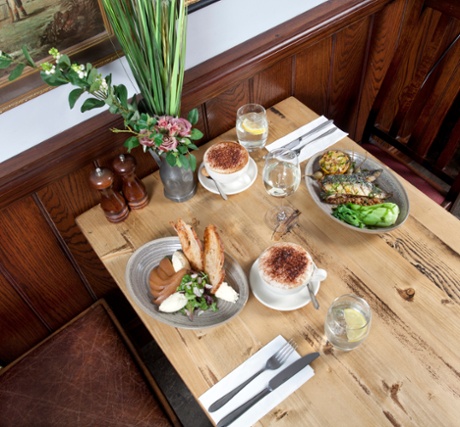
She orders a goat’s curd salad, though tempted by the mackerel that I choose, and we talk first about her new novel, the spark for which came from a documentary about a surrogacy clinic in India offering services mostly to childless couples in the UK.
“I have one good idea every 10 years,” she says. “But when I get one I do manage to finish it. I had rejected a lot of thoughts since my previous novel because I didn’t get that real tingle you should get. The synapses have to start firing. I was channel-flicking when I saw this documentary. At that point I hadn’t known India had the biggest surrogacy industry in the world. One of my favourite books is The Handmaid’s Tale by Margaret Atwood and in the collision of those two things I could see a new way of writing about the relationship between India and England.”
That relationship has obviously been fundamental to Syal, since her Punjabi parents upped sticks from Delhi and chose to settle in Wolverhampton, before she was born. At the moment, I suggest, it feels like the balance of power between the two nations is shifting quickly, a fact partly reflected in the sexual politics of her book.
“It certainly is changing,” she says. “I just see it in my own family. Those that weren’t as well off as us 15 years ago are now loads better off and their money goes much further. They have staff and help and all that. I go back fairly regularly, I’m going again this December. Mostly to Delhi where most of my dad’s family are.” Some of those family members have benefited from a property boom dramatic even by London standards. “Those little houses they bought in the old bits of Delhi years ago are like living in Kensington now …”
She didn’t go to a surrogacy clinic over there to research her book, but she interviewed people who had, including a British couple who’d had two children by Indian surrogate mothers. “You can all get the facts you like off the internet,” she says, “but I think you have to hear people describe the emotional journey to really get it.”
Her big bowl of salad arrives and she digs in. At 53 she has to work quite hard to stay fit, she says, at the gym three or four times a week, and then netball at a school hall one evening (“three quid and you just turn up”). Is she equally disciplined about writing?
“The worst bit is always starting. But out of all the media I’ve written for I find prose the easiest. I think it’s the privacy of it. Unlike a play or a film where only the first draft is really yours, you have to stand and fall by it. It’s not a collaborative process. You can work at your own pace.” That used to be sometimes at three in the morning, but not since she had her son.
“I couldn’t just write,” she says. “I love the communal experience of theatre. I’m not really solitary.”
She got round some of that solitariness this time by speaking the voices in her book out loud as she was writing, particularly those of the two women at the heart of it, adoptive mother and surrogate. “It always feels like channelling a bit,” she says. “It’s like when I used to do improvisation, you take on this other person quite quickly.”
Syal – recipient of an MBE and a CBE – is best known, I suppose, for her brilliant comedy – she wrote and starred in Goodness Gracious Me and The Kumars at No. 42 with her husband Sanjeev Bhaskar – but she doesn’t think of herself primarily as a comic actor. Everything, drama, comedy, writing, comes from a similar place.
That place is really her childhood, she suggests, or at least from the perspective her unusual formative years as the only “person of colour” in the mining village of Essington in the Midlands gave her.
Her first book, Anita and Me, told that story. “I feel really lucky that my parents chose such a strange place for an immigrant family to grow up,” she says now. “Right from the off I was an outsider. I was always forced to think about who I was and issues of identity and self-worth in ways I probably would never have had to if I had been born surrounded by people like me.”
When she goes into schools to give talks she stresses to the kids who feel different (“and all kids feel different”) that being on the margins looking in is always the most creative place to be. “We had a park near our house where all the kids used to gather, pretty feral, and I remember swinging on this swing, ridiculously high. If I swung high enough I could see over the trees and to the horizon stretching. And I remember vividly thinking, the world is bigger than this. I want to get out there.”
We meet before the election, and Syal is disturbed that immigration has played such a big part in the debates. “We had a leaflet through our door and it seems our local Ukip candidate is a black guy. Me and Sanjeev just stood there mouths open. It’s the Coopers from Goodness Gracious Me all over again: ‘Send them all back except for me!’”
The fact is, she says, with a laugh, Ukip or not, the British are adopting foreign culture. “My mum lives with us which is great. But all my English friends are also living as extended families because their kids never leave and their parents are there: I’m like: you are all turning Indian now, I told you! Dig out that basement! Extend that loft, they are all coming home!”
Syal is the cook in her three-generation household, mostly Indian food. Her husband can cook she says, but he somehow is rarely in the kitchen. They divide other areas of their life more equally – when she is working full-on, as she has been, he tends to turn down major commitments and vice versa.
“I have no idea what I am doing next,” she says. “But you have to be Mr Micawber, something will turn up. Otherwise you shouldn’t be in this industry. Actually I suppose most of the country now lives like actors. I’m not sure we are psychologically equipped for it. I’m not sure I was, being an immigrant, a non-steady job with no pension. Welcome to the world we have lived in for years.”
She had never planned to have no plan. After Manchester University she had her life mapped out: she was booked on an MA in drama and psychology that would lead to work in schools helping children with special needs.
That summer though, she did a one-woman show in Edinburgh at the fringe and was so good that she was offered not only a residency at the Royal Court but also a coveted Equity card. “So that was the chance to get out. And at 22 you have to take it.”
Does she ever think about what would happened if she had not?
“If I hadn’t I would have been sitting in a very nice suburban house somewhere, wondering, I suppose,” she says. “And I didn’t want to be that person.”
The House of Hidden Mothers is published on 4 June (Doubleday, £14.99). Meera Syal will be in conversation with Maya Jaggi at the Queen Elizabeth Hall, London on 20 May at 7pm. Tickets £10; southbankcentre.co.uk, 0844 875 0073