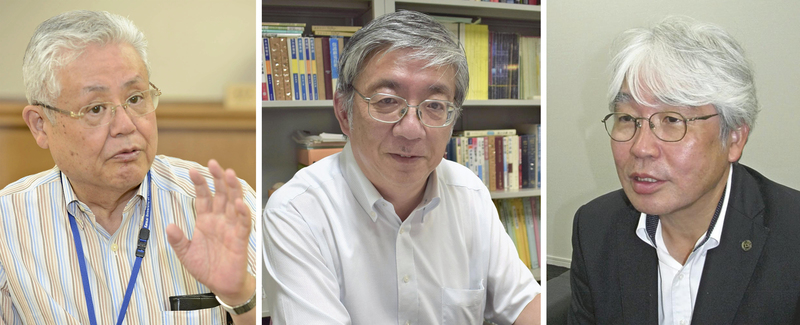
On Sept. 6, an earthquake with an epicenter in Hokkaido's Iburi region recorded the highest level on the Japanese seismic intensity scale of 7, causing a power outage across nearly all of Hokkaido. Questions surround the circumstances of what led to the unforeseen widespread outage. As we experience successive events including torrential rain, surging tides from typhoons and earthquakes, is it possible to fully prepare for complex disasters? We spoke with experts on power infrastructure and crisis management, and a physician experienced with disaster medicine. The following are excerpts from the interviews.
(From The Yomiuri Shimbun, Sept. 7, 2018)
Find ways to efficiently maintain power grids
Aside from isolated islands, I have rarely heard of any previous examples in Japan of total power failures across an area as big as Hokkaido. In order to operate thermal power plants, a source of electricity is needed to start up peripheral equipment such as pumps. Once there is a total power outage, it is difficult to bring the entire grid back on line.
Across one power grid, all of the power generators rotate on the same timing and work together to produce electricity. It is like using a large number of people to peddle one bicycle uphill. When one generator creating a huge amount of power suddenly stops, the load increases for the remaining generators and slows their rotations down. This results in a drop in the frequency level of electricty. If the frequency falls below a certain level, generators cannot operate.
During an emergency situation when many sources of electricity are unavailable, demand must be limited with measures such as partial power failure while the generators that are still on line continue to deliver supply. However, in Italy in 2003, when the limiting measures were not carried out in time, a domino effect was created, with one generator after another going down. Two-and-a-half minutes after the initial event in Italy there was a total power failure.
Trouble at one particular point can send ripples across a larger grid, which can be caused by reasons other than a drop in power frequency. In Germany in 2006, excessive load on one power transmission line led to the cutting off of 14 lines in 14 seconds and a spread of the outage to other countries. A domino effect can also arise from other causes, such as a drop in voltage or mistimed rotations between generators.
To what extent are preparations required against grid crises of this nature?
It is a question fraught with difficulty. Such measures need costs. Electricity deregulation has meant decreasing capital expenditure by power companies.
Tailored to the frequency and impact of troubles, companies must have taken countermeasures such as preventing outages when just one generator or transmission line is damaged, or preventing total outages, even if multiple generators go down. The latest trouble in Hokkaido may have eclipsed what preemptive measures can predict. It may be impossible to devise measures for eliminating every unexpected problem.
In the areas of western Japan that run at a frequency of 60 hertz, all of the generators operate on the same timing. During emergencies, they automatically compensate for each other. The same holds true for the 50 hertz areas in eastern Japan on Honshu. Only in Hokkaido, however, is the grid independent, which makes it difficult to re-route power from elsewhere. That could have been the Achilles' heel on this occasion.
Modern society grinds to a halt without electricity. Now and going forward, it is critical to research technology for efficiently maintaining a stable power grid, while also training human resources for the same purpose.
-- This interview was conducted by Yomiuri Shimbun Senior Writer Hiroshi Masumitsu.
-- Toshiya Nanahara / Professor at Tokyo Institute of Technology
Nanahara graduated from Kyoto University's Faculty of Engineering. He served at such posts as vice president of the System Engineering Research Laboratory at the Central Research Institute of Electric Power Industry. Since 2015, he has been a professor at the Tokyo Institute of Technology. He is researching electrical power engineering at the Department of Electrical and Electronic Engineering at the university's School of Engineering. He is 63.
Coordinate response to complex disasters
A string of major disasters -- including an earthquake in northern parts of Osaka Prefecture in June, heavy rain in western Japan in July, Typhoon No. 21 in September and now the earthquake in Hokkaido -- have occurred recently, plunging residents into considerable turmoil each time. I am concerned whether a response can be made to a large-scale disaster like a huge earthquake along the Nankai Trough or the Chishima Trench.
To protect the safety of citizens, it is essential to make improvements to the disaster prevention capabilities of local municipalities that have direct contact with residents. At present, I feel there is a large gap between the local governments that have and have not taken an interest in disaster prevention and enhanced their framework for preparations. This gap must be eliminated by raising the level of ability for making necessary responses, regardless of where in Japan a disaster occurs.
To that end, it seems it would be effective for the central government to stipulate disaster prevention standards. If we can set clear criteria for necessary measures, such as the number of disaster prevention officials, training programs and other criteria, while scaling those criteria in line with a community's size, we can systematically build out a framework for meeting the standards.
Although disaster prevention and crisis management directors have been appointed to assist governors and mayors across Japan, with the first in Hyogo Prefecture, the authority of these officials is insufficient in some cases. Systems involving such officials must be reviewed so that systems function well when a disaster does occur.
In general, a municipality's concern for disaster prevention rises once it experiences an event. A common scenario, however, is for a local government experiencing an earthquake to become overly focused on measures against an earthquake and to lack preparations for wind and rain disaster. Given that a variety of disasters have occurred recently, it must be understood that a complex disaster can occur at any time and in any place. Unless comprehensive measures with such understanding are taken, we are opening ourselves up to being tragically caught off guard.
The Hokkaido earthquake has affected numerous small local governments and will require nationwide support coordinated across a wide area. After the 1995 Great Hanshin Earthquake, organized systems of mutual support among municipalities were put in place, although its manner of implementation by various agencies and other bodies has been unbalanced.
It is important to come up with a unified system that is tied into efficient support efforts. The role of the prefectural government of Hokkaido is critical to gather requests from local municipalities to distribute support to local municipalities properly. It is hoped that the Hokkaido government will take initiatives in such efforts.
I would like to see municipal governments receive support to avoid leaving disaster responses solely to relief groups and instead mutually cooperate on both sides. Local municipalities must also take other measures to ensure that response expertise becomes an asset in an afflicted area.
With my current work on the ground in the field of university education, I am keenly aware of the importance of developing human resources that are able to take on disaster prevention responsibilities. The knowledge and wisdom of researchers and individuals with a wealth of actual experience in responding to disasters must be conveyed to young people, and we must better equip ourselves for future events and dedicate greater effort to initiatives for fostering real capabilities.
-- This interview was conducted by Yomiuri Shimbun Senior Writer Masaru Kawanishi.
-- Tomio Saito / Vice President at Kansai University of International Studies
Saito served as deputy chief of the governor's office at the Hyogo prefectural government during the 1995 Great Hanshin Earthquake. He served as the first disaster prevention director and the prefecture's deputy governor. Since 2016, he has been a professor at Kansai University of International Studies. He specializes in disaster prevention education. He is 73.
Secure emergency power supplies at hospitals
As an official in charge of emergency medicine and disaster damage prevention at the All Japan Hospital Association, I started communicating with hospitals in Hokkaido about the extent of damage on the morning of Sept. 6. Nearly all of their concerns surrounded power outages.
Electricity is a lifeline for hospitals. For instance, if the use of artificial respirators is lost due to a blackout, patients' lives are at risk.
However, the reality is that different hospitals are at varying levels of preparation for supplying emergency power.
Designated disaster base hospitals are required to have generators to cover about 60 percent of normal power needs, with three days of spare fuel in store. X-ray and CT machines and other equipment are indispensable for examining patients injured during disasters. Elevators to transport patients are also vital.
But among regular hospitals that are not disaster base hospitals, there are facilities that only have a minimal level of emergency power. These backups are for sprinklers and exit lights, and are not intended to support hospital operations.
After the Great East Japan Earthquake, awareness spread as to the importance of emergency power sources at hospitals. Some facilities independently set out to bolster their electrical infrastructure. However, installing equipment at the level of a disaster base hospital entails enormous costs. It is quite difficult to ask this of all hospitals.
Even for disaster base hospitals, it is difficult to imagine having a long-term outage. If there is only spare fuel for three days, it would be a challenge to procure fuel once that supply runs out.
At the hospital where I am the board chairman, we have installed two emergency power sources. We have anticipated the need to alternate between these systems during emergencies. Even enquiring with the manufacturer, though, did not give us a clear indication of how long the generators can last.
If we determine that we cannot continue examining patients due to a blackout, we need to carry out triage, with patients who we cannot easily treat being transferred to other hospitals and patients with stable conditions being temporarily discharged and asked to wait at home.
But this would be difficult in cases such as the earthquake in Hokkaido, where the entire prefecture was affected. It seems that all of the area's hospitals are extremely overextended at the moment in some parts of their operations.
The more time that passes, the more the number of hospitals that can remain up and running decreases. The Emergency Medical Information System provides progress reports. There have been calls to this system from Hokkaido hospitals that have only one day's worth of emergency supplies. We need to pray for the quickest possible recovery of power and for speedy relief to reach the hospitals that are in dire straits.
-- This interview was conducted by Yomiuri Shimbun Senior Writer Yoshihiko Tamura.
-- Masataka Inokuchi / Executive Board Member at All Japan Hospital Association
Inokuchi is board chairman at Heisei Tateishi Hospital and vice chairman of the Tokyo Medical Association. He is an official in charge of emergency medicine and disaster damage prevention at the All Japan Hospital Association and involved in such areas as disaster medicine. He is 61.
Read more from The Japan News at https://japannews.yomiuri.co.jp/