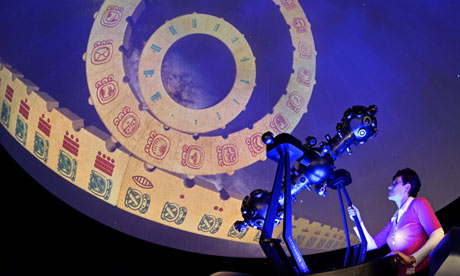
Seeing that everyone from France to China is cashing in on the Mayan apocalypse, I thought that I might as well too.
My favourite Mayan mathematical fact is that their religious calendar consisted of two cycles running concurrently, a 13-day week and a 20-day week.
The first type of week was denoted by a number from 1-13, and the second by a named day.
Imagine if we had a similar system – say, a five day numbered week, and a seven day named week. The dates of the first fifteen days would be:
1 Mon, 2 Tues, 3 Weds, 4 Thurs, 5 Fri, 1 Sat, 2 Sun
3 Mon, 4 Tues, 5 Weds, 1 Thurs, 2 Fri, 3 Sat, 4 Sun
5 Mon, 1 Tues, 2 Weds, 3 Thurs, 4 Fri, 5 Sat, 1 Sun
This provides a cycle of 35 unique dates, since 5 x 7 = 35. The Mayans had a cycle of 260 unique dates, since 13 x 20 = 260.
When we wake up in the morning, our most important calendrical concern is which day of the week it is. Mondays feel different from Tuesdays, which feel different from Wednesdays, etc.
If we obeyed two concurrent weekly cycles would we hate all Mondays, or just some of them?
(We could always ask the Balinese. Their traditional pawukon calendar is the most complicated ever invented: it has concurrent weekly cycles of 2, 3, 4, 5, 6, 7, 8, 9 and 10 days!)
The Mayans also had a civil month of 20 days each.
But rather than counting the days of these months from 1 to 20, they counted them from zero to 19.
The first day of the new month was zero in order to give the god that was "carrying the number" a rest.
Yet despite of the mystical justification, to have a zeroth day is mathematically much more elegant – we start the afternoon at 12.00pm not 12.01pm, and the millennium began in 2000 not 2001.
The Mayans, whose civilisation peaked in the first millennium CE, had a symbol for zero, a seashell.
However, it was just used as a marker rather than as a fully-fledged numeral that could be added and multiplied. The modern zero was invented in India
Still, the Mayans were a conceptual step above the Europeans living contemporaneously, who had no symbol for zero at all.