
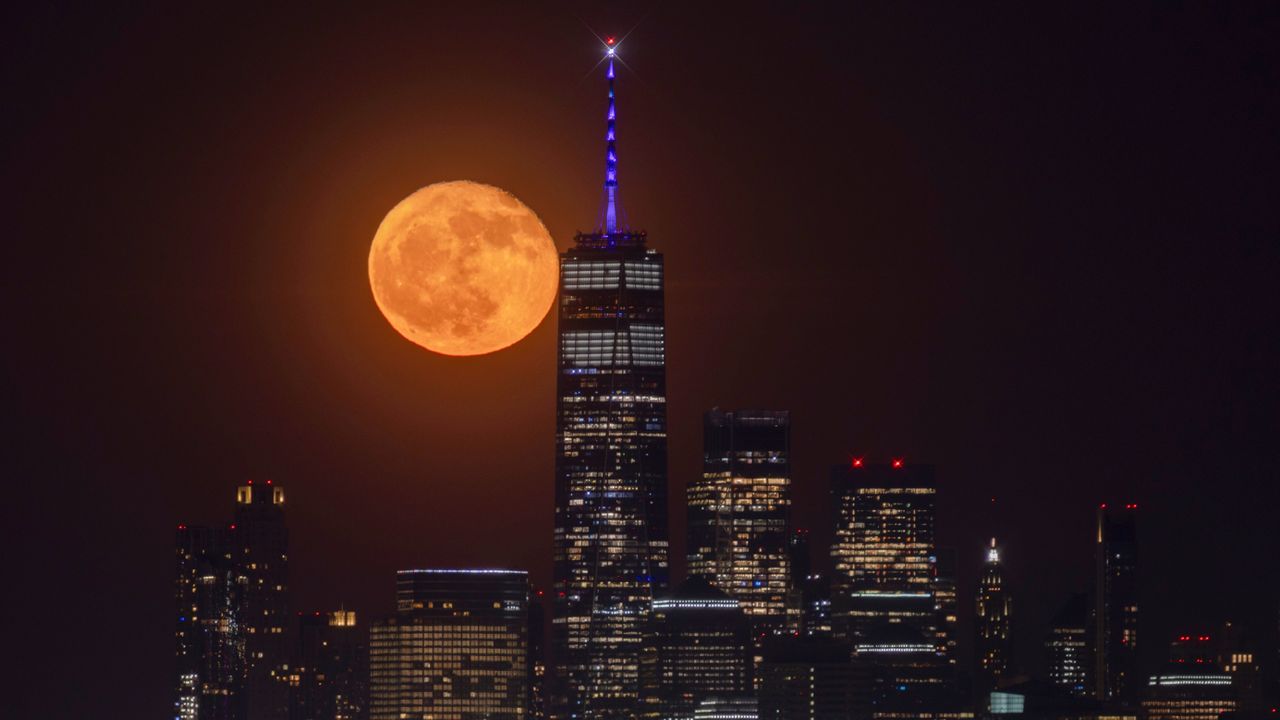
Editor's note: The full "Flower Moon" has come and gone, delighting skywatchers with a dazzling display of natural light as it climbed over the southeastern horizon on May 1. Check out our May 2026 full moon photo story to see the best pictures of the lunar extravaganza, captured from around the world.
The May full moon rises at sunset tonight! Here's what you need to know as the full "Flower Moon" takes to the spring sky on May 1 and when to look out for a rare "Blue Moon" later in the month.
The moon will be 100% illuminated at 1:23 p.m. EDT (1723 GMT) on May 1 (local moonrise and moonset times depend on your location), as the lunar disk appears opposite the sun in our sky, fully lit by its rays. The May full moon is also known as the "Flower Moon" in reference to the plentiful blooms that appear around this time as the northern hemisphere slips deeper into spring.
May's full moon will occur as the satellite is close to its most distant point from Earth in its near monthly elliptical orbit, giving rise to a "micromoon". Around this time, the moon may appear subtly smaller, while spanning 29.72 arcminutes — a unit used by astronomers to measure distances in the night sky — as opposed to its average size of around 31 arcminutes, according to the Las Cumbres Observatory.
Head out at sunset to catch the lunar disk as it climbs lazily over the southeastern horizon. You may see the moon adopt a distinctive yellow-orange hue as it rises low in the sky, as the sunlight reflected off its surface is filtered through the densest part of Earth's atmosphere, in a process known as Rayleigh scattering.
Look up after sunset and you'll spot bright stars Spica and Arcturus, the third brightest star in the night sky, shining above the glow of the full moon, which will wash out the fainter stars in nearby Libra.
On the western horizon, Venus glows brightly at sunset, while Jupiter hangs just above it. Higher up, Castor and Pollux shine in the constellation Gemini.
Through the night, the moon tracks a low, arcing path over the southern horizon, before finally setting in the southwest at dawn on May 2.
The Flower Moon sets the stage for a rare lunar event later in the month, when a second full moon — known to some as a "Blue Moon" — rises on May 31.
How can you have two full moons in a single month?
The moon takes roughly 29.5 days to cycle through its four key phases. Because this is close to the length of a calendar month, we usually experience 12 full moons in a year.
However, every 2.5 years, the subtle shift in monthly full moon timings conspires to give us 13 full moons in a single calendar year, with two occurring in a single month. The first full moon in a calendar month is always given the traditional name for that particular full moon, while the second is known as a Blue Moon.
The third full moon in a single season with four full moons is also sometimes referred to as a blue moon, though the actual color of the lunar disk remains normal for both definitions!
Want to see the full moon up close? Then be sure to read our guide to observing Earth's natural satellite, along with our picks of the best telescopes and binoculars for exploring the night sky.
Editor's Note: If you would like to share your lunar astrophotography with Space.com's readers, then please send your photo(s), comments, and your name and location to spacephotos@space.com.