Get all your news in one place.
100's of premium titles.
One app.
Start reading
The Independent UK
The Independent UK
World
Tom Batchelor

May Day protests: Hundreds arrested across Europe as demonstrations turn violent

Hundreds of demonstrators have been arrested across Europe as May Day protests turned violent.

European capitals from Paris to Moscow and Copenhagen to Athens saw mass rallies, strikes and violence on the streets.

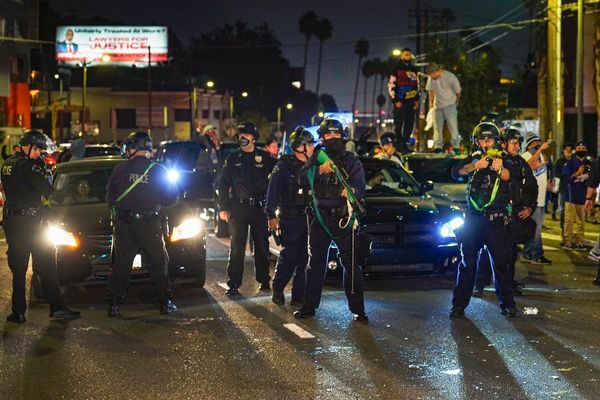
French police clashed with stone-throwing protesters who set fires and smashed up vehicles as thousands of people gathered for May Day rallies under tight security.

Neo-nazis scuffled with police in Sweden while in Greece a mass-walkout crippled public transport.

The global day of action saw people take to the streets in dozens of Asian and African capitals, with cities in North and South America also braced for disruption later on Wednesday.

A union rally in London was carried off peacefully and police there said they were not expecting significant demonstrations or violence.

Follow all the action and reaction in our liveblog below.

Good morning and welcome to our rolling coverage of protests and marches around the world to mark May Day, which coincides with International Workers’ Day and is traditionally a day for both celebrations and demonstrations.
Police in Paris are bracing for perhaps the most significant violence, coming in the wake of a months-long protest by the “gilets jaunes” (yellow vests) movement. 
 
French authorities have announced tight security, with the interior minister saying there was a risk that "radical activists" could join anti-government protesters and union workers in the streets of Paris and across the country. 
 
More than 7,400 police will be deployed, aided by drones to give them an overview of the protests and a quicker way to head off potential violence.
For those uninitiated with May Day, here is our guide to what it is and why there are often riots.
 
Police in Germany are also expecting violent demonstrations, with thousands of activists expected to rally against gentrification in parts of the capital, Berlin. Similar rallies will take place in more than a dozen German cities.
 
Ahead of the rallies, Germany's biggest trade unions have issued a call to voters to participate in this month's European elections and reject nationalism and right-wing populism. 

The DGB, a confederation of unions with almost six million members, said the European Union had helped ensure peace on the continent for decades and brought significant benefits to millions, from paid holidays to maternity protection.
The expectation is for a much quieter day in London. A Metropolitan Police spokesperson told The Independent the force was not aware of any specific plans for a protest today.
 
They said demonstrations were traditionally seen over the bank holiday weekend rather than on the actual May Day.
 
But the British capital - and other cities around the UK - have witnessed violent protests in previous years. In the early 2000s, violence erupted during several consecutive years of anti-capitalism protests in London. 
 

A largely peaceful demonstration against global capitalism flared into violence yesterday when anarchist protesters attacked a McDonald's restaurant and fought a running battle with riot police during clashes across the centre of London.

In echoes of the riot that caused havoc in the City last June, demonstrators selected the international burger chain, apparently as a token of their contempt for capitalism.

The attack, in which furniture was wrecked and windows smashed, marked the start of sporadic clashes that marred an otherwise peaceful day of protests by about 5,000 people who marched through London, congregating in Parliament Square, where they planted flowers and dug an impromptu "pond".

Most of the action so far today has – given the time zones – been in Asia
 
Here is a summary:
 
In the Philippines, thousands of workers and labour activists marched near the presidential palace in Manila. They demanded that President Rodrigo Duterte address labour issues including a minimum wage increase.

Wearing headbands and swinging their fists, protesters in the South Korean capital, Seoul, rallied in streets near City Hall, marching under banners denouncing deteriorating working conditions and calling for equal treatment and pay for non-regular workers. 
 
In Taiwan, several thousand workers were marching through the streets of Taipei, the capital, to demand better working conditions. They carried banners and flags and chanted for more days off and higher overtime pay. 
 
In Sri Lanka, however, major political parties called off traditional May Day rallies due to security concerns following the Easter bombings that killed 253 people and were claimed by militants linked to the Isis group. 
French police gather in the district of Montparnasse in the French capital prior to the start of May Day demonstrations
France is taking a zero-tolerance approach to protest violence
 
Among the biggest rallies so far on Wednesday has been the one in the Russian capital, Moscow.
 
Authorities say about 100,000 people are taking part in the centre of the city. Over the years, the May Day in Russia has transformed from the occasion for rallies for workers' rights to an official event carefully orchestrated by Kremlin-controlled groups. 

Opposition activists, however, often try to use the May Day to promote their agenda. 

The respected activists' group OVD-Info which compiles police reports on detentions of political activists said that six political activists have been detained in Moscow before the morning rallies.
 
Separately, in the remote Petropavlovsk-Kamchatsky in Russia's Far East, police have detained at least 10 people who showed up at the local May Day rally wearing yellow vests in an apparent nod to the protest movement in France. 
 
John McDonnell, the shadow chancellor, is due to speak at a May Day rally in central London this afternoon. 
 
He will be joined by union leaders for a march to Trafalgar Square in support of trade union rights and human rights and in protest at the government's austerity programme.
 
Organisers said the May Day March will follow its traditional route from Clerkenwell Green, passing Clerkenwell Road, Theobalds Road, Red Lion Square, Kingsway, Aldwych, the Strand and Trafalgar Square.
 
The March moves off at 13.00 and usually gets to Trafalgar at around 14.20. The rally with speakers will run from around 14.25 to 16.00.
A protester speaks through a megaphone as smoke from coloured smoke bombs billows near people taking part in the annual May Day rally in Strasbourg, eastern France
People attend a May Day rally organised by the Federation of Independent Trade Unions of Russia (FNPR) at Red Square in Moscow
 
In Turkey, police have detained demonstrators who tried to march toward Istanbul's symbolic main square in defiance of a ban. 
 
Turkey declared Taksim Square off-limits to May Day celebrations citing security concerns. Roads leading to the square have been blocked and police are allowing only small groups of union representatives to lay wreaths at a monument. 
 
But groups chanting "May Day is Taksim and it cannot be banned" attempted to break the blockade. The official Anadolu news agency said more than two dozen were detained. 
 
Trade unions and political parties will mark the day with rallies at government-designated areas in Istanbul and the capital, Ankara. 
 
Taksim holds symbolic value for Turkey's labor movement. In 1977, 34 people were killed there during a May Day event when shots were fired into the crowd from a nearby building. 
Greece has been left without national rail, island ferry and other transport services for a day as unions hold strikes and rallies to celebrate May Day. 
 
Hundreds of people gathered in central Athens for three separate rallies and marches to parliament organised by rival unions and left-wing groups. 
 
The Greek capital was left without public bus, trolley bus and urban rail services all day due to a 24-hour transport union strike, although the city's metro trains are mostly running. 
 
The national train and island ferry services are set to resume on Thursday. 
Former Greek Finance Minister and leader of MeRA25 party Yanis Varoufakis and his wife Danae Stratou take part in a rally commemorating May Day in Athens
 
An opposition party in South Africa is using May Day to rally voters a week before the country's national election. 

Economic Freedom Fighters members, wearing their signature red tops and berets, gathered at a stadium in Johannesburg to cheer in support of populist stances that have put pressure on the ruling African National Congress to address issues like economic inequality and land reform. 
 
 
Our Middle East correspondent Richard Hall has spoken to Lebanon's new labour minister on this International Workers’ Day about a sponsorship system which ties the legal residency of migrant domestic workers to their employers. It has been likened to 'modern day slavery' – but can he stop the abuse?
 
Police have clashed with protesters in Paris
 
Video shows demonstrators, some wearing yellow vests, in scuffles with officers, who appeared to charge the crowd. Loud bangs could be heard and smoke - possibly tear gas - filled the air. 


VIDEO: Tear gas thrown at May Day rally in Paris
 
Around 165 protesters have been arrested in Paris – some of them throwing stones, lighting fires and smashing vehicles, police said. 
 
Police repeatedly used tear gas to try to control the crowd gathering near Montparnasse train station for the main protest. It wasn't immediately clear how many people were injured.
 
One bandaged-up man with a head wound was helped away from the scene by paramedics. 
US cities waking up this morning are also bracing for protests, including in Seattle where this Starbucks has been boarded up in anticipation of violence:
 

Unions in Spain have used the May Day marches to call on the Socialist Party, which is likely to head the government after Sunday's election, for pension rises and a roll-back of tough labour legislation.
 
Prime Minister Pedro Sanchez, who won 123 seats in the 350-seat parliament, must fix labour market reforms imposed by a conservative government from 2012, union leaders told people celebrating International Worker's Day.
 
"The result of the election has given us the opportunity to face what the unions believe is a political priority; the fight against inequality," Unai Sordo, the head of Spain's largest union, CCOO, said as thousands prepared to march through the centre of Madrid and other towns and cities across the country.
Sign up to read this article
Read news from 100's of titles, curated specifically for you.
Already a member? Sign in here
Related Stories
Top stories on inkl right now
One subscription that gives you access to news from hundreds of sites
Already a member? Sign in here
Our Picks
Fourteen days free
Download the app
One app. One membership.
100+ trusted global sources.