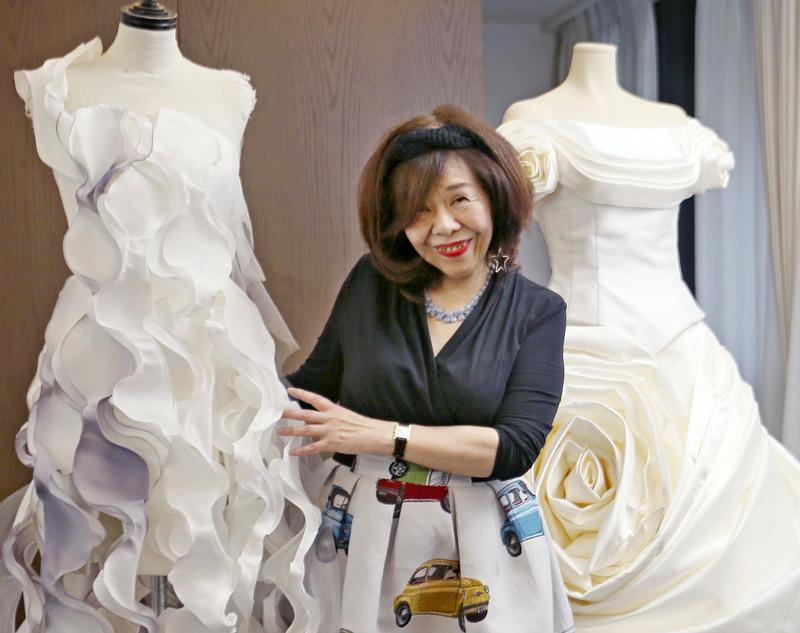
For wedding dress designer Ema Rie, artificial intelligence is like a "superb apprentice." Her apprentice is eager to learn once a task is given, and presents to her a wide range of designs, some of which are beyond her imagination.
Ema is known in the world of fashion as a "maverick" designer who incorporates scientific and mathematical perspectives into her work. Her career in haute couture is at about 30 years and counting. Her ultimate goal is to make women happy by creating clothes that perfectly fit their bodies. She believes such garments -- rather than ready-made products to which people must conform -- can maximize the individual beauty of each person. To attain that goal, she says advanced technology holds the key to elevating fashion from uniformity to diversity.
"The fashion world has lagged behind in introducing technology. But I think the use of AI for fashion will become ubiquitous in the future," Ema said during a recent interview with The Japan News. "Mass production has delivered significant benefits, but more advanced technology could usher in an age of haute couture by making individually created clothes more affordable."
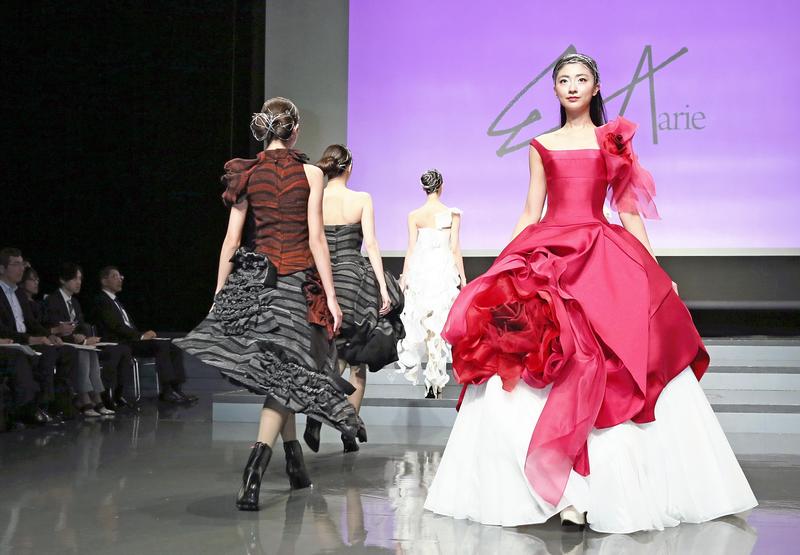
In late November, "collaborative works" produced by Ema and AI technology were showcased in Yokohama at a venue that seemed out of place for a fashion show: a symposium hosted by Riken, one of the nation's largest research institutes. As hip-hop music played, models wearing dresses created jointly by Ema and AI walked down the runway. The dresses featured intricate, elegant designs. When the models walked, the dresses swayed, evoking beautiful feminine silhouettes.
A team of Riken researchers used AI to analyze about 500 of Ema's works along with images of objects such as shells and roses, and then output designs. Ema then used the designs as inspiration to bring dresses to life for the show. The type of AI technology used for their "collaboration" is called the Generative Adversarial Network (GAN) in which a "discriminator" network acts like a teacher to discern work by a "generator" network, which acts like a student and tries to make the teacher accept its work. The two networks compete in an attempt to outperform each other. Through this process, both get better and become capable of "creativity," a human ability that AI is thought to be unable to truly replicate.
There has been concern that AI technology will surpass human ability and take away jobs. If AI becomes creative, that could have an impact even on fashion design, which largely requires aesthetic sense and creativity. But Ema doesn't harbor such concerns.
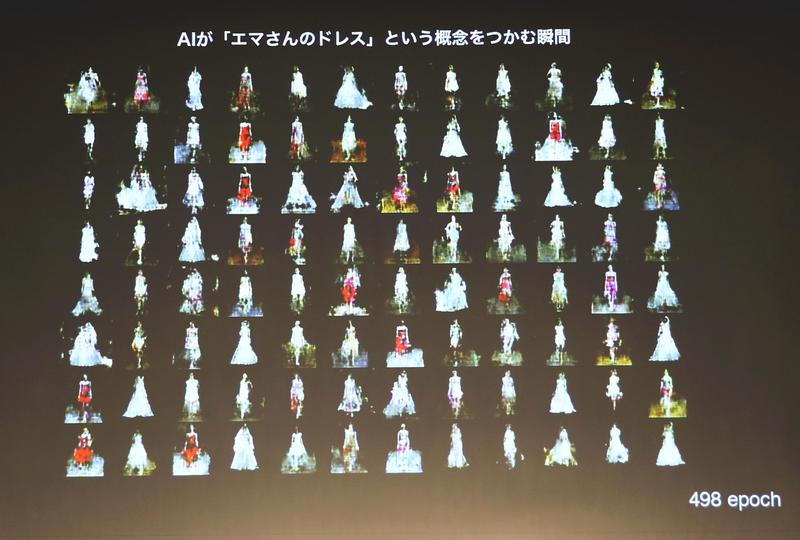
"This is not about which one wins or loses. I think humans and AI can have a cooperative relationship," Ema said with amusement. "If humans have a clear vision, we could create a better society with AI."
At the symposium, a red and white dress in a flamboyant rose design drew particular attention, with many in the audience taking photos. The dress was created after the GAN analyzed about 1,000 images of roses and Ema completed a design that it produced.
The dress apparently opened a 15-year-old girl's eyes to this unconventional fashion approach. "The dress looks very innovative. The idea that humans and AI can cooperate is fascinating," the high school student, who is enthusiastic about science, said at the venue.
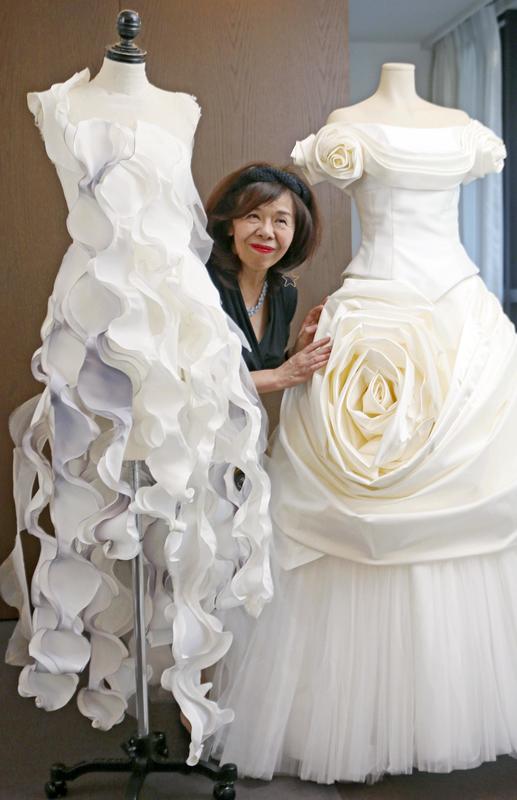
Initially, fashion was "the last thing" Ema had in mind for her career. A native of Aichi Prefecture, she studied fine arts at a high school in the prefecture and craft design at a junior college in Tokyo. She was good at drawing, but she thought she did not have enough intensity of feeling, which she thought was critical for an artist.
"My mother often said, 'You're too calm and cool' and 'You don't have emotional ups and downs,'" she recalled. "Rather than passion, I drew with my mind. Part of me was always calculating. I was ashamed of that at the time."
The turning point came in the 1980s after she moved to Chicago with her husband. She intended to go to a local college to improve her English, but her American friends urged her to study fashion as they apparently saw her potential. After entering a fashion design course at college, she won one contest, then another. Some boutiques in Chicago even began selling her creations while she was still a student, launching her career. She previously designed under the name Eri Matsui. Her current brand, EMarie, specializes in bridal wear aiming to maximize the beauty of each woman on her special day.
At first, Ema wasn't a scientific person. One day, a staff member said casually, "Time is the fourth dimension," and this caught her by surprise. She then encountered the book "Hyperspace" by Michio Kaku, who pioneered the theory of higher dimensional space. In physics, time and space are handled together, but the idea of handling two such different things together intrigued her. "It was eye-opening and I feel that science is very creative," she said.
Since then, Ema has been drawn to science and mathematics, leading her to seek collaborations with researchers in such fields as topology, mathematical engineering and chronobiology. To design clothes, she sought to understand human bodies and found that bodies, especially female bodies, have complicated curves and are asymmetrical. She then looked for answers in math and science to work out matters like how to deal with curved shapes and fabric strain. Searching for an answer to her question "What is beauty?" she even reached out to Gen Matsumoto, who was a group leader of Riken's Brain Science Institute.
"Science and art do not oppose each other, they embrace each other," Ema said. "I put importance on instinct born out of an accumulation of thought."
In 2005, her realm of fashion expanded into space when she served as unit leader for a Japan Aerospace Exploration Agency (JAXA) project in which she presided over the Space Couture Design Contest. She created a buzz at home and abroad when she designed a dress for the world's first wedding held in zero gravity, which was covered by major newspapers such as The New York Times and The Guardian. Her name has also been mentioned in leading scientific journal Nature for her unconventional approach.
"One fashion magazine once called me a fashion designer covered by Nature first before Vogue," Ema chuckled.
Back then, her thinking seemed far-fetched, but her inexhaustible pursuit of the fusion of art and science has paid off, with researchers in various fields now wanting to work together.
"I've been told recently that time is catching up with me," she said. "When technology makes individuals happy, I believe that is the result of a fusion of thought and emotion, and of science and art."
Read more from The Japan News at https://japannews.yomiuri.co.jp/