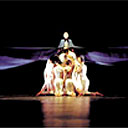
A choreographer who is game enough to make ballets about Charlie Chaplin, Che Guevara and the rock band Queen apparently has nothing to fear from the big subject. But with Mother Teresa and the Children of the World, Maurice Béjart has gone one historic name too far.
Even Béjart's fans had a hard time imagining how he would transform the tiny, wrinkled philanthropic legend into a dancing character, despite having 63-year-old ex-ballerina Marcia Haydée in the lead role. What we see on stage suggests less a saint than a ballet mistress.
Though Haydée's first entrance is made on her knees, swabbing the floor with a towel, and at one point she dishes out rice to the hungry, she spends much of the piece watching her young cast (the titular Children of the World) drilling their bodies through a series of dance routines, when she is not showing off her own flexible limbs with some deep yoga stretches.
Quite what point Béjart is trying to make in this piece is unclear. If Haydée does not remotely evoke the figure of Teresa, neither do the fit and smiling young dancers around her suggest the world's destitute.
The only clues come in the religious texts that Haydée declaims: they argue that the rich, young and healthy are as much in need of benediction as the poor. There seems to be a suggestion that through mutual acts of grace and prayer, we all get to be one happy family - and, preposterously, that Béjart is offering up his own choreography as the medium for that grace.
If so, it is a sorry offering. Béjart's best works have been powered by a glossy, bravura attack. Yet here he dishes out some of the most lacklustre, lazy moves ever seen on the professional stage. Bits of a modern dance class and ballet barre jostle emptily alongside half-formed classical duets and showy routines. Half the time he seems to be relying on his young performers to fill in the gaps with their own speciality numbers: a snatch of hip-hop, some gymnastics, even at one point an operatic aria.
This show feels more like an audition for Fame Academy than a work by a veteran choreographer, and it is a shocking betrayal of its dancers. Aside from Haydée, they are all graduates from Béjart's school, and they are not only fiercely trained but hopeful and heartbreakingly eager to please. Béjart's sloppy, sentimental work casts a slur not only on their talent, but on the reputation of Mother Teresa and on the rest of the dance profession.
· Ends tomorrow. Box office: 020-7863 8222