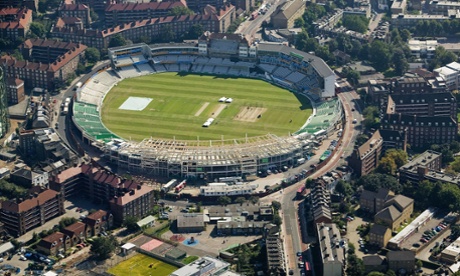
A sun-drenched early September Friday saw two unfamiliar sides – Barley Cricket Club and Thorley Cricket Club – taking each other on in a Twenty20 match. Unsurprisingly, neither team, both from small Hertfordshire villages (although Barley play in the Cambridge League) had played at the UK’s oldest Test venue before, so pre-match excitement levels were through the roof. Along with a frisson of trepidation: would the game prove to be a mismatch, given that the two sides owed their presence to winning a competition hosted by the Guardian and run by Kia?
Happily, there were few signs of nerves when the match got under way, although some players would, inevitably, leave the Kia Oval with fonder memories of their cricketing exploits there than others. Thorley won the toss and opted to field. A strategy that initially seemed to pay dividends, as Barley’s top order crumbled – in the face of bowling that wasn’t enormously intimidating. Riggs looked good at first, taking 10 off the first over, but subsequently became somewhat becalmed, although he held the fort for an obdurate 21. But after just nine overs, Barley had collapsed to 47 for 6 and we began to wonder whether their innings would even last the distance. One of Thorley’s senior bowlers, purveying inviting-looking spin, had taken three wickets in his four overs, for just four runs.
But enter Shafi Ullah, coming in at number eight. Ullah proceeded to do his best Chris Gayle impression, repeatedly clumping a variety of bowlers over wide long-on into the OCS Stand for a hatful of sixes. Astonishingly, Barley recovered to 165-7 from their 20 overs, with Green, offering Ullah sterling support, unbeaten on 28.
Thorley, perhaps having seen Barley’s top-order wreckage, opted to take more of a slow and steady approach which, in the initial stages, appeared to be warranted: after six overs, they were sitting fairly pretty at 35 for 1, with Mills on 16. But Mills, confronted by a juicy-looking spinner, holed out to long on for 17, and while the trickle of Thorley wickets never became a flood, the runs dried up in the face of some tight Barley bowling. As a consequence, Thorley had just 82 runs on the board, for the loss of five wickets, after 15 overs. A belated flurry saw Thorley pass the 100 mark, but they never got anywhere near the required 166, with the last wicket falling to a last-ball run-out. Thorley had made 116.
A jubilant – and relieved after their top-order collapse – Barley scooped up the cup and turned their minds to the final part of their prize: attendance at the Professional Cricketers Associations Awards dinner, thanks to Kia. Afterwards, both teams retired to the Long Room, where the inevitable ale was quaffed, and tall cricketing yarns spun. The Kia Oval may have hosted two unfamiliar teams, but the sporting and gentlemanly spirit in which the cricket was played would not have been out of place at the great Test venue in any period since Lord Harris led England out to play Australia in 1880, and WG Grace scored 152 on his debut.