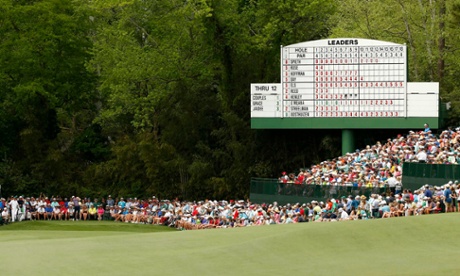
“The only thing money gives you,” reckoned Johnny Carson, “is the freedom from worrying about money.” Despite the trademark swing with which he ended each of his routines, the former chatshow host wasn’t much of a golfer. But the line is a good one and gets to the heart of one of the more curious things about Augusta National: the club’s attitude towards money.
For a long time the rule has been that just enough is plenty. Take its television deal. In the US, CBS has been on a rolling one-year contract since 1956. The details have never been made public. But the story goes that CBS just sends the club a bill for its costs each year. Augusta then arranges for its main sponsors to pick up the tab in return for four minutes of adverts per hour, which is about half the screen time given over at the other majors.
Contrast that with the deal the USGA made with Fox for the US Open (and other tournaments), said to be worth $93m a year. Or the deal the R&A has just made with Sky, worth £10m a year for the next 10 years. The Masters, certainly the most marketable of the majors, would be worth a lot more than that if the club was interested in selling the rights to the highest bidder. But it is not. What it gets, instead, is complete control over the broadcast. The Masters is one of the very few tournaments – perhaps the only one – in any sport where the broadcaster works to the host’s bidding rather than vice versa.
According to the autobiography of the former CBS broadcaster Pat Summerall, who died in 2013, there is no written contract between Augusta National and CBS. The deal is done with a handshake and comes with a long list of dos and don’ts. “Announcers can’t mention what brands of shoes or clothes a player is wearing or what equipment he is using,” he wrote in 2008. “That would be free advertising. You can’t broach the subject of money either. For example, you can’t say: ‘That putt means X amount of dollars to him’, or ‘A par will put him 25th on the money list’.” They couldn’t talk, either, about how one gets to be a member of the club, or about membership at all.
Only “appropriate” and “positive” language is allowed on air. In 1970, when Billy Casper beat Gene Littler in a play-off on the Monday, CBS’s Jack Whitaker described the crowds as “a mob” who had left a lot of “garbage” on the course. Whitaker was banned from taking part in the coverage for the next few years. “The Masters didn’t have a ‘mob’, they had ‘patrons’,” Summerall wrote. “Nor did they have ‘garbage’, they had ‘debris’.” Same thing happened to Gary McCord in 1994, when he described the greens as looking “bikini-waxed” and said that there were “body-bags” hidden behind the 17th green for golfers unlucky enough to hit it over there.
There is similar thinking behind the ticket prices and concessions, two more major sources of revenue for the hosts of most other tournaments. Here the costs of admission and refreshment are kept low. The price of a ticket for all four days has just gone up by $75 to a grand total of $325.
Likewise, at the Masters the prices of the sandwiches are set at a silly $1.50. Admirable in that it’s all designed to make the tournament as enjoyable as possible for the “patrons”, whether they’re at the course or watching at home on TV. There are no ugly logos around either, no hoardings, flags or billboards that would spoil the aesthetics. The only insignia you’ll see is the tournament’s own.
But this attitude, the inheritance of the club’s first chairman, Clifford Roberts, has caused a few problems, too. While the members would never be so déclassé as to admit it, the club needs money to fund its campaign to grow the game and expand its grounds.
As well as its own Drive, Chip and Putt Championship for under-15s, it is also running Amateur Championships in Latin America and Asia. In the past 15 years it has also spent $55m buying up land around the course, and built new practice facilities and lavish corporate hospitality centres. So where has the money come from, if not from tickets, food sales, or TV rights?
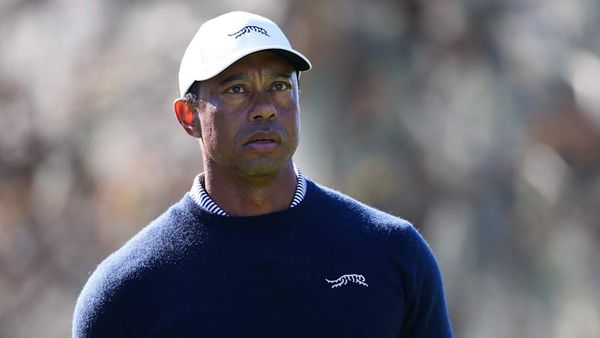
You will find the answer between the 1st hole and the practice range, in the one place where the crowds are thicker than they are around Tiger Woods. There is a superstore that stocks every conceivable piece of Masters-branded merchandise any fan could want, from cufflinks to earrings to necklaces, paintings, posters, vintage signposts, socks, sunglasses, shirts, jackets, caps and slacks, underpants, cups, plates, crystalware, a dozen different kinds of beaker, teddy bears, dog leads, dog bowls, holdalls and handbags, jigsaws, towels and hip flasks.
Best estimates are that it all totals up to a touch under $50m in sales each year. It’s one place on the course where money gets you a lot more than the freedom Carson mentioned.