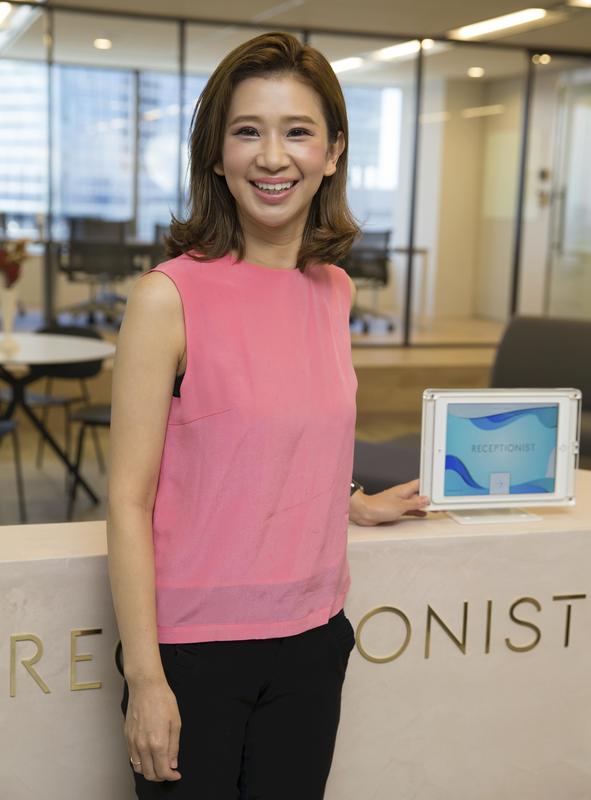
There are those who refine their specialist skills after completing their education and joining the workforce. One such person is Mariko Hashimoto, who built her career working as a contracted receptionist for 11 years and then starting a company that develops reception systems.
Hashimoto recently told The Yomiuri Shimbun about her journey to master the art of being a receptionist and why she chose to quit job hunting during her final year at university.
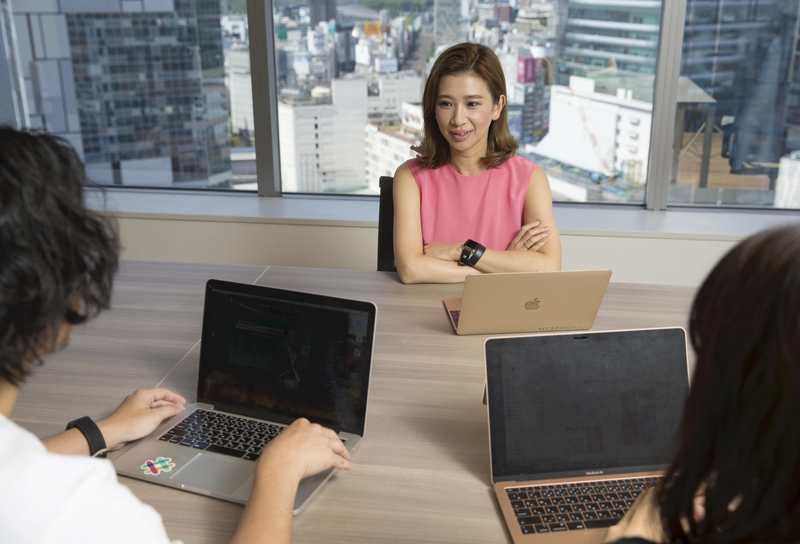
-- 11-year career as receptionist
"People tend to think the job of a receptionist is easy, doing things like making tea, answering phones and interacting with guests. I thought that way too, at first," Hashimoto said.
When she actually began working as a receptionist, she found out just how difficult the job can be.
"There were hundreds of guests every day, I had to remember the name, face and position of every employee. I also had to keep track of when each conference room was unoccupied and available for use. It's a very busy job with a myriad of tasks, but it's also very rewarding. You can feel how much you've improved over time," she said.
Hashimoto thinks that for someone to work as a receptionist for as long as she did -- 11 years -- is very rare.
However, it isn't as though being a receptionist was the first job that she came across.
Born in 1981 in Mie Prefecture, Hashimoto graduated from Musashino Womens University (now Musashino University). During her time participating in job hunting activities as a university student, many recruiting events were held by companies as a means of introducing themselves to students and encouraging them to apply. However, she always felt at odds with them and her fellow students, who were trying hard to behave impeccably at such events. She stopped participating in the job hunting activities, feeling that at the rate she was going, she couldn't become an adult who takes pride in her job.
After graduating, she gained experience in a variety of part-time jobs, such as working at a call center.
"I really felt the importance of having a stable income," she said.
She once again began job hunting for full-time employment, but this was during the so-called "employment ice age," when finding full-time work as a non-recent graduate was difficult. So, at the age of 23, she registered with a temp agency.
"I chose to take the receptionist job because I thought that I'd be able to use the English I had learned at university and would be able to acquire better business etiquette," she said.
She started her career as a receptionist for an IT company, where she thoroughly learned the basics and how to get into the right frame of mind for the job.
"It made me want to master this job," she said. "A receptionist is the face of a company, giving visitors the first impression of the company. I always made sure I behaved in a sophisticated manner, imagining that I am on stage. It made me really happy when someone appreciated my work. On the other hand, I also went through temp-staff lay-offs due to a downturn in business."
-- Simplifying tasks, working flexibly
Hashimoto worked as a temp receptionist for companies such as Usen Corp., mixi, Inc. and GMO Internet, Inc.
"Most receptionists are young women, and the reality is that it's difficult to continue working as a receptionist for a lifetime," she said. "After working at five companies, I decided to start a business to make the most of my career. So I founded the system development company Delighted to change the way receptionists work, given that the job is very much influenced by analog culture."
The company, which has since changed its name to Receptionist Inc., started in a small room of a Tokyo condominium in January 2016.
"What I had in mind was to reduce receptionists' workloads so that they can concentrate on tasks such as interacting with visitors. For example, when there's a visitor for a specific employee, the receptionist calls that employee on their extension number then notifies the visitor should the employee be unavailable. Such routine work occurs many times each day and winds up taking a lot of time. Therefore, I came up with the idea of implementing a chat system through which a visitor can directly contact the employee with whom they have an appointment. It's a simple function, but just the removal of that task can significantly streamline the job of a receptionist," Hashimoto said.
In January 2017, one year after the company's founding, it commercially released an automated cloud receptionist system called Receptionist for tablet computers. More than 3,000 companies have currently introduced the system, according to Hashimoto.
"The novel coronavirus is spreading. This system has gained popularity because it reduces unnecessary physical contact among people while the companies can also keep records of meetings with outside visitors. I'd like to keep providing services that flexibly respond to current needs," she said.
The company, which changed its name in March this year, has also produced scheduling software and a smartphone app for meeting room management. Its number of employees has increased from four to 33.
"I think it's better for students to not think about their lives too much on a mid to long term," Hashimoto said. "Things you can't control no matter what do occur, like the novel coronavirus. If you care for what you feel and dutifully execute what's in front of you and what you have to do at each and every moment in your life, then that will become your strength and surely lead to a fulfilling career."
-- Few female leaders in Japan
Fewer than 10% of company presidents in Japan companies are women. According to a survey by Teikoku Databank, Ltd., the percentage of female presidents at Japanese companies as of the end of April this year was 8%. The percentage of growth has been slow -- in 1990, it was 4.5%, 5.6% in 2000 and 6.8% in 2010.
Looking into how current female presidents obtained their posts, the majority -- 50.8% -- have done so through heredity, while 35.3% started their own companies and only 8.3% were promoted internally.
Meanwhile, there have been attempts at supporting female entrepreneurs. Development Bank of Japan annually holds a competition for new business plans devised by women. Women who are planning to start businesses within the next 12 months are qualified to apply to the competition. The winner will receive up to 10 million yen in prize money and support for 12 months. Japan Finance Corp. has set credit lines of up to 72 million yen for women, those aged under 35 and those aged 55 or older.
Read more from The Japan News at https://japannews.yomiuri.co.jp/