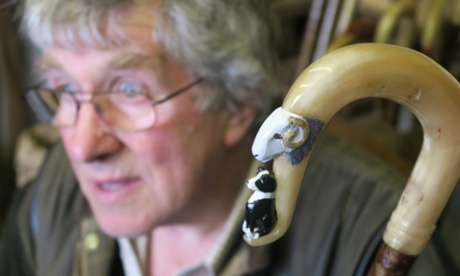
There are sticks – and there are sticks. Tell Bob Beaty about them. While fell walkers have their beloved trekking poles, over the decades he has been crafting the kind of walking sticks and shepherd’s crooks with ornate horn handles that are favoured by farmers like himself.
In his cabin he works away beneath the limestone pavements known as Stennerskeugh Clouds on Wild Boar Fell, between the Lake District and Yorkshire Dales. His workbench is heaped with ram’s horns, Herdwick horns being best, he tells me over coffee, because they are solid and “dense”. But even the most gloriously curled horn can be ruined if the shepherd has had to saw the tip off to prevent it digging into the sheep’s face and creating a breeding place for maggots.
As Bob’s flock are mostly Swaledales, he swaps or is donated or even buys horns from other farmers in Lakeland and nearer home.
After softening a horn by boiling it in water, he flattens it in a vice before taking his razor-sharp penknife to carve a pheasant, fox, leaping salmon or ram’s head as decoration. His wife, Marjorie, colours these carvings with acrylic paints in the conservatory of their home at nearby Newbiggin-on-Lune.
They met in 1959 at Ravenstonedale Young Farmers’ Club and married a year or two later. It was then he began stick-making, to “earn a shilling”. Nowadays, though his crooks and sticks are hugely prized by those fortunate enough to own one, this semi-retired 73-year-old is more likely to give them away.
“Blackthorn is strongest but hazel is more plentiful in lowland areas like the Lyth Valley, near Kendal,” he says. He cuts the sticks before the sap runs, otherwise their bark becomes wrinkled, and stores them for at least two years. He straightens them by flexing them across his knee in front of a glowing electric bar heater, then dipping them into cold water.
One end of the stick he fashions into a dowel, which he pushes deep into the hole he has bored into the dense, thick end of the painted-horn handle.