This series presents basic information and tips for preparing washoku dishes. In this installment, we talk about how to cut vegetables.
Cooking instructor Yoshiko Fujino said unlike Western dishes that require a knife when eaten, washoku dishes need food items to be cut into easy-to-eat sizes in advance.
"There are many ways of cutting that go hand in hand with certain dishes and food items," she said.
The numerous ways of cutting include one that helps flavor sink in, as well as one that makes the items easy on the palate.
In this lesson, Fujino taught three types of cutting food items -- hyoshigi-giri (cutting into sticks), tanzaku-giri (cutting into reed shapes) and sasagaki (shaving into thin pieces).
Before preparing the vegetables, place a wet dishcloth or similar item under a cutting board. By doing so, the board will not accidentally slide.
Place another wet dishcloth or other type of wiping towel near the board, and wipe the knife before cutting the next new vegetable.
Cutting into sticks
The hyoshigi-giri style is suitable for vegetables that are used mainly for dishes that are stir-fried before simmering.
First, cut a peeled daikon radish or similar item into pieces 3 to 4 centimeters long.
Cut enough off one side to make it flat. Place the item with the flat side down on the cutting board so the piece stays stable.
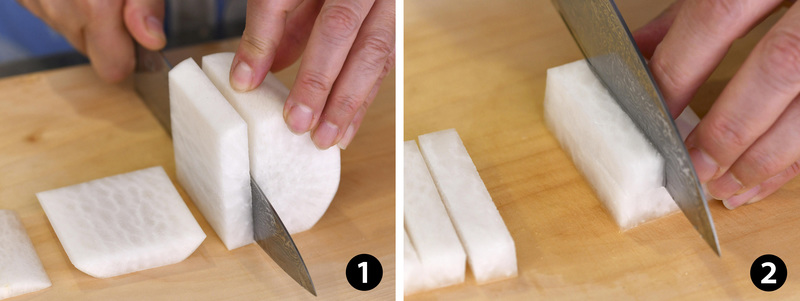
Cut the radish in the same direction of the fibers into pieces 5 to 6 millimeters wide (photo 1). Place them on their sides and cut again in the same width (photo 2).
"Cutting along the fibers makes the texture better," Fujino said. "Cutting in this way makes items more tender, but the vegetable's umami flavor dissipates more easily. So this method is great for soups and other dishes that can be made in a short period of time."
Cutting into reed shapes
Next is how to cut vegetables into reed shapes. This way is often used for stir-fried dishes.
First, cut a peeled carrot or similar vegetable into pieces 4 to 5 centimeters long. Cut enough off one side to make it flat and place the item with the flat side down on the cutting board.
Cut into slices in the same direction as the fibers. Place the slices on the board and cut them into about 8-millimeter-wide pieces.
Shaving into thin pieces
Sasagaki is the method used when preparing burdock root and other slender, long vegetables. This style helps the items easily absorb flavor because they are thin and have a large surface area.
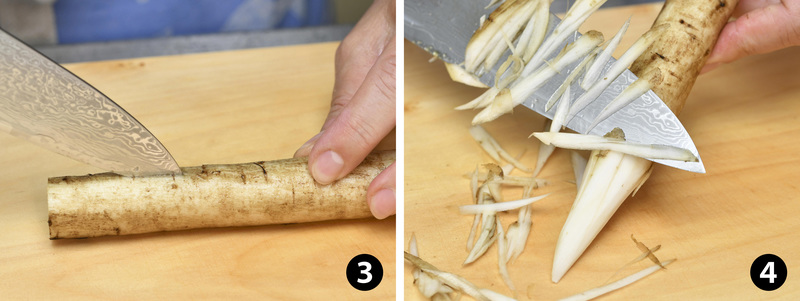
Place the vegetable on the cutting board. Then make several slits into the vegetable (photo 3). Rotate it, shaving it at a sharp angle with a kitchen knife. The action is similar to sharpening a pencil (photo 4).
"What's important is to keep the size of the pieces as uniform as possible," Fujino said. "If the sizes are vastly different, the texture and amount of flavor absorbed also become vastly different."
Recipe for daikon and carrot kinpira
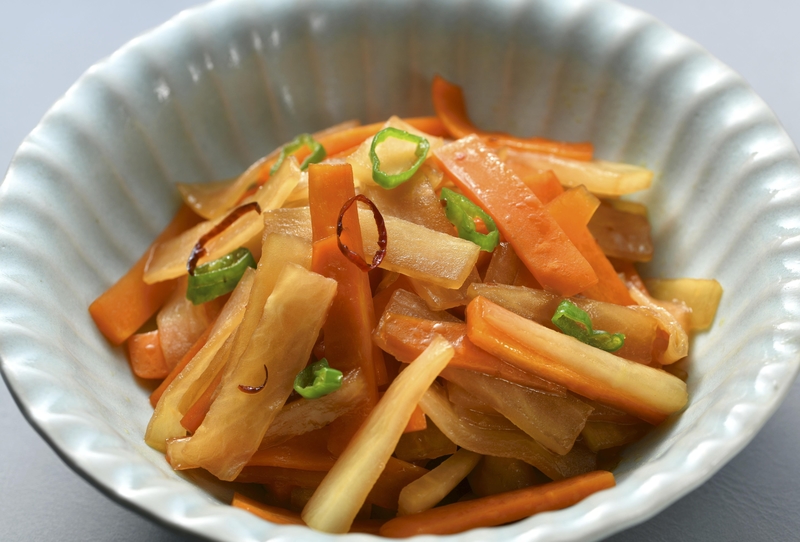
Fujino recommends kinpira (sautee in sugar and soy sauce) using daikon radish and carrots as a simple dish cutting the vegetables into reed shapes.
Ingredients (serves 2):
150 grams daikon
50 grams carrot
1 stick shishito green pepper
1/2 stick red pepper
Directions:
1. Cut the daikon and carrot into reed shapes. Remove seeds from the shishito and slice it into thin rings. Also slice the red pepper into thin rings.
2. Put 1 tablespoon sesame oil in a pan and add the red pepper. Turn on the heat and allow the spice to warm. Then stir-fry the cut pieces of daikon, carrot and shishito at medium heat. When the ingredients soften, add 1 tablespoon each of sugar and soy sauce. Then stir-fry the vegetables until most of the daikon's moisture is gone.
To find out more about Japan's attractions, visit http://the-japan-news.com/news/d&d
Read more from The Japan News at https://japannews.yomiuri.co.jp/