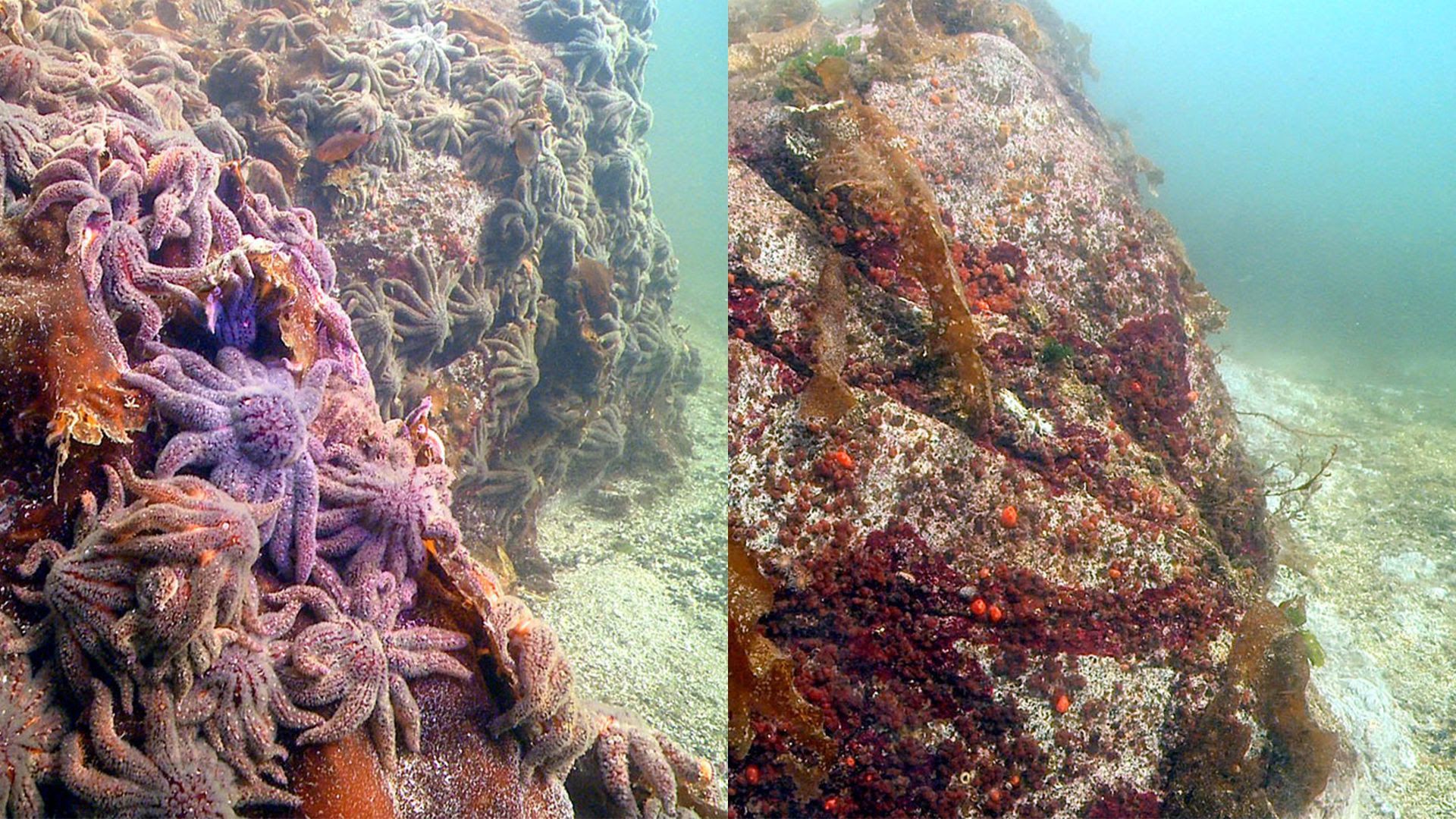
The predatory sunflower sea star, whose limbs can stretch 4 feet across, is rapidly disappearing due to infectious disease outbreaks worsened by marine heat waves, a comprehensive new study found.
Why it matters: The sea star, Pycnopodia helianthoides, is a vital component in marine ecosystems. In its absence, scientists documented a large increase in many types of urchins and a subsequent decline in kelp populations, to the potential detriment of many other species. The study warns of the potential for a "trophic cascade" to occur, "causing urchin populations to explode and kelp to rapidly diminish."
Details: Researchers investigated the effects of the Northeast Pacific sea star wasting disease event, which hit its epidemic phase from 2013 to 2015 but continues to have major impacts. Infected sea stars suffer a gruesome fate, beginning with dermal lesions and ending in "white piles of ossicles and disconnected limbs."
The impact: More than 20 species have been hit with this disease from California to British Columbia, and the predatory sunflower star has seen an 80–100% decline across its approximately 1,800-mile range. The study utilized biomass data from deepwater-trawl surveys from 2004 to 2016, as well as diver surveys of shallow nearshore regions from Alaska to California.
They found that steep drop-offs in sunflower sea star populations coincided with periods of unusually high sea surface temperatures.
- Much of the area affected by the sea star wasting disease was within the zone of a marine heat wave known to meteorologists and oceanographers at the "The Blob." That lasted from 2014 through 2016, and has been tied to global warming.
- A statistical analysis conducted as part of the study found that temperature alone explains more than one-third of the variance in sunflower sea star abundance.
- In other words, where and when the waters got warmer, pathogens turned deadly.
The bottom line: The study warned that continued exposure to sea star wasting disease, along with warming waters, could cause the predatory sunflower sea star to disappear completely.


.jpg?w=600)