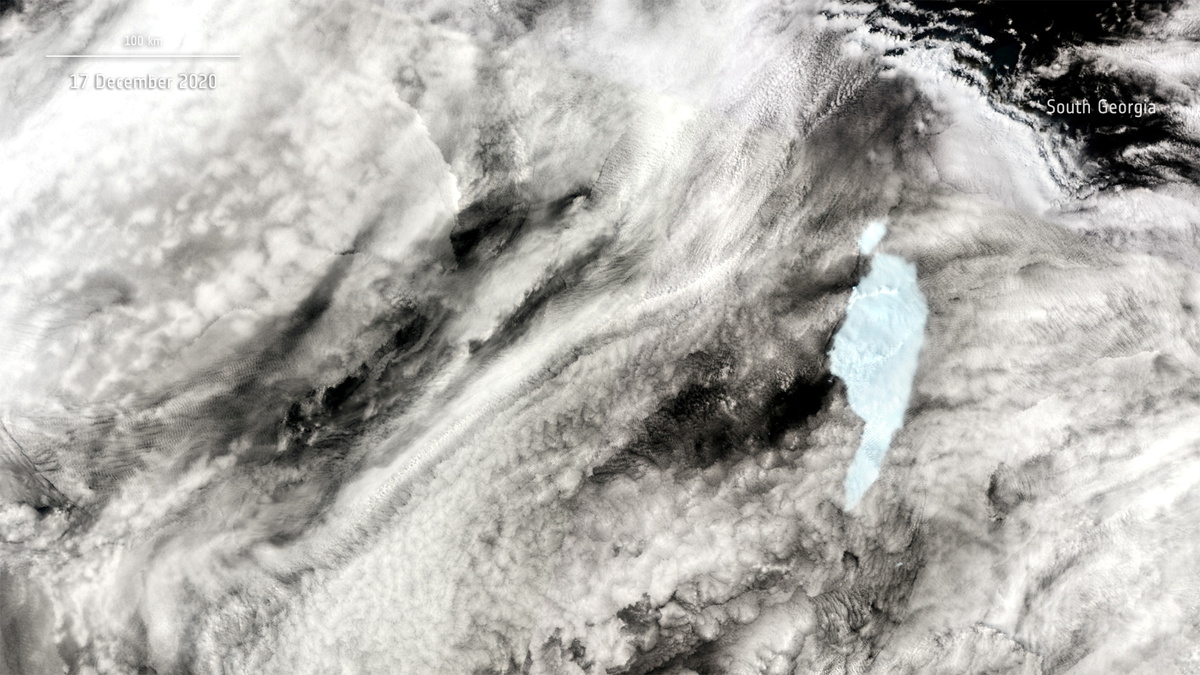
A massive Antarctic iceberg that last month threatened a penguin-populated island off the southern tip of South America has since lost much of its mass and broken into pieces, scientists say.
The main ice mass, called A68a, and its "child bergs" are still on the move, swirling in waters near South Georgia Island, said scientist Ted Scambos at the University of Colorado in Boulder.
Scambos and other scientists have been tracking the iceberg - one of the largest-ever recorded - since it broke off from Antarctic's Larsen C ice shelf in July 2017 and drifted north through a region known as "iceberg alley."
In the last month, the main berg shed about a third of its size, or more than 1,400 square kilometers (541 square miles), in smaller pieces and ice melt. On Tuesday, the main iceberg covered about 2,450 square kilometers (946 square miles).
The edges of A68a have "curled up like a dinner plate," causing pieces to break off from its sides as it moves through warmer currents, Scambos said.
The iceberg could block penguins from foraging grounds if it lodges off the island's coast, or it could grind over the seabed and significantly damage marine life.
That may already have happened, Scambos said, when the ice over moved some of the southern shelf in December. Scientists have yet to check on the impact up close.
The baby bergs are also still a threat.
"There's city-block-sized bergs that are drifting around," Scambos said. Scientists are tracking six of these smaller chunks, four of which are near the island.
Pieces began breaking off from A68a as it was approaching the island's western shelf in December. Strong currents caused the berg to pivot nearly 180 degrees. Satellite images suggest an underwater shelf may have clipped the berg, causing the first big break.
More big bits then broke off, including a protruding piece scientists had called the iceberg's "finger."
The bergs "keep wandering" around the island, Scambos said. "They might grind to a halt for a short while... days, maybe weeks."
But then they should melt and thin away, he said. "The bergs are in water that's too warm for them."
(Reporting by Cassandra Garrison; Editing by Katy Daigle and Aurora Elis)