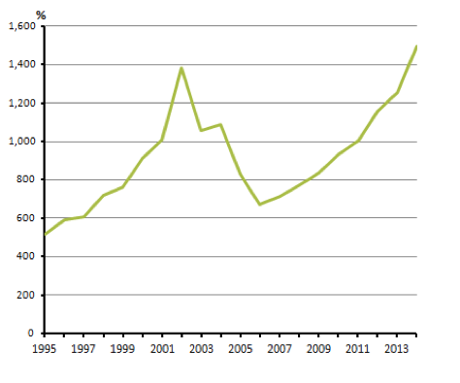
The divide between the most and least expensive areas to buy a home in England and Wales grew to its widest level in at least two decades in 2014, figures from the Office for National Statistics show.
While in Kensington & Chelsea, the median house price was £1.2m in 2014, in Blaenau Gwent in Wales it was just £75,000. This gap, of almost 1,500% compares with a divide of 516% when the figures began in 1995. At that point half of homes in Kensington & Chelsea cost less than £181,750 while in Blaenau Gwent they could be bought for £29,500.
The country’s property markets have been diverging since 2006, when London’s housing market all but escaped the crash, while in the rest of the country prices tumbled. In many parts of the country, prices are yet to return to their previous highs, but in the capital they have moved ahead of their pre-crisis peak.
However, the ONS figures show that prices have started to move upwards almost everywhere. Between 2013 and 2014 the median price of a home had increased in 336 local authorities and fallen in just six. In another six, prices remained static.
Over that one-year period, South Bucks recorded a 23% leap in prices, with the median rising by £90,000 to £480,000, while in the Isles of Scilly prices dropped by 15% to £235,000.
The ONS also looked at prices in so-called MSOAs – areas within local authorities defined as containing at least 5,000 residents and 3,000 households with an average population size of 7,500. “This can be helpful in assessing the affordability of homes for small areas where more general local authority statistics would not provide adequate resolution,” it said.
Again, analysis of prices at this level showed a huge disparity between the costliest and cheapest areas to buy homes.
In 2014, median house prices in the Knightsbridge area of Westminster, London, hit £3.4m – almost 100 times the £39,000 recorded in one area of Middlesbrough, according to the ONS. This is in stark contrast to figures for 1995, which showed Westminster was the most expensive place to buy, but at £327,000 the median price was just 24 times the £13,500 paid in the cheapest area, a neighbourhood of Sheffield.
Matthew Pointon, property economist at Capital Economics, said the data was consistent with earlier evidence that prices in London have grown far faster than any other part of the UK.
“In part, that reflects the usual pattern of London house prices leading the rest of the country during the early stages of a housing market recovery,” he said.
“Additionally, the inflow of foreign money into prime central London has boosted prices in the most expensive areas, at the same time as demand from traditional buyers of cheaper properties has been held back by the disruption to the mortgage market caused by the raft of new regulations introduced last year.
“Together, those forces have acted to drive the gap between the most expensive and cheapest homes ever wider.”