Massachusetts voters will decide nine statewide ballot measures in November 2026, tying 1972, 1976, and 1994 for the second-highest number in state history. Secretary of State William Galvin (D) announced on July 17 that campaigns for eight initiative petitions had collected enough valid signatures to qualify their measures for the ballot. A previously certified veto referendum brings the total to nine.
Initiated measures in Massachusetts are indirect. While a direct initiative is placed on the ballot once supporters file the required number of valid signatures, an indirect initiative is first presented to the state legislature. Legislators have until the first Wednesday of May in the election year to adopt the initiative into law. Should legislators take no action or reject the initiative, proponents must collect a second round of signatures supporting the measure.
The Massachusetts General Court chose not to take action on any of the initiatives. Campaigns supporting the initiatives submitted a second round of signatures with the secretary of state by July 8, 2026. Secretary of State William Galvin (D) announced that the campaigns supporting all eight initiative petitions submitted more than the required number of signatures. The measures were therefore certified for the November 2026 ballot.
The eight ballot measures that were certified for the ballot are as follows:
- Change State Tax Revenue Limit Initiative - The initiative would change the method of calculating the state's tax revenue limit so that it is equal to the sum of the net amount of state revenue from the year prior and the average growth of wages and salaries in Massachusetts over the past three years. It would also include revenue from the tax on income exceeding $1 million in the state’s definition of tax revenue .
- Establish the Nature for All Fund Initiative - The initiative would create a new state fund, the Nature for All Fund , which would receive revenue from the sales tax on sporting goods, recreational vehicles, and golf courses. The fund would be used for natural resource conservation.
- Limit on Required Lot Size for Single-Family Homes Initiative - The initiative would require cities and towns to allow single-family homes on residentially zoned lots that meet minimum standards of at least 5,000 square feet in area, at least 50 feet of frontage on a street or public way, and access to public sewer and water services. In effect, the initiative would preempt local zoning rules that require lots for single-family homes to be larger than 5,000 square feet, which is about 0.12 acres, as long as the other conditions are met.
- Permit Collective Bargaining for Committee for Public Counsel Services Employees Initiative - The initiative would permit employees of the Committee for Public Counsel Services (CPCS) to engage in collective bargaining with their employer. The CPCS workforce includes public defenders, social workers, investigators, and administrative staff.
- Permit Same-Day Voter Registration Initiative - The ballot initiative would provide for same-day voter registration .
- Public Records Requirements for Legislature and Governor’s Office Initiative - The initiative would require that records the state legislature and the governor’s office hold be public records. As of 2026, documents held by government agencies are considered public records and are subject to legal access requirements, but documents held by the state legislature and the governor's office are exempt from this requirement.
- Top-Two Primary Elections Initiative - The initiative would adopt top-two primaries for state offices and require gubernatorial and lieutenant gubernatorial candidates to run as a joint ticket in primaries.
- Eliminate Recreational Marijuana Sales and Allow Limited Possession Initiative - The initiative would repeal the state's laws that legalized, regulated, and taxed retail sales of recreational marijuana. It would continue to allow possession of up to one ounce without penalty and possession of more than one ounce but no more than two ounces subject only to civil penalties. Voters originally legalized the use of recreational marijuana in 2016 when 53.7% approved Question 4 .
In addition to the eight initiatives certified for the ballot, a veto referendum has been certified for the ballot since November 2024. It will allow voters to decide whether to retain or repeal House Bill 4885, which made several changes to the state's firearm regulations. Under HB 4885, the state would develop an electronic tracking system for firearms, prohibit assault-style firearms (as defined in law), require safety certificates to obtain firearm parts, mandate serial numbers for firearms, allow school administrators and licensed healthcare providers to request that a court issue an Extreme Risk Protection Order, and permit courts to order firearm surrenders when issuing a Harassment Prevention Order.
Historical context
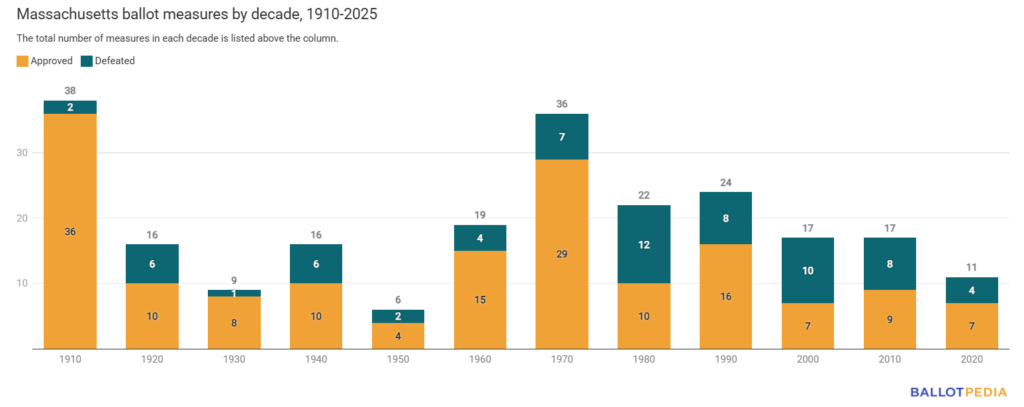
Including the veto referendum, Massachusetts voters will decide on a total of nine ballot measures in 2026. Massachusetts voters have decided on nine ballot measures three separate times: in 1972, 1976, and 1994. Massachusetts voters only decided on more than nine measures once, in 1918. That year, voters decided on 19 constitutional amendments referred to the ballot by a constitutional convention.
The nine measures on the 2026 ballot bring the total number of statewide ballot measures in Massachusetts from 2020-2026 to 20. Between the 1910s and the 2010s, the average number of ballot measures per decade was 20, with an average approval rate of 70.0%. The 1910s had the greatest number of measures, with 38 on the ballot. The 1950s saw the fewest number of measures, with six on the ballot.
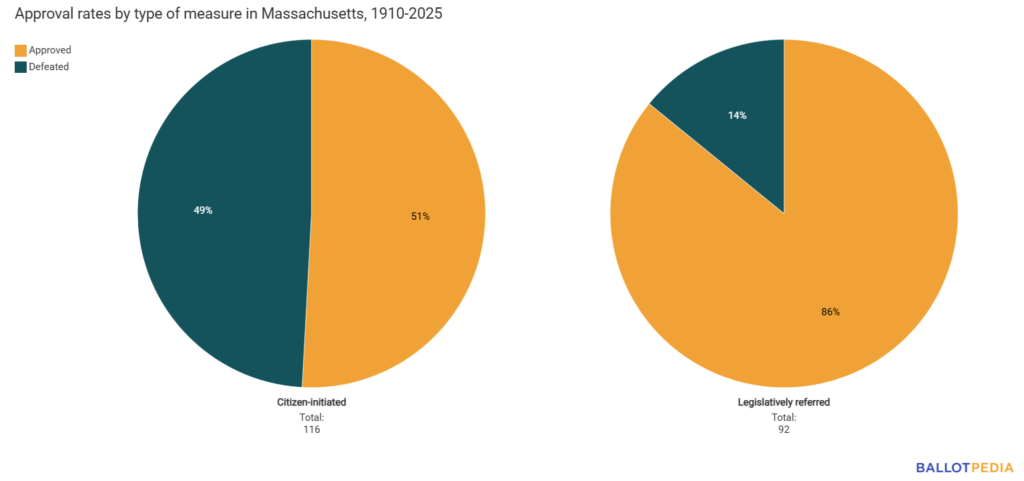
All of the measures on the 2026 ballot were initiated by citizens; none were referred to the ballot by the state legislature. In Massachusetts, legislatively referred measures have had better success at the ballot box than citizen-initiated measures. Legislatively referred measures were approved 86% of the time, as compared to 51% for ballot initiatives.
Initiatives not on the 2026 ballot
Three initiative petitions that submitted signatures in December 2025 did not submit signatures for the second signature deadline in July. All three were blocked by an action of the Massachusetts Supreme Court.
- Decrease State Income Tax Rate to 4% Initiative - The initiative would have decreased the state tax rate for personal taxable income (including interest, dividends, wages, and salaries) from 5% to 4% by 2029. On June 18, 2026, the Massachusetts Supreme Court ruled that the measure could not be placed on the ballot because the ballot summary prepared by the attorney general was misleading and likely to influence voters.
- Rent Control Initiative - The initiative would have established rent control in Massachusetts, limiting annual rent increases for residential units to the Consumer Price Index or 5%, whichever was lower. On June 24, 2026, the Massachusetts Supreme Court ruled that the measure could not be placed on the ballot because it would have exempted units in religious facilities. The Massachusetts constitution states an initiative petition cannot relate to religion.
- Legislative Stipend Calculation and Payment Rules Initiative - The initiative would have changed the method of calculating the stipends that state legislators receive in addition to their base salaries. On April 27, 2026, the Massachusetts Supreme Court issued an opinion on the initiative, stating that the measure is neither a constitutional amendment nor a law, and thus "lies outside the scope of the initiative process." On May 6, 2026, the Massachusetts attorney general issued a letter stating that the measure could not proceed with the initiative process because, according to the opinion of the state Supreme Court, the initiative contains a rule change rather than a change of the law.
Additional reading: