Welcome to the Wednesday, July 22, 2026, Brew.
By: Briana Ryan
Here’s what’s in store for you as you start your day:
- Massachusetts voters to decide nine ballot measures this year — tying for the second-most in state history
- Colorado could become the seventh state to decide a voter ID ballot measure this year
- U.S. House passes bill banning foreign contributions to state and local ballot measure campaigns
Massachusetts voters to decide nine ballot measures this year — tying for the second-most in state history
Massachusetts voters will decide nine statewide ballot measures this year, above the even-year average of four and tying with 1972, 1976, and 1994 for the second-most measures in the state's history.
On July 17, Massachusetts Secretary of State William Galvin (D) announced that campaigns for eight initiative petitions collected enough valid signatures to qualify their measures for the Nov. 3 ballot. A previously certified veto referendum for the Nov. 3 ballot brings the total to nine.
Initiated measures in Massachusetts are indirect. While a direct initiative is put on the ballot once supporters file the required number of valid signatures, an indirect initiative is first presented to the state legislature. Legislators have until the first Wednesday of May in the election year to adopt the initiative into law. Should legislators take no action or reject the initiative, proponents must collect a second round of signatures supporting the measure to place it on the ballot.
The Massachusetts General Court chose not to take action on any of the initiatives. Campaigns supporting the initiatives submitted a second round of signatures to the Secretary of State by July 8.
Of the eight initiatives:
Two initiatives — the Permit Same-Day Voter Registration Initiative and the Top-Two Primary Elections Initiative — are on election policy. The first initiative would permit same-day voter registration, and the second would adopt top-two primaries for state offices and require gubernatorial and lieutenant gubernatorial candidates to run as a joint ticket in primaries.
The Eliminate Recreational Marijuana Sales and Allow Limited Possession Initiative would repeal the state's laws that legalized, regulated, and taxed retail sales of recreational marijuana. Massachusetts is one of 13 states and Washington, D.C. to have used the ballot initiative process to legalize the possession and personal use of marijuana for recreational purposes.
The Change State Tax Revenue Limit Initiative would change the method of calculating the state's tax revenue limit so that it is equal to the sum of the net amount of state revenue from the year prior and the average growth of wages and salaries in Massachusetts over the past three years.
The Establish the Nature for All Fund Initiative would create the Nature for All Fund, which would receive revenue from the sales tax on sporting goods, recreational vehicles, and golf courses. The fund would be used for natural resource conservation.
The Limit on Required Lot Size for Single-Family Homes Initiative would require cities and towns to allow single-family homes on residentially zoned lots that meet minimum standards of at least 5,000 square feet in area, at least 50 feet of frontage on a street or public way, and access to public sewer and water services.
The Permit Collective Bargaining for Committee for Public Counsel Services Employees Initiative would permit employees of the Committee for Public Counsel Services (CPCS) to engage in collective bargaining with their employer.
The Public Records Requirements for Legislature and Governor's Office Initiative would require that records the state legislature and the governor's office hold be public records.
Additionally, the veto referendum will allow voters to decide whether to retain or repeal House Bill 4885, which made several changes to the state's firearm regulations. Under HB 4885, the state would develop an electronic tracking system for firearms, prohibit assault-style firearms (as defined in law), require safety certificates to obtain firearm parts, mandate serial numbers for firearms, allow school administrators and licensed healthcare providers to request that a court issue an Extreme Risk Protection Order, and permit courts to order firearm surrenders when issuing a Harassment Prevention Order. Massachusetts is one of 22 states that have enacted laws authorizing courts to issue extreme risk protection orders.
Historical context
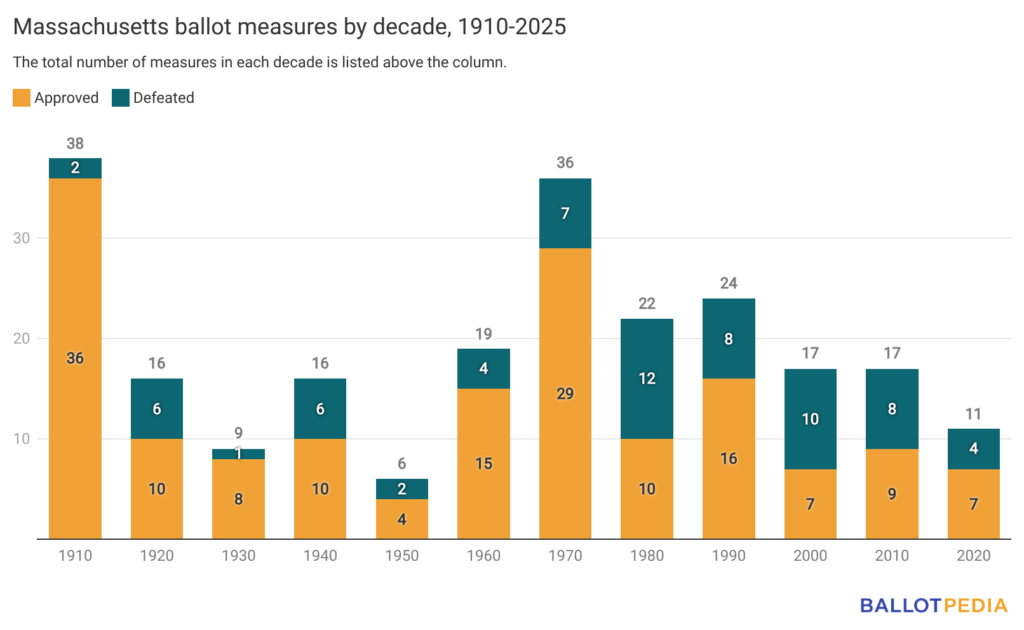
Massachusetts voters have decided on nine measures three separate times: in 1972, 1976, and 1994. Massachusetts voters decided on more than nine measures only once, in 1918. That year, voters decided on 19 constitutional amendments that a constitutional convention referred to the ballot.
From 2020 through 2026, 20 statewide measures have been on the ballot in Massachusetts. Between the 1910s and the 2010s, the average number of measures per decade was 20, with an average approval rate of 70.0%. The 1910s had the greatest number of measures, with 38 on the ballot. The 1950s saw the fewest number of measures, with six on the ballot.
Click here for more information about all measures on the ballot in Massachusetts this year.
Colorado could become the seventh state to decide a voter ID ballot measure this year
Voters in six states will decide voter identification ballot measures this year, the most on statewide ballots in a single year. Colorado could become the seventh state. All seven of those measures would institute or strengthen voter identification requirements. On July 16, proponents of a Colorado ballot initiative on voter identification requirements for mail-in voting submitted signatures to the secretary of state's office.
Other voter ID measures are set to appear on the ballot in Arizona, California, Nevada, North Carolina, Ohio, and Oklahoma. Voters will decide most of those measures on Nov. 3, while Oklahoma voters will decide that measure on Aug. 25. Previously, voters decided the most statewide voter ID measures in 2022 when they decided three.
The secretary of state's office has until Sept. 2 to review the signatures to determine if the petition contains at least 124,238 valid signatures, the minimum requirement to be placed on the ballot for Nov. 3.
Colorado currently requires voters to sign their mail ballot envelope, but does not require additional identification. Colorado is one of eight states with all-mail voting. In these states, voting is conducted primarily by mail, and all eligible voters receive a ballot by default, in at least certain elections.
Initiative 362 would add a new section to Article VII of the Colorado Constitution to require voters to provide both their signature and an identification number:
- the last four digits of their Social Security number
- a Colorado REAL ID number
- a Colorado REAL ID driver's license number
- the last four digits of another Colorado identification number meeting federal REAL ID requirements
Additionally, Initiative 362 would require election officials to compare the information voters submit to the statewide voter registration database. If there is any discrepancy in the information, the voter must be notified, and the voter may correct the discrepancy by providing a copy of their identification. The ballot cannot be counted until the discrepancy is corrected.
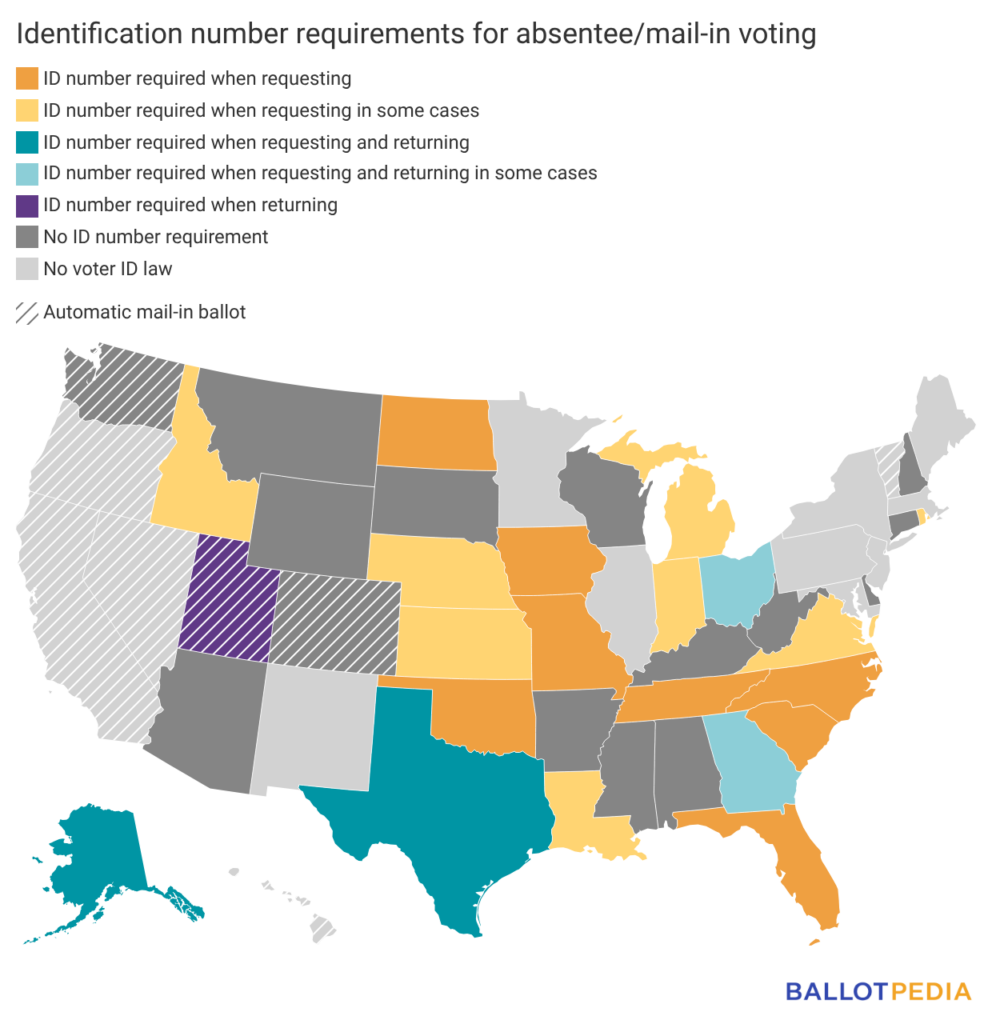
Currently, 21 states require voters to provide a driver's license number, Social Security number, or other identification number to vote by absentee/mail-in ballot. Five of the eight all-mail voting states have no voter ID laws, and two all-mail voting states with in-person voter ID requirements — Washington and Colorado — have no identification number requirements for returning absentee/mail-in ballots. Utah requires a voter identification number when returning an absentee/mail-in ballot.
Click here to read more about Initiative 362 and here for more about the seven measures Colorado voters will decide on Nov. 3.
U.S. House passes bill banning foreign contributions to state and local ballot measure campaigns
On July 13, the U.S. House of Representatives passed H.R. 3535, which would ban foreign nationals from contributing to state or local ballot measure campaigns.
Federal law prohibits federal, state, and local candidates from soliciting, accepting, or receiving contributions from individuals who are not citizens or permanent residents of the United States. The law also bans contributions from foreign governments, political parties, corporations, organizations, or groups whose principal place of business is in a foreign country.
However, federal courts have established that the ban does not apply to issue advocacy, such as lobbying or spending in ballot measure campaigns. The Federal Election Commission (FEC) has affirmed that under current federal law, foreign individuals, corporations, and governments may contribute to ballot measure campaigns.
H.R. 3535 explicitly extends the prohibition on foreign national donations in state and local elections to include ballot measures, referenda, and recall elections.
U.S. Reps. Brian Fitzpatrick (R-Pa.), Jared Golden (D-Maine), and Susie Lee (D-Nev.) sponsored the bill, which the U.S. House passed unanimously by a voice vote. It now goes to the U.S. Senate for consideration.
While federal law currently allows foreign nationals to donate to ballot measure campaigns, some states have enacted their own prohibitions.
Twenty-five states have enacted laws banning foreign nationals or governments from contributing to ballot measure campaigns. Seven states have enacted bans on direct contributions, while 18 states have banned direct and indirect contributions from foreign individuals or entities.
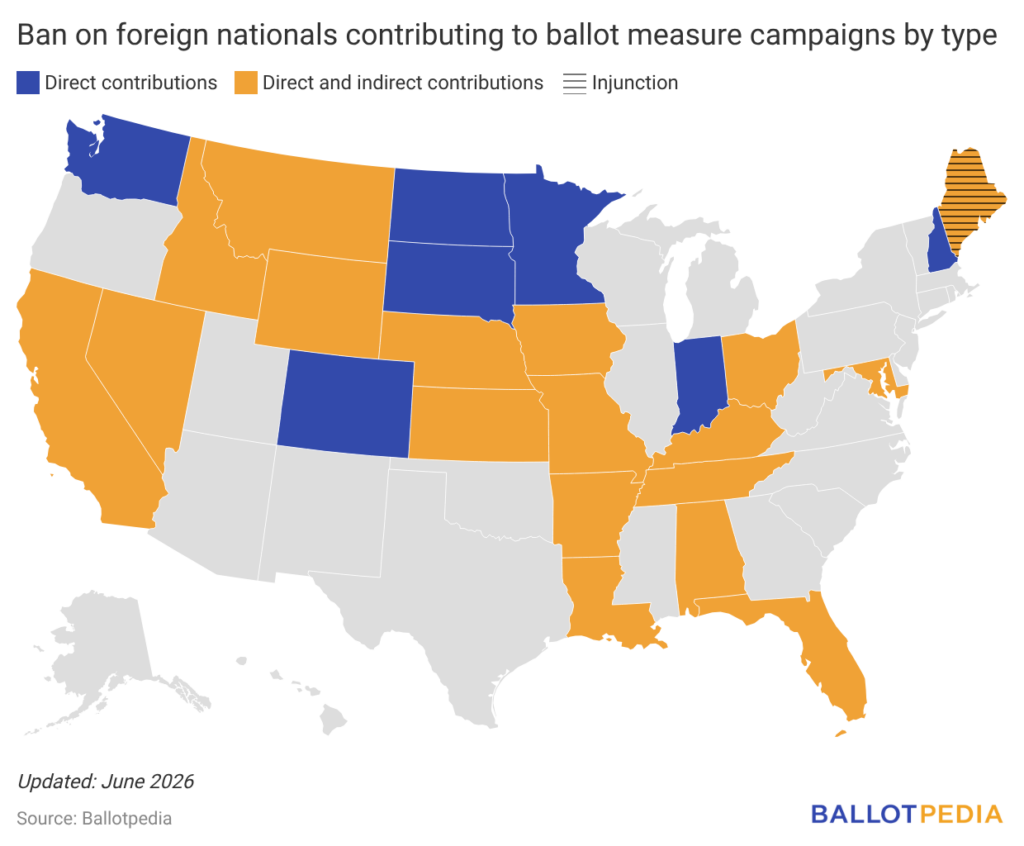
Thirty states have also enacted state-level prohibitions on foreign national donations to candidates. New Jersey and New York have prohibitions on foreign nationals making independent expenditures.
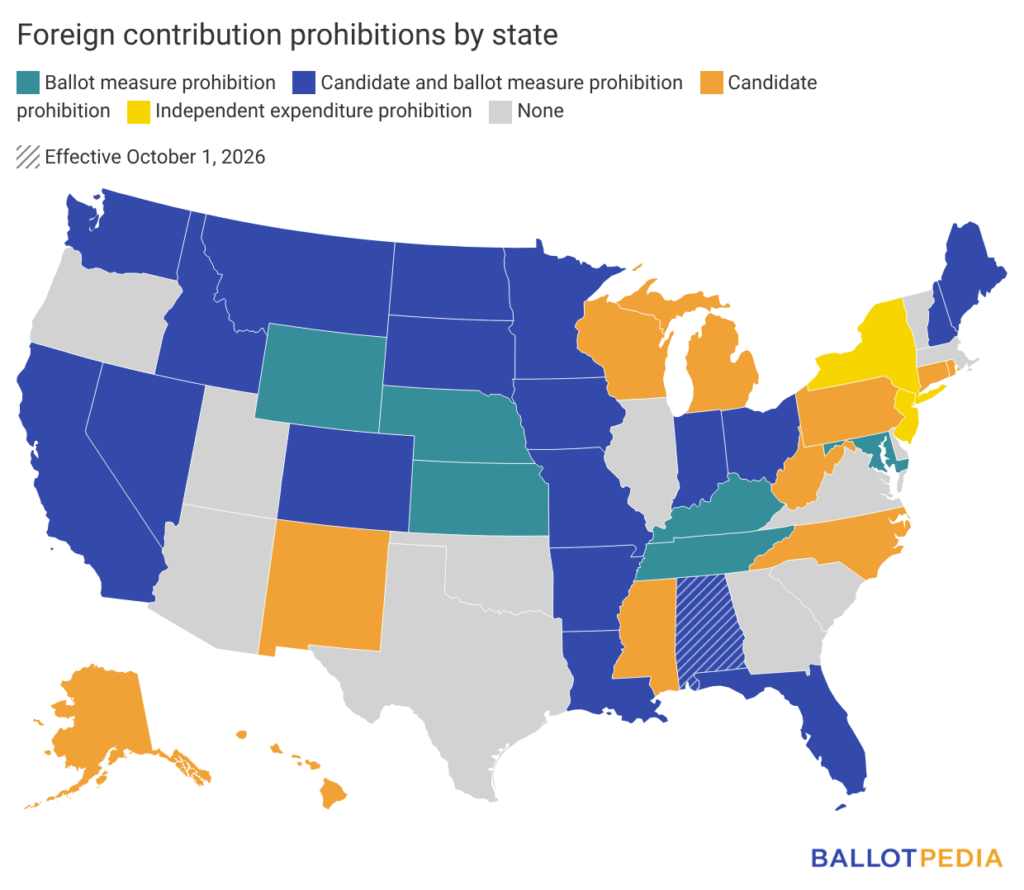
This year, Alabama, Iowa, Nebraska, and New Hampshire have enacted or expanded a prohibition on foreign national donations to ballot measure campaigns.
Additionally, on Nov. 3, Arizona voters will decide a constitutional amendment to ban foreign contributions for candidate and ballot measure elections.
Click here to read more about foreign funding in elections.