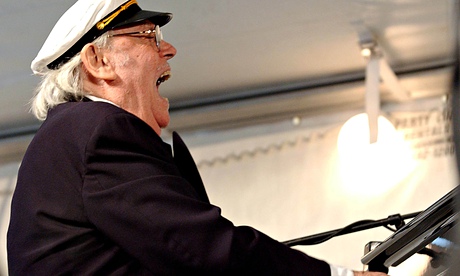
The last surviving instrumentalist to have been a member of the Louis Armstrong All-Stars, the pianist Marty Napoleon, who has died aged 93, was a popular and versatile performer blessed with an ability to fit easily into a variety of jazz genres.
His early experience was in big bands but he became more widely known once he joined the saxophonist Charlie Ventura’s stirring bebop band. In the interim, he had played with his uncle Phil Napoleon’s rather refined Dixieland band and was able to switch easily to Armstrong’s more extrovert traditional style when the call came to replace Joe Sullivan in the All-Stars in 1952. He was to rejoin Armstrong a number of times, most notably, as far as British audiences were concerned, when the great trumpeter brought the All-Stars, including Napoleon, over to Batley Variety Club in Yorkshire for a two-week engagement in June 1968.
Napoleon was born in Brooklyn, New York, to Sicilian immigrant parents. All the immediate family, including his many uncles and cousins, had some degree of musical talent and he grew up surrounded by music and musicians. His father, Marty (originally Matteo Napoli), played the banjo; his mother, Jenny (originally Giovanina Giamporcaro), played the guitar and sang; his elder brother Teddy Napoleon, also a pianist, was with the drummer Gene Krupa’s group for many years; two sisters were vocalists; and his brother, Andy, was a drummer. Marty first thought to play the trumpet, only changing to piano due to a heart ailment. Listening to Teddy practise furthered his interest and a year’s piano lessons probably helped, but he confessed that for years his reading skills were poor.
Nevertheless he turned professional aged 17 and was soon working for a local dance-band leader, Bob Astor, who used him for summer jobs. Then came a degree of prominence with Chico Marx’s rather good big band, which also provided the breakthrough gig for the young vocalist Mel Tormé. Good-looking, and happy to embrace the spotlight, Napoleon developed a flashy routine on Moonlight Cocktail which Chico seemed to like, and he stayed for a year and a half.
Thereafter, Napoleon worked his way through swing bands led by Georgie Auld, Teddy Powell and Joe Venuti, before joining Charlie Barnet’s orchestra, with whom he made his recording debut in January 1945. This was followed by brief stints with Krupa and most tellingly, Ventura’s acclaimed Big Four in 1951. It was during this period that he developed his exuberant keyboard style, albeit with a hint of Erroll Garner in the note placements.
He stayed a year or so with Armstrong the first time, touring in Europe and filming in Rome while “finding the pace pretty hard”. Recalled by Armstrong’s manager Joe Glaser, he appeared with the band in the 1953 Universal movie The Glenn Miller Story. Committed to his family, Napoleon opted then to stay close to New York and became a regular at the Metropole Cafe in the city. This celebrated location featured continuous music, one band after another, which allowed Napoleon over his 10-year association to perform and record with the greatest players of the day including trumpeter Henry “Red” Allen and star tenor-saxophonist Coleman Hawkins. He also kept busy playing “industrials”, or corporate events, and in all-star TV shows sponsored by the Timex Company in the late 1950s and for many episodes of Art Ford’s Jazz Party.
Having been content to front his own trios and to work locally for years, Napoleon was cajoled to rejoin Armstrong in 1966 following the death of the pianist Billy Kyle, and in effect stayed with the trumpeter off and on until his death in 1971. Again, there was wide-scale touring and plenty of recordings, and Napoleon always thought of himself as an Armstrong sideman even when the gigs dried up. He toured with Lionel Hampton, played for movie soundtracks and performed at the White House during Ronald Reagan’s presidency, while also playing at European festivals and at Armstrong memorial events.
In recent years, Napoleon lived in a retirement home in Glen Cove, Long Island, but emerged occasionally to play guest slots with New York swing bands, radiating bonhomie and clearly relishing the chance to play and sing. He made his final recording at the age of 90 and proudly claimed: “I have never worked at anything else except playing the piano.”
His wife, “Bebe”, the former Marie Giordano, died in 2008. Napoleon is survived by his daughter, Jeanine, and son, Marty.
• Marty Napoleon, jazz pianist and vocalist, born 2 June 1921; died 27 April 2015