The way Thursday started off, President Donald Trump seemed to be smack dab in the middle of perhaps the worst day, of his worst week, of his worst month as president. And it looked like things were only going to get worse � right up to Election Day and beyond.
The president was plunging in the polls. He was panicked because all the world knew he had failed to lead his nation to diminish the pandemic crisis as well as all other industrialized world leaders. Now he had no idea whether his rush to reopen America's schools (and the U.S. economy) would again backfire and massively create a deadly new COVID-19 wave. And Trump was stunned that the Democrats' designated presidential nominee, Joe Biden, and his vice presidential running mate Sen. Kamala Harris, just had a flawlessly fine first day on the virtual campaign trail. So Trump was doubling down on warning Americans their vote-by-mail results will be fraught with fraud. All Americans understood his real plan: He'd be ready to challenge any November result that showed he was a loser.
So who knew, on midmorning Thursday, when White House press aides came to fetch the press corps, that Trump and his ever-changing team were about to look better than ever _ amazingly able and even globally adept, at least at something.
But that's what happened. Indeed, when the White House correspondents were escorted into the Oval Office, it was as if they had stepped into a time machine.
Inside, they witnessed, live, the way things used to happen, rather often, in presidencies past. The reporters and all the world watched a dramatic announcement of a diplomatic breakthrough. And we all felt the way it sparked feelings of global optimism. It brought some of us all back to the sort of newsmaking events and environments we used to take for granted as the natural order of the way things happen. After all it was the way things happened ever since the world started calling America's presidents "Leader of the Free World." Reporters covering Trump hadn't seen anything like it for three-plus years.
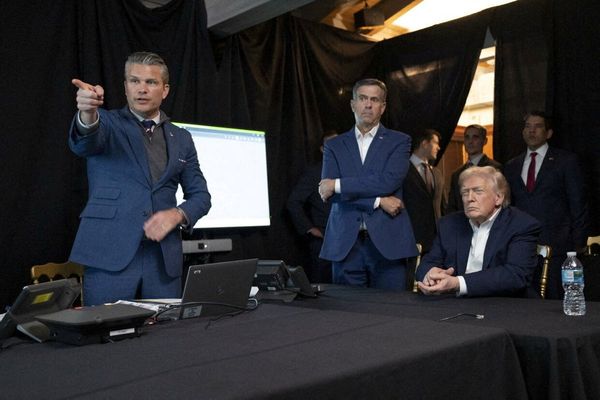
Surrounded by his team of Middle East advisers, Trump announced a genuinely historic Israeli-Arab accord. Israel and the United Arab Emirates agreed to normalize diplomatic relations _ and Israel agreed to "suspend" its planned annexation of Palestinian territory on the West Bank.
Trump read slowly and carefully the statement that was loaded with unfamiliar names and words. He called it "a significant step towards building a more peaceful, secure and prosperous Middle East." As he got more comfortable in this very different gig, Trump tried out an ad lib with his reality-TV skills to explain to you why this was historic: "UAE is big stuff. The UAE is very powerful, very strong ... It's big stuff."
But the most impressive words spoken in that Oval Office ceremony came from a most unlikely source: the usually silent adviser who spearheaded the deal. Called on by his father-in-law, Trump's influential (also often-disparaged) adviser on all things, Jared Kushner, observed:
"The president ... urged us to take an untraditional approach. You can't solve problems that have gone unsolved by doing it the same way that people before you have tried and failed. ... I would like to say to the people of the region _ Muslims, Jews, Christians _ that this does give hope that the problems of the past do not condemn you to a future with conflict."
The most optimistic part of the deal is what was left unspecified: Israel agreed only to suspend its annexation of Palestinian lands. But experts say it will be hard to unsuspend from now on. Maybe a two-state Israel and Palestine solution isn't dead after all.
Meanwhile, after a few minutes, Trump veered off his high road and reverted to his backyard bullying so he could describe his Democratic opponent as "Sleepy Joe Biden."
So the press was herded back to their briefing room. And Trump's head was back to where it had been that morning, when he'd greeted Biden's veep choice with a torrent of tweets and comments that were mean-spirited, misogynistic and down to Trump's usual low-bar standards. He called Harris "extraordinarily nasty," "the meanest" and a "mad woman."
Son Eric, ever eager to please his pop, rushed to his tweet machine and publicly "liked" someone's tweet suggesting Harris was "a whorendous pick." Get it? Someone told Eric to delete that tweet. He did.
The advice Eric followed remains sound. It is advice we all need to heed when voting for president this fall. We need to recalibrate our Oval Office Time Machine � set it forward to the lost spirit of yesteryear. We've let our presidential bar get way too low.