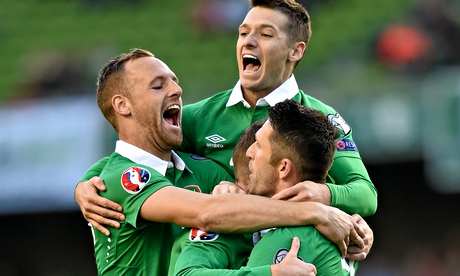
Martin O’Neill is not thanking Georgia just yet, nor kissing Scotland goodbye. He has always said that Group D is no place for pleasantries. In that, at least, the Republic of Ireland manager has been proved right. On Monday he could take a big step towards even greater vindication. But he also knows that his team could slip up again.
Ireland host Georgia in Dublin three days after Kakhaber Tskhadadze’s team did them a good turn by beating Scotland in Tblisi, a result that, coupled with Ireland’s victory over Gibraltar, dented Scottish chances of reaching the European Championship finals and gave O’Neill’s team a boost.
Ireland took just one point from two meetings with Scotland yet will go four points clear of Gordon Strachan’s side if they beat Georgia and the Scots lose to Germany at the same time. Ireland will face Germany next month and then travel to Poland, who may have already qualified by then.
There is an unmistakable sense among Irish fans of being given an unexpected second chance in the campaign, but O’Neill insists that it was wrong for anyone to give up hope in the first place, just as it would be folly to think that Georgia cannot buoy Strachan’s men by taking a point or three in Dublin. The satisfaction, says O’Neill, should be in the fact that his team, despite the criticism he and the players have endured, remain in contention among such awkward company. “It’s a tough old group we’re in,” he says. “And we’re still fighting.”
O’Neill foresees Germany pulling away after a win over Poland on Friday put the world champions top of Group D for the first time. He reckons Ireland, Scotland and the Poles will jostle for the remaining automatic qualification spot and the play-off berth but warns that practically any permutation is still possible.
“I would have thought at this minute that Germany, who are the outstanding team in the group, would win the group, so it’s a fight for everything else after that and that’s fine. You never know, Scotland could go out with renewed determination and beat Germany. Scotland are still in it, well and truly in it. They have a better head to head than us so we have to try and stay ahead. And Poland will feel that they’ll still have something up their sleeve.”
Georgia could cause another twist too. O’Neill warns they have improved since Aiden McGeady scored a last-minute winning goal when Ireland opened the campaign with a 2-1 victory in Tblisi. Georgia and Gibraltar are the only countries that Ireland have vanquished so far. Even if they gain another victory over Georgia, they will surely have to beat a country of higher standing if they are to make it to France.
It is not clear that they have the ability to do so, as they have yet to produce a single all-round impressive performance: there was a stirring rearguard action when drawing in Germany and 45 minutes of rousing attacking play in the home ties against Scotland and Poland, both of which also ended in draws. Friday night in the Algarve was patchy too, with attacking too often predictable and Gibraltar, despite their severe limitations, sporadically exposing panic in an Irish defence that still looks skittish.
Persistent defensive wobbles, frequent midfield torpor and the suspicion that the manager still regards, with justification, Robbie Keane as his sharpest striker mean there is a case for suggesting Ireland have not progressed since the start of the campaign. But with Wes Hoolahan, at 33, assuming a greater role than any previous manager gave him, and Robbie Brady emerging as a threat from left-back, O’Neill believes a decent team is taking shape. “I do, I actually do,” he says. “I think the players are playing with great determination. Listen, we make mistakes in the matches and we don’t have an abundance of incredibly creative players in the side but we are fighting. We’re fighting away and we’re doing our best. What we’re trying to do is get creative players on the ball as much as possible. We don’t possess a Gareth Bale but we can try and work out other ways to win the matches.”