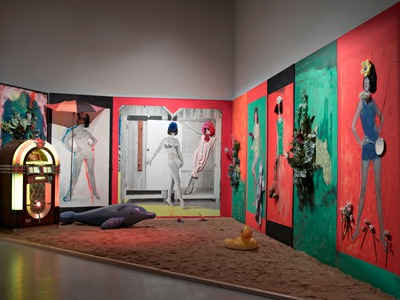
Made in Japan - La grande odalisque (1964), by Martial Raysse. Regarded as one of the major artists of the second half of the 20th century, Raysse, now aged 78, sometimes struggled for recognition in France. It is only now that the Pompidou stages a retrospective of his work.Photograph: Philippe Migeat/Centre Pompidou, MNAM-CCI/Dist.RMN-GP/Adagp, Paris 2014Raysse Beach (1962-2007), was an installation before the word existed in artistic parlance. Made with real sand, fake swimsuit adverts, a real jukebox and a dolphin rubber ring, 30 years before Jeff Koons started using inflatable toys.Photograph: Philippe Migeat/Centre Pompidou, MNAM-CCI/Dist.RMN-GP/Adagp, Paris 2014Camembert Martial extra doux (1969). Raysse's first stab at film-making in 1964 was an updated tale of Susanna and the Elders. Two years later, he produced Jesus Cola, followed by Camembert Martial in 1969 and in 1972 the prodigiously inventive Grand Départ with faded, diluted colours and a soundtrack in several languages, part of which was scrambled.Photograph: Philippe Migeat/Centre Pompidou, MNAM-CCI/Dist.RMN-GP/Adagp, Paris 2014
Le pot de fleur (1964). Raysse's work during this period used imagery from the consumer society of the 1960s, which dovetailed with the rise of Pop Art in the US. Neon, used in several pieces during this time, was described by Raysse as "the living colour, a colour beyond colour".Photograph: Adagp, Paris 2014Tableau métallique: portrait à géométrie convexe (1964). Raysse has been described as the only French nouveau réaliste for whom the term "pop" is as apt as it is for Andy Warhol and Roy Lichtenstein in the US, Sigmar Polke in Germany and David Hockney in Britain.Photograph: Philippe Migeat/Centre Pompidou, MNAM-CCI/Dist.RMN-GP/Adagp, Paris 2014Poissons d'Avril (April Fools), from 2007, brings together Lars von Trier loonies or George Romero zombies with a backdrop of flowers. It is also a throwback to Grand Départ.Photograph: Arthus Boutin/Adagp, Paris 2014Detail from Ici Plage, comme ici-bas (2012). This frieze is the 2012 version of Raysse Beach. It features a crowd of flirts, exhibitionists, fashion victims and pitiful philanderers. This is no beach, more like the first circle of hell. Martial Raysse 1960-2014 is at the Pompidou Centre, Paris, until 22 SeptemberPhotograph: arthus boutin/Adagp, Paris 2014
Sign up to read this article
Read news from 100’s of titles, curated specifically for you.