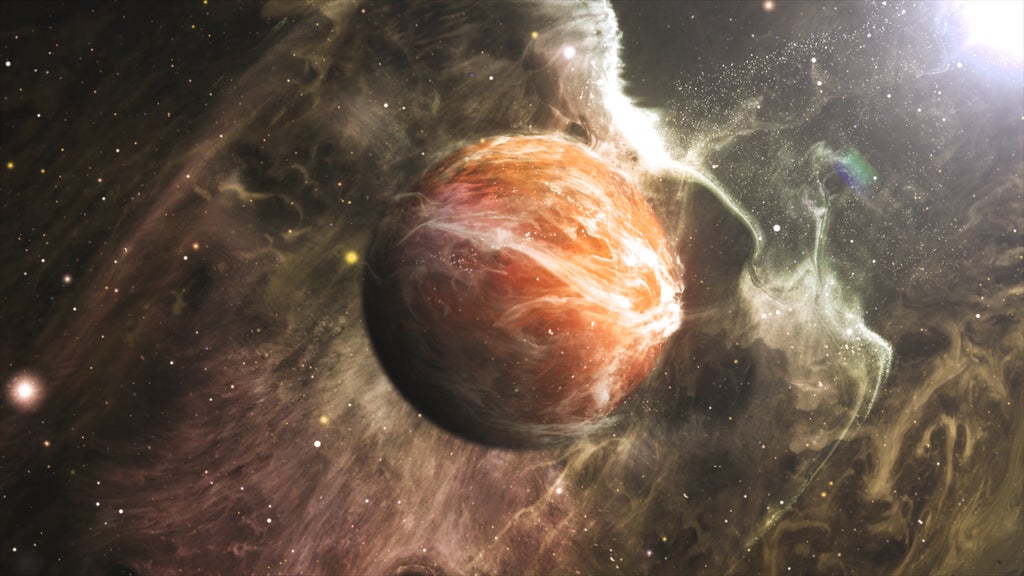
Nasa’s outgoing director Jim Green has said that Mars could be terraformed using a giant magnetic shield.
Dr Green had been the space agency’s planetary science division director for 12 years, during which he developed the ‘Confidence of Life Detection (CoLD) scale for verifying signals of potential alien life from other planets as well as publishing works on terraforming the Red Planet.
One of those ideas is blocking the Sun’s rays from Mars, which would allow it to trap more heat and make it habitable. The surface temperature on Mars is -62 degrees Celsius, with an atmosphere 100 times thinner than on Earth.
“Stop the stripping, and the pressure is going to increase. Mars is going to start terraforming itself”, Dr Green told the New York Times in an interview. A higher temperature and pressure would allow humans to start growing planets in the soil.
“The first level of terraforming is at 60 millibars, a factor of 10 from where we are now. That’s called the Armstrong limit, where your blood doesn’t boil if you walked out on the surface. If you didn’t need a spacesuit, you could have much more flexibility and mobility”, Dr Green said.
“The planetary community does not like the idea of terraforming anything. But you know. I think we can change Venus, too, with a physical shield that reflects light. We create a shield, and the whole temperature starts going down.”
This is not the first time that Dr Green has proposed the shield idea, predicting in 2017 that the technology could return “one-seventh of the ancient ocean” to Mars.
"The solar system is ours, let’s take it. That of course includes Mars and for humans to be able to explore Mars, together, with us doing science, we need a better environment," he said.
Dr Green is also optimistic about the search for alien life on other planets because, despite humans having searched for life on Mars since 1976 with the first two Viking landers, the way that scientists are now searching for life is more methodical.
“We put the Viking landers in a horrible place because we didn’t know where to put them — we were just trying to put them down on the surface of Mars. It was like putting something down in the Gobi Desert. We should have put them down in Jezero Crater, in this river delta we’re at right now with the Perseverance rover, but we didn’t even know it existed at the time”, he said.
“One of the Viking experiments indicated there was microbial life in the soils, but only one of the three instruments did, so we couldn’t say we found life. Now we’ll really, definitively know because we’re going to bring back samples. We didn’t know it would need a sample return mission.”
It is not yet known who will replace Dr Green at Nasa when he retires later this year, but he has said he will assist in the search for his replacement.