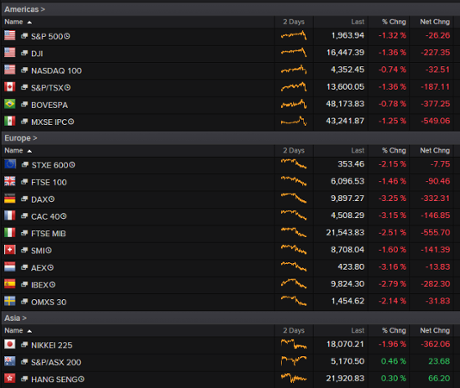
Stock markets fell sharply on both sides of the Atlantic on Friday after the US Federal Reserve backed away from raising interest rates, and blamed the weaker global economic outlook.
The German and French indices both shed over 3%, while the FTSE 100 fell by 105 points or 1.7% by mid afternoon.
Wall Street then joined the sell-off, with the Dow Jones industrial average dropping by 1.5% or 255 points to 16,418 at the open.
Investors were disconcerted by unexpectedly dovish comments by Federal Reserve chair Janet Yellen on Thursday night.
“The Federal Reserve surprised market participants by combining a decision to leave interest rates unchanged with a dovish commentary and outlook,” explained Guy Dunham of Baring Asset Management.
“Prior to the Fed decision, markets were looking positive but they now find themselves under pressure with global growth concerns weighing on sentiment,” FXTM research analyst Lukman Otunuga added.
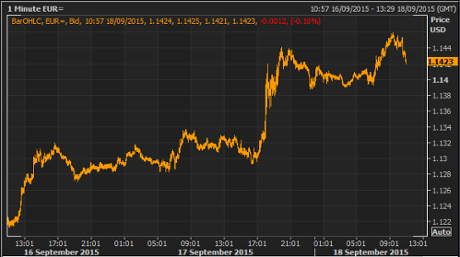
European stocks suffered as the euro strengthened one cent against the US dollar to $1.143, a move that would hurt eurozone manufacturers.
“The longer investors had to ruminate on Thursday’s Fed statement the worse they seemed to take it, with the European indices widening their losses as the day went on,” said Conner Campbell of SpreadEX.
“An export-hurting rise in the euro-dollar was the main culprit.”
The sell-off came after the Federal Open Market Committee voted to leave borrowing costs at their current record low of zero to 0.25%. At a later press conference, Yellen cited volatility triggered by the slowing Chinese economy as a reason for caution.
“The outlook abroad appears to have become less certain,” Yellen said. “In the light of the heightened uncertainty abroad ... the committee judged it appropriate to wait.”
That helped to drive the US dollar down by 0.2% against major currencies.
In Japan, the Nikkei index fell 2% as the yen strengthened against the dollar.
Money also flowed into German government debt, a classic safe haven, driving down the yield on bunds.
Big moves in European #bond yields following US...German debt rallying, yield dropping 9bps on 10yer pic.twitter.com/St3WcgBPjJ
— Caroline Hyde (@CarolineHydeTV) September 18, 2015
Some economists had predicted that Thursday’s FOMC meeting would deliver the first rate hike in almost a decade, given recent improvements in the US labour market.
But after Yellen’s unexpectedly dovish performance, the Fed is unlikely to raise rates at its next meeting in October.
And there’s now roughly a 50% chance that the first hike comes in 2016, according to M&G’s Bond Vigilantes.
Implied probabilities of a Fed rate hike following yesterday’s meeting pic.twitter.com/dNsqvdk1dN
— Bond Vigilantes (@bondvigilantes) September 18, 2015
Risk aversion pushed the gold price up, meaning shares in gold producers bucked the trend on Friday.
Market reaction to the Fed’s decision was split. Marc Ostwald, of ADM Investor Services, accused Yellen of “ injecting further unwanted uncertainty” into the markets.
If the FOMC’s objective was to convey confusion, it has succeeded, thereby ploughing a deep furrow of instability and destabilisation, and shining a very bright light on the large debt and liquidity trap it and other G7 central banks have spent seven years crafting.
But Anne Richards, chief investment officer at Aberdeen Asset Management, believes the Fed made the right call.
“Right now, there is not a compelling reason to raise interest rates in the US,” she told Bloomberg TV.
There is a risk that by hiking too soon, the Fed “could make 2016 much uglier from an economic perspective”, Richards added.