Here’s our updated report on the US jobs data, by Jana Kasperkevic in New York and Phillip Inman:
A slump in world trade and a slowdown in China took their toll on the US economy last month as surveys revealed that firms delayed hiring and factory orders contracted.
US businesses created only 142,000 jobs in September, according to official figures, about 64,000 fewer than expected by analysts. The report by the US Labor department also found that employers kept average pay rises at zero and thousands of workers quit the labour market, taking the participation rate back to levels last seen in the 1970s.
The much anticipated data was widely seen as ending any expectations of an interest rate rise by the US Federal Reserve before Christmas.
The lack of any pressure on wages is likely to be the biggest factor persuading Fed officials against a rise from the current rate of near zero, which was anticipated last month until it became obvious that the slowing Chinese economy and the panic it caused on global markets formed a powerful case against a rate rise.
Separate surveys added to the gloomy picture, showing that US factory orders fell 1.7% in August, compared with expectations of a 1.3% decline, and business activity in New York contracted for the first time in eight months in September.
The Dow Jones fell more than 200 points on the news, only to recover to a 27 point loss by 1700 BST. The FTSE 100 shrugged off the news as investors welcomed the prospect of ultra low interest rates until at least next year. the index of Britain’s top 100 companies closed up nearly 1% at 6,129 points.
On that note, it’s time to close up for the evening. Thanks for all your comments, and we’ll be back next week.
I think the market response to the jobs report is: Weak report makes 2015 hike less likely, but on further inspection, firming trend remains
— Joseph Weisenthal (@TheStalwart) October 2, 2015
10-year yield rebounding faster than the 2-year yield. pic.twitter.com/yVJwWiepri
— Joseph Weisenthal (@TheStalwart) October 2, 2015
Updated
Markets recover some ground after US jobs shock
It was a rollercoaster day for investors, with early market gains wiped out after the worse than expected US non-farm payroll numbers, but an attempted recovery by the time European markets closed.
Traders said that, after the initial jobs report suggested the US economy was much weaker than feared, there was a revival of sorts on the basis that the Federal Reserve was now unlikely to raise interest rates this year. The final scores showed:
- The FTSE 100 finished 57.51 points or 0.95% higher at 6129.98 having climbed as high as 6176 and fallen as low as 6051
- Germany’s Dax added 0.46% to 9553.07
- France’s Cac closed 0.73% better at 4458.88
- Italy’s FTSE MIB rose 1.19% to 21,395.29
- In Greece, the Athens market slipped 0.27% to 640.99
On Wall Street the Dow Jones Industrial Average - which lost nearly 260 points after the jobs data - is now down just 29 points or 0.18%.
Markets have recovered some of the immediate losses after the US jobs data:
Some of the post-NFP moves are fading slightly, with US stocks recovering, #EURUSD fading back below 1.13 and #USDJPY back up to 119.30 ^MW
— FOREX.com (@FOREXcom) October 2, 2015
Good news for Spain. Standard & Poor’s has raised the country’s sovereign credit rating from BBB to BBB+ with a stable outlook.
It said it now projected Spain’s nominal GDP to grow at about 4% over the next few years and said a broad based economic recovery and budgetary consolidation should balance the risks from its large net external debt.
But it warned that Spain’s creditworthiness would weaken if Catalonia were no longer part of the country. Over the weekend separatists took control of Catalonia’s regional government.
Over to the Greek situation for a moment, and ahead of a Eurogroup meeting on Monday, junior ministers have been working on the list of bailout measures Greece must take in return for its next loan payment:
#Eurogroup Working Group: #Greece asked to complete 48 milestones by mid-October in order to comply with bailout conditions ~BBG
— Yannis Koutsomitis (@YanniKouts) October 2, 2015
Markets would benefit from the Fed getting a rate rise out of the way, says Julian Jessop at Capital Economics:
The disappointing US jobs report for September will clearly do little to improve investor confidence in the global economy. Yes, it will probably delay the first interest rate hike from the Fed until early next year. However, our view remains that the prices of equities, other emerging market assets and industrial commodities would benefit more from the lifting of uncertainty once lift-off does finally take place. In the meantime, the few winners include safe-haven bonds – and gold.
On Wall Street the Dow Jones Industrial Average is off its lows but still down more than 1% on the day so far.

It never rains, it pours... I can't find any silver lining in this US data
— Michael Hewson (@mhewson_CMC) October 2, 2015
#US factory orders -1.7% on month in Aug. #US economic picture has been hammered this afternoon. #Fed Dec hike probability down to 28% (bbg)
— Ipek Ozkardeskaya (@IpekOzkardeskay) October 2, 2015
Updated
US factory orders fall
And those US factory orders have also disappointed.
New orders fell 1.7% in August, compared to expectations of a 1.3% decline. July’s rise of 0.4% has also been revised downwards to an increase of 0.2%.
Updated
More disappointing economic news from the US.
Business activity in New York contracted for the first time in eight months in September, with the Institute for Supply Management’s index falling from 51.1 in August to 44.5.
NY ISM, joins Empire Fed, Philly Fed, Richmond, etccc Do you really want to see Factory Orders in 15 mins? https://t.co/qsHFzfncwZ
— Ashraf Laidi (@alaidi) October 2, 2015
A weak US economy - as evidenced by the weak job numbers - will also hit emerging market exporters. Sanjiv Shah at emerging markets specialist Sun Global Investments said:
The weaker than expected NFP data today suggests that the US Economy, which is the largest export market for many EM countries, is slowing down much more than was previously expected.
These numbers probably rule out a Fed interest rate increase for the rest of 2015 and, indeed, we worry that the Fed’s decision not to raise interest rates earlier this month was a missed opportunity.
It is without doubt that a weak US economy will negatively affect EM exporters but we expect lower bond yields to help EM bonds and EM equities.
If a rate rise in October is pretty much off the table, some analysts do believe a move higher in December is still possible. Dr Harm Bandholz, chief US economist at UniCredit Research said:
Today’s employment report has most likely removed even the last small chance for a rate hike as early as this month.
But we continue to expect the first move at the mid-December meeting. Various Federal Reserve Open Market Committee members have over the past couple of weeks verbally teed up for a rate hike this year. The latest being Boston Fed President Eric Rosengren, who said in a TV interview this morning (admittedly before the employment report) that “raising rates in 2015 is a ‘reasonable forecast’”. What makes his statement so important is that he is one of the more dovish FOMC members.
Yesterday, San Francisco Fed President John Williams (centrist FOMC member and a voter this year) said that the decision to not raise rates in September was “a very close call”, which means that “it doesn’t take a lot of information to tip the balance.” Mr. Williams added that job gains of “above 100,000 or 150,000 would be good to me”, as the slower pace of job gains was “just a sign that the labor market was closer to being completely healed.”
Along the same lines Chair Yellen acknowledged last week that “the labor market has achieved considerable progress over the past several years.” In other words: The Fed is very pleased with the development of the labor market, and we doubt that two weaker months will alter this assessment. Before the December FOMC meeting we will be getting two more employment reports. In addition to possible upward revisions to the past numbers, they will likely show again faster job gains and an unemployment rate of 5.0% - or less. That, in turn would be good enough for the Fed to finally pull the trigger.
Summary
If you’re just tuning in, here’s Jana Kasperkevic’s early take on the disappointing Jobs Report
Our rolling coverage with full details and reaction starts here.
Wall Street falls in early trading
Wall Street has opened sharply lower after the much weaker than expected US jobs figures, which have cast new doubts on the strength of the US economy.
The Dow Jones Industrial Average is currently down 214 points or 1.3% while the S&P 500 has fallen 1%. Nasdaq has fallen 1.2%.
Updated
An early contender for sarcastic tweet of the day:
See, now if we had raised rates a week ago we could be cutting them today
— Urban Carmel (@ukarlewitz) October 2, 2015
The Federal Reserve simply cannot raise interest rates this month, says Marvin Loh of Bank of New York Mellon:
While recent Fed speakers have put on a brave face in saying that October is a live meeting, we don’t see how that is possible after this repot and the likely volatility that it will generate.
So, December? Perhaps not, as Washington politicians could be wrangling over a possible government shutdown in three months time.
Loh adds:
The debt ceiling is also in play, and it will now influence both the October and December FOMC meetings. We maintain our March, 2016 first hike view.
The non-farm payroll report could be the worst since the one which preceeded the second round of US quantitative easing, says Christopher Vecchio, currency analyst at DailyFX:
It might be time to put a pin in hopes for the Federal Reserve to raise rates in 2015. With the US labor market having been the sole pillar of fundamental strength supporting the US dollar over the last year, the strongest talking point for a rate hike just took a significant hit. The September US labor market report was disappointing all around, arguably the worst report in recent memory – the worst perhaps since the May 2012 report that paved the way for QE2.
The US economy endured the second consecutive month of jobs growth below 200,000, all but erasing the potential for a Fed rate hike this year. Earlier this week, there was over a 42% chance of a rate hike in December, per the Fed funds futures contracts. After the report today, that probability dipped to 30% (and falling).
It’s always important not to over-react to one single data release, but Paul Ashworth, chief US economist at Capital Economics, is making an exception this time.
The chances of a rate hike by the Fed this year just went way down.
He reckons that the US economy is still in fairish shape, with unemployment claims down and consumer spending up.
Accordingly, we wouldn’t be surprised if the economy had a stronger fourth quarter. But that isn’t going to show up in the published data for another few months, which means the Fed won’t be raising rates until early 2016.
Even the most bearish (realistic?) of the 104 economists in @ReutersPolls wasn't bearish enough on payrolls. EAA predicted 154k.
— Jamie McGeever (@ReutersJamie) October 2, 2015
Something is heading higher after the jobs data - precious metals.
#Gold spikes on US jobs data. pic.twitter.com/QbavohLmRL
— Holger Zschaepitz (@Schuldensuehner) October 2, 2015
#Silver relief.... pic.twitter.com/VizLG02iob
— Mark Barton (@markbartontv) October 2, 2015
Today’s jobs report has created a lot of angst in the financial world; the FT’s Katie Martin is rounding it up:
BBH: "Simply dreadful US jobs report"
— Katie Martin (@katie_martin_fx) October 2, 2015
DB Ruskin: "too early to bury Dec tightening hopes completely. Nonetheless, 2 weak reports starts to show lost growth momentum"
— Katie Martin (@katie_martin_fx) October 2, 2015
Updated
Dennis de Jong, managing director at UFX.com, says the Fed would still like to raise borrowing costs.
However today’s data, and the state of the global economy, doesn’t justify it.
“The US economy seems fairly resilient but, with employment data particularly disappointing for a second month running, enthusiasm for a rate hike in the short term will surely be tempered.
“The Federal Reserve don’t want to sit on their hands for too much longer, yet with significant global issues continuing to affect the US economy, now would not be the wisest time to press the button.
“We’re surely not too far away from a first hike in seven years, although both US and global economic data will have to improve if it’s to happen before the end of the year.”
Updated
Market expectations on chances of a December #Fed rate hike just tanked. It was 42% an hour ago, now 30% pic.twitter.com/MqsYu9Bq4B
— Trista Kelley (@trista_kelley) October 2, 2015
This is a “uniformly dreadful” report, says Rob Carnell of ING, with just 142,000 new jobs being created across the American economy.
He agrees that it will prevent the Fed raising rates this month, and possibly not until 2016.
The other disappointment in the data was from hourly wages growth, which only needed to show a 0.2% month-on-month increase to take its annualized growth rate into new territory. But instead, it was unchanged, and the annual rate remains stuck at 2.2% YoY. Not enough to get the Fed doves vote for a hike, at least not yet......
For once, these labour market numbers gave an unambiguous result. The problem is that it was unambiguously negative. No rate hike this month then it seems. But it raises doubts too about the probability of a December hike, unless the Fed changes the basis upon which it decided policy rates.
A US rate rise must be off the agenda until next year after 0% pay growth in non-farm payroll figures @BusinessDesk @guardian
— Phillip Inman (@phillipinman) October 2, 2015
More on when the US may raise rates, in the wake of these latest jobs figures:
#Fed futures pricing in the following probabilities: Oct 10% (16% pre NFP) Dec 30% (45% pre NFP) Jan 37% (52% pre NFP) Mar 50% (66% pre NFP)
— RANsquawk (@RANsquawk) October 2, 2015
The full non-farms report can be found at the Bureau of Labor Statistics website.
Instant reaction: It's bad....
Economists are united -- this is a grim jobs report, showing the US economy is in worse shape than hoped.
It also vindicates the Federal Reserve’s decision to not raise interest rates last month.
And wow, wages: Average hourly earnings actually fell a penny last month. We've hit 5.1% unemployment, and there's no sign of wage growth.
— Justin Wolfers (@JustinWolfers) October 2, 2015
"I told you so." --Janet Yellen over her morning coffee. #NFP
— Bill Griffeth (@BillGriffeth) October 2, 2015
Payrolls in a word: ouch.
— James Mackintosh (@jmackin2) October 2, 2015
But a weak US labor market is not good news, and traders are reacting accordingly:
For now, bad news = bad news. S&P futures take a dive. pic.twitter.com/fvPr1ki1u6
— Jonathan Ferro (@FerroTV) October 2, 2015
Bad news officially no longer good news, judging by FTSE reaction to disappointing US jobs data. Many just want hike over and done with.
— Dan Jones (@DW_Jones) October 2, 2015
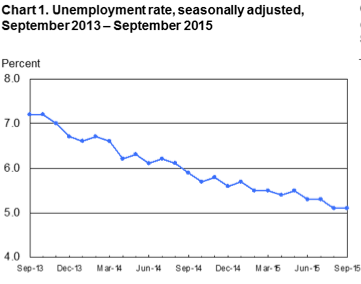
And here’s the unemployment rate:
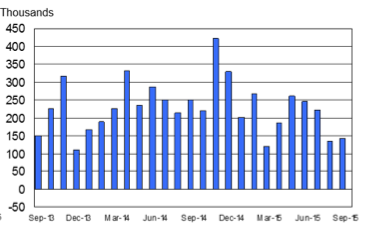
Here are the changes in non-farm payrolls since September 2013:
And so much for a rate rise this year:
JUST IN: Fed funds futures now pricing first rate in March 2016 after weak jobs data » http://t.co/jJ1WCEJoVt
— CNBC Now (@CNBCnow) October 2, 2015
More Americans quit the labor force
More gloom - the US labor force participation rate has fallen to just 62.4%, down from 62.6 in August.
That’s the lowest since the mid-1970s, showing that more Americans are simply dropping out of the labor market.
stunning: factor in whatever and just stunning here is labor partic back to 1977 pic.twitter.com/rbaoOqp2po
— tom keene (@tomkeene) October 2, 2015
The wage data is bad too -- average hourly earnings were unchanged month-on-month.
Economists had expected that wages grew 0.2% last month.
Updated
US bond yields are also on the way down:
There she goes. US 10-year yield back below 2% #NFP pic.twitter.com/2am8BOumJs
— Jonathan Ferro (@FerroTV) October 2, 2015
Dollar and markets fall
The much weaker than expected US jobs data has sent the dollar falling, on the basis that a US interest rate rise this year - already in some doubt - was now less likely.
Against the pound, the US currency has fallen from $1.5162 before the data to $1.5200.
Stock markets have moved lower, since the jobs numbers show the US economy is nowhere near as strong as expected.
The FTSE 100, up 94 points ahead of the release, is now up 50 points, while US futures are now down 0.7%.
The US unemployment rate is unchanged at 5.1%, dashing hopes that it might have dipped again to 5%.
US JOBS REPORT MISSES FORECASTS
Here we go!
Just 142,000 new jobs were created in America last month. That is a big miss - much way less than the 201,000 that economists had expected.
And August’s reading has been revised DOWN - to 135,000, from the original 173,000 polled last month.
At first glance, it’s a poor show.
Lots more to follow....
Updated
You can almost taste the tension, even though today’s NFP report is a little less exciting than usual.
— Joseph Weisenthal (@TheStalwart) October 2, 2015
Updated
Heads up: September US NFPs due in <10-mins: +201K expected from +173K. Note: past 5 years, August has had avg revision higher of +79K.
— Christopher Vecchio (@CVecchioFX) October 2, 2015
Also due out: September US Unemployment Rate due at 5.1% unch, and wages due up +0.2% m/m and +2.4% y/y.
— Christopher Vecchio (@CVecchioFX) October 2, 2015
Non-Farm Payroll: What to watch for
There are five key things to watch out for when the Jobs Report lands in 15 minutes time.
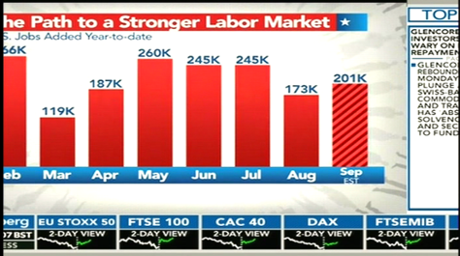
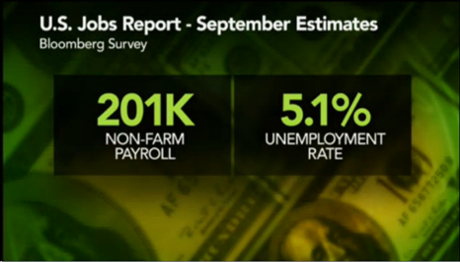
1) Was September a good month for job creation? The consensus is that 201,000 new jobs were created last month. That’s close to this year’s average of 218,000. Anything north of that would be a good sign.
2) Could the jobless rate fall again? Last month it dipped to 5.1%, which is pretty much ‘full employment’ in the Federal Reserve’s book. Another fall to 5.0% can’t be ruled out.
3) Any progress on wages? Average earnings growth has been stubbornly weak in the financial crisis, helping to keep inflation pegged.
4) Was August really so bad? A month ago, the NFP rose by just 173,000, but August’s data is typically revised higher.
5) The nitty-gritty. Economists will be looking at the under-employment rate, showing how many Americans wanted to work longer hours, and the labour force participation rate, which measures people who drop out of the market altogether.
Updated
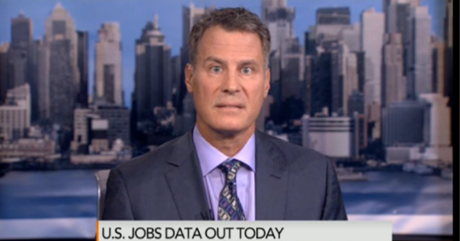
Krueger: US labor market is polarised
Alan Krueger, Professor of Economics at Princeton University, is concerned that the benefits of the US jobs recovery aren’t being shared fairly.
Krueger, who used to chair Barack Obama’s Council of Economic Advisers, told Bloomberg TV’s Tom Keene that:
We’re continuing to see polarisation of the work force. Job growth at the bottom and the top, but not so much in the middle.
What we need in the near term is a stronger economy overall to help lift wagers. In the longer term we need more of a rebalance in favour of workers.
You can see the interview here.
Updated
A month ago, there was genuine excitement ahead of the Non-Farm Payroll because there was a good chance that the Federal Reserve would raise interest rates at September’s meeting (they didn’t).
Today’s report does not have the same drama, as the Fed isn’t likely to hike before December. But still, it will show how America’s labour market is faring this autumn.
Bloomberg’s Joe Weisenthal reckons a decisively strong US unemployment report would be welcomed by investors, even if it means interest rates are likely to rise in December.
What would be the best NFP result for stocks? I think strong across the board would be the most bullish. A number that screams December.
— Joseph Weisenthal (@TheStalwart) October 2, 2015
Basically, a number that eliminates economic and Fed confusion in one fell swoop.
— Joseph Weisenthal (@TheStalwart) October 2, 2015
Updated
One hour until Non-Farm Payroll, and markets are up
Investors are ending the week in positive mood as they anticipate the final data release of the week, the US jobs report.
In London the FTSE 100 is up 100 points, or 1.7%, at 6172 points. Banking shares are still rallying, after the Financial Conduct Authority proposed a deadline for PPI compensation claims.
That was fast. No sooner does the City watchdog suggest the end of PPI payouts than I get two calls in one morning. Ugh.
— Alex Lawson (@MrAlexLawson) October 2, 2015
Over in Paris, the France’s CAC has gained almost 2%.
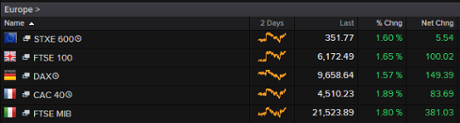
And the Dow Jones is is expected to gain around 0.5%, or 80 points, when Wall Street opens.
The Non-Farm Payroll could potentially drive shares even higher, if it calms fears about the world economy.
Jasper Lawler of CMC Markets explains:
At the moment it seems that fears over global growth are outweighing concerns about a US rate-hike.
A jobs number that beats expectations and gives the Fed ammunition to signal its confidence in the US and even global economy by hiking interest rates this year, may well trigger a rally in equities.
Ilya Spivak, currency strategist at DailyFX, predicts the dollar could spike if America’s labour market is stronger than expected:
“The implications of an upbeat outcome for the US Dollar seem relatively straight-forward. If traders walk away from the jobs report thinking a Fed rate hike seems more likely than previously, the currency will probably strengthen.
Such a result may likewise help calm global slowdown fears and boost risk appetite, which ought to translate into outsized losses for funding currencies like the Euro and the Japanese Yen.
A weaker euro would not upset the European Central Bank, as it is good for exports and inflationary pressure.
Paypal sounds alarm over Dublin housing

Paypal is warning that foreign direct investment into Ireland is in danger if rents continue to soar in Dublin.
Our correspondent Henry McDonald reports:
Louise Phelan, Paypal’s boss of Irish operation, says she is paying €2,000 in hotel bills to every new employee coming to work in the Republic’s capital.
Speaking to the Irish Construction Industry Federation in Dublin today, Phelan says she is resorting to appealing to Paypal staff already in Ireland to offer rooms to new workers arriving there.
She warned:
“It’s crisis time for us and for bringing in foreign direct investment overall,”
The likes of Paypal and other mainly US multi-nationals has created tens of thousands of jobs over the last 40 years.But economists have warned that the recent spike in rents especially in Dublin could put off future global corporations setting up their European HQs in Ireland.
A recent survey found that in 80% of the Republic it is now cheaper to pay a mortgage than rent to a landlord.
Updated
Meanwhile in Greece, anti-terror police say they have unearthed detailed plans of kidnappings of prominent figures in what many fear may well be the next stage of the country’s economic crisis.
Helena Smith, our correspondent, reports from Athens.
As Greece slips ever deeper into recession – the side effect of implementing fiscal consolidation reforms that have come as the price of being bailed out for a third time – fears of heightened criminality are also mounting. After a soar in break-ins (with the sale of safe deposit boxes skyrocketing during fraught negotiations with creditors over the latest loan deal), counter-terrorism officials now say they have discovered the makings of a plot that would have involved abductions at the highest echelons of society.
A notebook listing suspected targets for kidnapping – and naming at least 25 leading businessmen, ship-owners and their families – was discovered alongside a heavy weapons cache in a building in Marathon, eastern Attica earlier this week. Authorities are believed to have been led to the building, described as a storeroom, after a tip off.
Although police have not released the names of the individuals, they say they have been left in no doubt that plans were afoot to kidnap them in the coming months. The notebook, which is currently being examined, also contained in-depth details of abduction plans.
Almost six years into its worst economic crisis in modern times, Greece has become increasingly divided between rich and poor with fears of kidnappings being openly aired among the more affluent members of society.
Notebook found at terror cache had list of abduction targets http://t.co/e94nXLsLSv pic.twitter.com/4LZwQg8NrF
— Kathimerini English (@ekathimerini) October 2, 2015
Updated
Over in Portugal, they’re gearing up for a general election. And, despite the country’s deep austerity programme, the current government could well squeak back into power.
Our own Angelique Chrisafis reports:
Portugal could make history by becoming the first eurozone bailout country to re-elect a government that imposed harsh and unpopular austerity measures when it votes this weekend.
Final polls suggest the centre-right ruling coalition is on course to win Sunday’s general election after a close-run campaign, although it appears likely to lose its absolute parliamentary majority.
The incumbent prime minister, Pedro Passos Coelho, who implemented severe austerity measures, including cutting pay and pensions, slashing public services and introducing the largest tax hikes in living memory, argued on the campaign trail that he was the only one to be trusted to protect the fragile economy as it emerges from years of recession.
“If we stay on the path we’ve been following, we won’t need any more bailouts,” he said, as his Social Democratic party ran on a joint ticket with its coalition partner, the smaller, conservative Popular party.
Here’s her full story:
Shinichiro Kadota, FX strategist at Barclays in Tokyo, believes today’s Non-Farm Payroll report would need to be remarkably good, or bad, to shake the Federal Reserve.
Kadota said (via Reuters)
“Fed chair Janet Yellen has already mentioned that labour conditions are improving and hinted that developments overseas, notably in China, and prices were chief concerns.
“A very bullish report would of course have a big impact. But the Fed may not make its rates decision on employment data alone.”
As covered in the introduction, economists expect around 200,000 new jobs were created in September; August’s 173,000 reading could also be revised higher.
US NFP's for SEP out at 10;30PM AEST with market expectations at +201k after +173K in AUG. #NFPguesses +206k. pic.twitter.com/yuFsGZhHWT
— James Foster (@JFosterFM) October 2, 2015
Updated
Concerns that Europe is heading back into deflation have been heightened by new data, showing that prices charged by eurozone producers fell in August:
Euro area producer prices -0.8% in Aug 15 over July 15, -2.6% over Aug 14 #Eurostat http://t.co/TfZfnbh44B pic.twitter.com/NFr6EmcqXF
— EU_Eurostat (@EU_Eurostat) October 2, 2015
Here’s our take on the latest developments in the emissions scandal, including reports that BMW, Chrysler, General Motors, Land Rover and Mercedes-Benz are all being investigated by US officials:
Updated
VW investigated over "aggravated deception" in France
Another front has opened up in the Volkswagen diesel emissions scandal, with French prosecutors probing the carmaker for potential “aggravated deception”.
Reuters has the story:
The Paris Prosecutor has opened an inquiry into suspected “aggravated deception” by Volkswagen, an official from the Prosecutor’s office told Reuters on Friday.
The move adds to the legal burden the German carmaker faces after U.S. investigators found that it had rigged vehicle pollution emissions tests.
Paris prosecutor's office opens inquiry into VW for suspected aggravated deception, Reuters and L'Express report http://t.co/rW7qoakDQ5
— Julia Kollewe (@JuliaKollewe) October 2, 2015
UK construction growth hits 7-month high
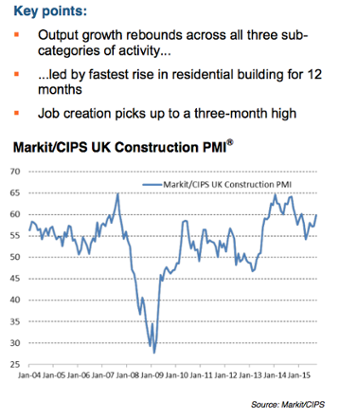
Britain’s construction sector grew at its fastest pace in seven months in September, driven by housebuilding.
Markit’s construction PMI, which measures activity across the sector, jumped to 59.9 from 57.3 in August (any reading over 50 shows growth).
Builders reported greater workloads, and are more upbeat about the business outlook too.
Markit says:
House building remained the best performing broad category of construction activity in September.
The latest expansion of residential building was the strongest for 12 months which some survey respondents attributed to the launch of development projects that had been delayed earlier in 2015.
Apple’s latest smartphone has helped drive sales up 6.9% at John Lewis, a handy barometer of UK consumer confidence.
New iPhones help John Lewis ring up sales rise, strong week at dept store bodes well for September UK retail sales http://t.co/F6prx1HEAV
— Julia Kollewe (@JuliaKollewe) October 2, 2015
A third Glencore director has given the mining and commodities company a vote of confidence, by buying more shares.
William Macaulay spent more than £1.5m buying 1.7 million shares in Glencore at 90p yesterday, as the shares rebounded from their record plunge on Monday.
He follows chairman Tony Hayward, who bought 100,000 shares, and fellow director John Mack who snaffled 550,000 at just 80p.
Spanish jobless total creeps up as tourists depart

With the tourist season over, the Spanish unemployment total is rising again.
The number of people out of work across Spain rose by 26,087 in September, the Labour Ministry reported, a rise of 0.64%.
That pushes Spain’s jobless total to 4,094,042 million unemployed people. That’s 353,608 fewer than in September 2014, and the lowest since the eurozone debt crisis began:
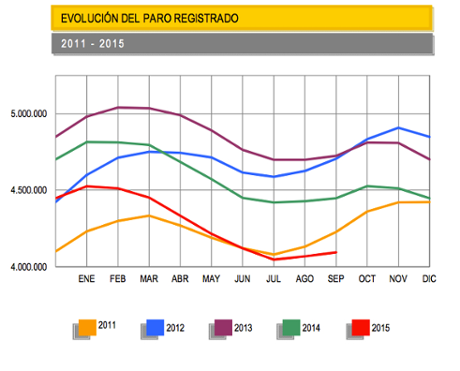
And on a seasonally adjusted basis, Spanish unemployment in September fell by 9,746 people.
2015 has been a bumper year for Spanish tourism, with visitor numbers up 4.2% to a new record high of 29.2m.
Updated
Reminder of a typical NFP day - boring, boring, boring, boring, eye twitches, GREAT TERROR, REVERSAL, boring, boring, pub, pub, pub, pub
— World First (@World_First) October 2, 2015
Here’s confirmation that some traders are losing their enthusiasm for the Non-Farm Payroll circus:
Fantastic jobs number, upward revisions to August won't matter cos the Fed is never hiking #NFPGuesses
— Nicola Duke (@NicTrades) October 2, 2015
Shares in Experian have fallen by 4.5% this morning after the consumer credit monitoring firm announced it had been hacked.
The data breach risks exposing personal data of 15 million T-Mobile consumers, including names, addresses, and social security, driver’s license and passport numbers.
More here:
Updated
The end may finally be in sight for Britain’s long-running payments protection insurance saga.
The City regulator has announced plans to force consumers to file compensation claims by the spring of 2018, if they believe they were wrongly sold insurance on financial product.
My colleague Jill Treanor explains:
The regulator had faced pressure from the industry to set a deadline for customers making claims for the insurance sold alongside loans as the bill has already reached more than £25bn in compensation and administration costs.
Over £20bn redress has been paid to over 10 million consumers so far, the FCA said.
Bank shares have jumped by around 2.5% this morning, on relief that compensation payments might finally be capped.
Hopefully it will mean an end to irritating PPI phone calls too – just in time for Volkswagen compensation claims instead....
Updated
European markets rally at the open
European stock markets have jumped over 1% in early trading, ahead of the US jobs report this afternoon:
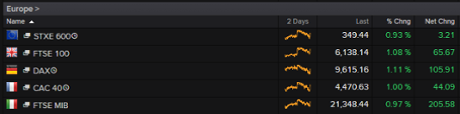
After recent losses, traders will be hoping for a solid but unspectacular NFP reading. However, a strong or weak number could cause some alarm:
Tony Cross of Trustnet Direct explains:
This number risks either scaring investors off with fears that the US economy is plateauing, or will reaffirm the view that the Federal Reserve needs to hike rates soon to prevent overheating – if there is a Goldilocks zone here, it’s likely to be rather narrow.
Introduction: US jobs report on the way
Good morning, and welcome to our rolling coverage of the world economy, the financial markets, the eurozone and business.
There’s a running joke in financial circles that every US jobs report is the most important ever. That might be a slight exaggeration this month, but today’s Non-Farm Payroll report still has the power to shift the markets
The September Non-Farm Payroll, due at 1.30pm BST, will show how many new jobs were created in America last month. It’ll also show whether workers benefitted from the recovery with higher wages.
Economists predict that just over 200,000 new jobs were created last month, up from a disappointing 173,000 last month.
The market expects the US to have created 201,000 non-farm jobs in September, up from a poor 173,000 in August. #NFPGuesses
— SCOFIELD!!! (@Scofield_Fx) October 2, 2015
That would put more pressure on the Federal Reserve to take the plunge and raise borrowing costs before the end of 2015....
.... except it’s not quite that simple any more. The Fed is also worried about the state of the global economy, and the impact of China’s slowdown on the financial system.
Chris Weston of IG says traders are getting “a bit exhausted” about the steady stream of allegedly “game-changing” data releases, especially when none of them actually prompt a change of policy.
He also reckons the earning data should be interesting:
The single most influential issue that should jump out immediately is that forecasters are expecting wages to grow 2.4% (range 2% to 2.5%). This would effectively be the strongest pace of wage growth since late 2009 and should increase the implied probability of a December hike closer, if not above 50%.
There’s not much else on the calendar today, alas, apart from UK construction data at 9.30am BST, and new Spanish unemployment data....
And in the eurozone, junior ministers should be working on the list of bailout measures Greece must take in return for its next loan payment, ahead of a full eurogroup meeting on Monday.
#Eurogroup Working Group meeting today in Brussels to specify timetable of prior actions and tranches for #Greece.
— Yannis Koutsomitis (@YanniKouts) October 2, 2015
Updated