European markets end mixed ahead of Fed decision
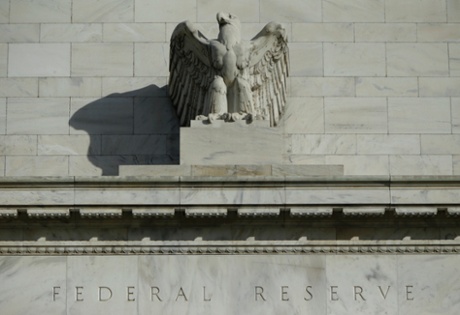
As investors waited for the US Federal Reserve to end its monthly bond buying programme, the mood remained cautious. A small decline on Wall Street as Europe closed took some of the earlier shine off, and disappointing news from Total and Sanofi soured the mood a little. The final scores showed:
- The FTSE 100 finished up 51.70 points or 0.81% higher at 6453.87
- Germany’s Dax was up 0.16% at 9082.81
- France’s Cac closed 0.05% lower at 4110.64
- Italy’s FTSE MIB lost 1.64% to 19,157.41
- Spain’s Ibex ended down 1.41% at 10,247.8
On Wall Street the Dow Jones Industrial Average is currently 20.56 points or 0.12% lower.
On that note, it’s time to close up the blog for the evening. Thank’s for all your comments, and we’ll be back tomorrow.
The US central banker who popularised the term “irrational exhuberence” is forecasting the end of QE will cause market turmoil. According to Bloomberg:
Former Federal Reserve Chairman Alan Greenspan said he doesn’t think the Fed can unwind years of extraordinary stimulus without causing turmoil in financial markets.
“I don’t think it’s possible,” Greenspan said during an event today at the Council on Foreign Relations in New York, responding to a question about the likely market impact of the Fed’s exit.
Full story here:
Greenspan Sees Turmoil as QE Boost to Markets Unwinds

man whose decision to keep rates too low for too long a decade wreaked mayhem says QE “has not worked." http://t.co/UQOkq287qk” @WSJmarkets
— kit juckes (@kitjuckes) October 29, 2014
Updated
Ahead of the US Federal Reserve meeting, Capital Economics says that QE will probably be ended but the central bank’s forward guidance is unlikely to be altered just yet. Meanwhile forthcoming figures are expected to emphasise the disparity between the US and European economies. Capital Economics said:
While the recent market volatility should not have prevented the Fed from announcing an end to its asset purchases at the conclusion of the two-day Federal Open Market Committee meeting, it does mean the Fed is unlikely to alter its forward guidance until December’s meeting. Most officials agree that they need to alter the phrase that rates will not be raised from near-zero until a “considerable time” after the asset purchases end, but they are struggling to agree on an alternative form of words. Meanwhile, the Fed may have acknowledged the recent softening in the inflation outlook. This means it will have become a little less likely that the first rate hike will occur before June.
The focus of the markets could soon return to the latest economic data and the large gap that has opened up between the performances of the US and the euro-zone. Figures to be released in the coming days should underline this divergence. Our calculations suggest that US GDP growth slowed only slightly in the third quarter to a still-robust 3.3% annualised, from 4.6% in the second quarter. The largest euro-zone countries will not release their GDP data until mid-November. However, figures released on Wednesday showed that Belgian GDP grew by just 0.2% quarter on quarter in the third quarter (around 0.8% annualised), barely any better than the 0.1% recorded in the second... Spanish GDP [is expected to be] still growing relatively quickly in the third quarter by euro-zone standards, but failing to pick up from the second. And timelier PMI data suggest the gap between the US and the euro-zone has only narrowed a little at the start of the fourth quarter.
Of course, this is not a new story. Indeed, the underperformance of the eurozone economy to date has already been fully reflected in the euro exchange rate. This makes us wary of predicting a collapse in the value of the euro (as some have) on the basis of growth differentials alone. Nonetheless, the risks are still skewed towards further euro weakness, especially given the likelihood that the ECB will eventually be forced to implement full-blown QE in the face of the growing threat of deflation.
Back to Tesco, and it’s starting to feel like kicking someone when they’re down.
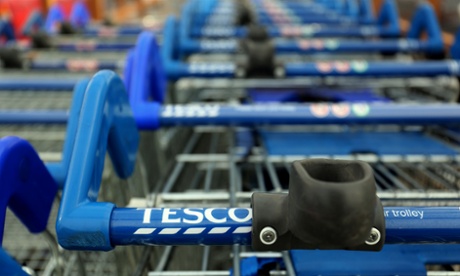
After news of the investigation by the Serious Fraud Office, Moody’s is back to put the boot in. The ratings agency has just issued a report suggesting rival Morrisons is better placed than Tesco to narrow the price gap with discounters such as Aldi and Lidl.

Sven Reinke, a vice president and senior analyst at Moody’s and the author of the report said:
We believe that Morrisons has a slightly better risk profile than Tesco, supported by its lower leverage, lower exposure to very large stores and decisive strategy of narrowing the price gap with the discounters such as Aldi and Lidl.
The report concludes:
- While Tesco benefits from having a more geographically diversified business than Morrisons, the latter’s store estate provides a large degree of operational and financial flexibility compared to Tesco’s much higher exposure to troubled large, out-of-town hypermarkets.
- Morrisons has taken more decisive action in tackling the rising market share of the discounters to date than Tesco.
- Morrisons (Baa2 negative) has slightly better credit metrics than Tesco (Baa3, on review for downgrade).
Updated
My colleague Angela Monaghan has put together six key charts covering the five year period of the US Federal Reserve’s $4.5tn quantitative easing programme, expected to be brought to a halt this evening.
Showing the growth of the Fed’s balance sheet, the effect on equities, the economic recovery, unemployment, bonds and inflation, the report can be found here:
The Fed to call time on QE in the US
Updated
Markets update
US markets are fairly static, ahead of today’s Fed announcement. The Dow Jones is flat at 17,005 points and the S&P equally becalmed at 1,986 points.
The major European markets are all up.
- FTSE +0.75% at 6,450 points
- France’s CAC40 +0.31% at 4,125 points
- Germany’s DAX +0.68% at 9,129 points
With that, I’m handing over to my colleague Nick Fletcher.
Updated
Here is our latest Tesco story, with full background on the supermarket’s accounting practices that led it to overstate its profits by £263m.
Tesco confirms criminal investigation
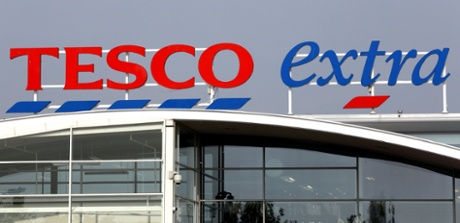
Tesco has confirmed that the Serious Fraud Office has launched a criminal investigation into its reporting practices.
The company has said it is co-operating fully with the SFO and will continue to do so.
The City regulator, the Financial Conduct Authority, is stopping its investigation, as the SFO takes over.
Updated
What is the link between Tesco, the supermarket now facing a criminal investigation over an accounting scandal....
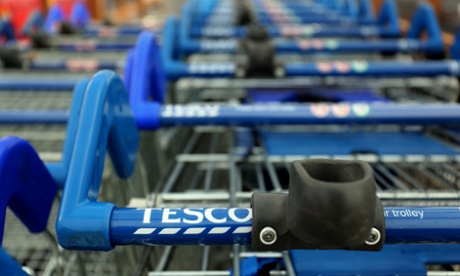
... and Norway?

It might not be immediately obvious, but the nordic state is one of the biggest investors in the UK supermarket group. And that is not a good thing for the people of Norway.
Norway’s $860bn sovereign wealth fund owns almost 7% of Tesco, which has dragged down the fund’s performance.
The fund reported flat returns in its third quarter, following poor performance of many of its stocks, especially Tesco.
Yngve Slyngstad, chief executive of the fund, said the fund was “in dialogue” with Tesco’s board, but declined to give the retailer advice.
It is clear that our investment in the British company Tesco has performed particularly poorly in the course of the year .
Last month renowned investor Warren Buffett said investing in Tesco had been a “huge mistake”.
Source: Reuters
Updated
Fed preview: what the economists think
Nobody should expect great drama when the Federal Reserve reveals its hand on financial stimulus later today.
No post-meeting press conference is scheduled. The Fed will simply publish an announcement at 2pm local time (18.00 GMT).
So what should Fed watchers be looking for? Helpfully, Bloomberg has published this guide to the policy statement, having polled 64 economists about their expectations.
A clear majority (62 of 64) are convinced that the Fed will end its financial stimulus, while 80% expect the Fed to favour holding interest rate near zero for a “considerable time” after bond buying ends.
Many also expect cautious language on employment despite a recent fall in worklessness to 5.9%: 64% of economists expect the committee to refer to “significant underutilisation of labor resources”.
But some economists think the Fed will steer clear of mentioning the weak state of the global economy, for fear of spooking investors.
Most do not expect a significant reaction from markets to the widely-trailed ending of QE.
Allan von Mehren at Danske Bank
The market is already prepared for a dovish shift in this statement.
Via FX Street
Updated
Total hit by falling oil prices
Total has reported a fall in profits, as it becomes the latest oil major to be hit by the falling price of crude.
France’s second-largest oil company is on a cost-cutting mission under new chief executive Patrick Pouyanné, who replaced Christophe de Margerie, who died in a plane crash in Moscow earlier this month.
Total posted profits of $3.56bn for June to September, a 2% fall, but better than analysts expected.
Iain Reid of BMO said Pouyanné had already driven costs down in his previous role in charge of refining.
Much of the credit for that [cost cutting] goes to the incoming CEO, who has successfully lowered Total’ breakeven point in the [downstream] division via his cost reduction initiatives.
Updated
Tesco faces criminal investigation into profits overstatement
Sky News has published the details of their story on the criminal investigation into Tesco. It reports that the Serious Fraud Office could confirm as early as this week that it is opening an inquiry.
The SFO is understood to have notified Tesco of its intention to formally investigate the issue in recent days, and is expected to trigger a stock exchange announcement by the supermarket giant.
Still no comment from Tesco or the SFO.
Updated
Personal bankruptcies and company failures in decline
The number of people filing for bankruptcy has fallen by 19%, according to the latest official statistics.
Companies are also less likely to go into administration.
Here are the data headlines from the Insolvency Service:
- The number of company liquidations in England and Wales decreased by 11.7% compared with July to September 2013.
- The number of companies going into administration has fallen by 18.8%, while voluntary arrangements and receiverships also fell.
- The number of people who became insolvent in England and Wales decreased by 4.6% compared with July to September 2013, driven by a fall in bankruptcy orders (18.7%).
Updated
Sky News is reporting that the Serious Fraud Office will open a criminal investigation into Tesco’s profits overstatement.
The SFO and Tesco have declined to comment.
Updated
"Too few" women study economics
Not enough women study economics, which could affect how the country is run, according to academics at Southampton university.
Women make up just 27% of economics students, despite being 57% of the undergraduate population in UK universities, according to the researchers.
Mirco Tonin, lead author of the study, said
This under-representation of women in economics degrees could have major implications in policy-making. Economists have an influential role in think tanks, ministries, central banks and international organisations, like the IMF and the World Bank.
Part of the problem is that not enough girls study maths, but even those that do are less likely to take up the dismal science.
Girls are less likely to have A-levels in maths than boys, and this could represent an impediment to applying for an economics degree. However, even among those who have studied maths, females are still less likely to apply for an economics degree than males, suggesting that differences in the choice of A-level subjects cannot explain the whole gap.
Based on a random sample of administrative data covering all university applications in 2008, the researchers found no discrimination against females in the university application process. They argue that cultural factors are holding young women back from studying economics.
Female under-representation is also likely to contribute to the gender pay gap, because economics graduates tend to receive relatively high earnings.
Souce: Press Association
Economists have been raking over what the latest Bank of England lending data tells us about the state of the UK economy.
First, business lending
Howard Archer, chief UK and European economist at IHS Global Insight, described the dip in net bank lending to non financial companies as disappointing.
Nevertheless, the underlying trend in net bank lending to businesses is looking better, with an overall increase of £1.33 bn in the third quarter compared to falls of £3.84 bn in the second quarter... Overall, it does appear that underlying credit conditions for businesses are improving which is important for the economy’s long-term health.
The data also shows momentum has slipped in the housing market.
Matthew Pointon, property economist at Capital Economics, thinks the current weak patch won’t last much longer.
The subdued mortgage market may reflect a regulatory clampdown on risky lending in June, but he does not expect approvals to stay at this level for long.
Taking a step back from the regulatory environment, the macroeconomic backdrop is still supportive of a gradual recovery in lending. The economy is growing at a robust pace, and the employment rate continues to rise, which would usually be expected to boost mortgage activity. Furthermore, the threat of an imminent rise in interest rates is receding.
Mortgage approvals falls to 14-month low
In another sign that the housing market is cooling, UK lenders approved fewer mortgages in September.
The Bank of England said that mortgage approvals for house buying fell to 61,267 in September, down from 64,054 in August - their lowest level since July 2013 and a bigger fall than forecast.
Mortgage lending, which lags approvals, rose by £1.8bn in September, compared to £2.2bn in August.
Lending to business fell by £710m and is 3.1% lower than last year.
Sanofi ousts chief executive
Turmoil in the boardroom at French pharmaceutical giant Sanofi.
The company, France’s second largest, has sacked its chief executive Chris Viehbacher, who had clashed with unions over plans to lay off hundreds of staff.
The decision, announced this morning, comes one day after Sanofi warned that sales of its leading diabetes treatment would stall because of tough competition from rivals.
Sanofi’s shares lost 8% yesterday. Markets have reacted predictably to the ouster of Viehbacher: Sanofi’s stock is down almost 4% today.
As one unnamed Paris trader told Reuters
This creates more uncertainty just after the group published results and outlook figures, which were not reassuring.
Further reading:Sanofi chief Chris Viehbacher sacked in boardroom row
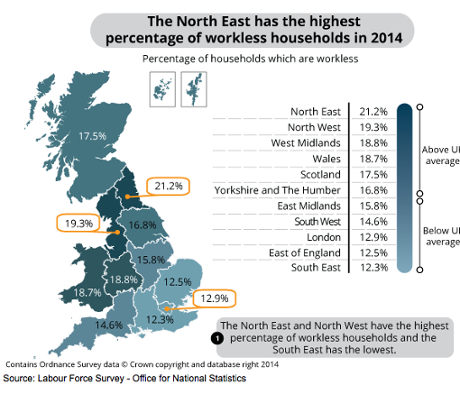
The ONS data shows a familiar regional divide in worklessness. The north east of England has the highest proportion of workless households (21.2%), while the south east has the lowest (12.3%).
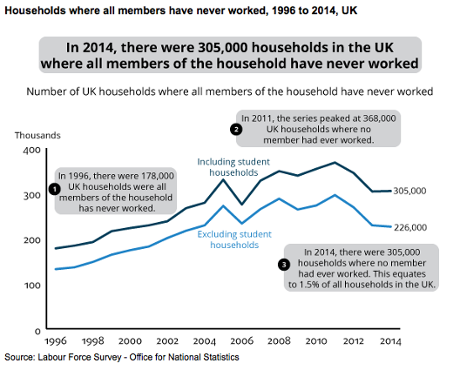
n 2014, there were 305,000 households in which no adult has ever worked, up 1,000 from a year earlier. The percentage of households, where no one aged 16-64 has ever worked was unchanged at 1.5%.
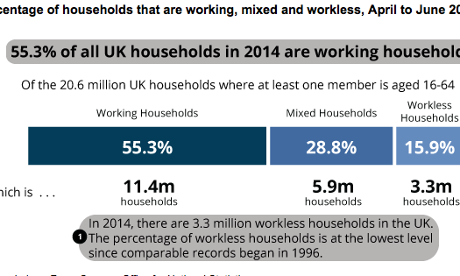
A helpful graphic from the ONS, showing the employment status of UK households.
A workless household is one where no one aged 16 or over is in paid employment, a varied category encompassing carers, people with family commitments, students, retired people, people who cannot work because of sickness or disability.
The ONS explains how the statistics have changed
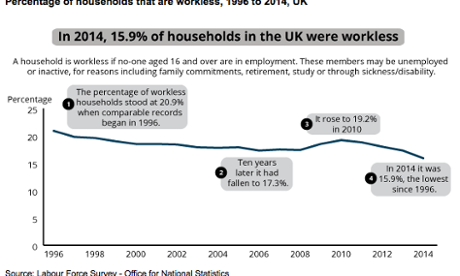
In 1996, the earliest point at which a consistent data is available, the percentage of workless households stood at 20.9%. Ten years later in 2006, two years before the economic downturn hit the UK, it had fallen to 17.3%. During the recent economic downturn it rose to a high of 19.2% in 2010. In 2014 it has fallen to 15.9%, the lowest since 1996. Excluding student households this trend remains the same; the workless rate fell from 20.6% in 1996 to 17.1% in 2006 and rose to 18.8% in 2010 before it began falling again, where it is now at 15.5%.
Updated
Fall in workless households
The percentage of households where no adults work has fallen to the lowest level since records began, according to the Office for National Statistics.
The ONS reported that 1.5m children are living in workless households, a fall of 132,000 on last year.
Here are the headlines from the ONS worklessness report, which covers April to June:
- The percentage of households where no adults work was 15.9%, down 1.4 percentage points from a year earlier and the largest fall since comparable records began.
- The percentage of households where all adults work was 55.3%, up 1.5 percentage points from a year earlier.
- Of the regions in England and countries of the UK, the North East had the highest percentage of workless households at 21.2%, while the South East had the lowest at 12.3%.
- The percentage of households in which no adult has ever worked was 1.5%, the same as a year earlier.
Updated
For everyone who enjoys random facts
Updated
Rouble slides to all-time low
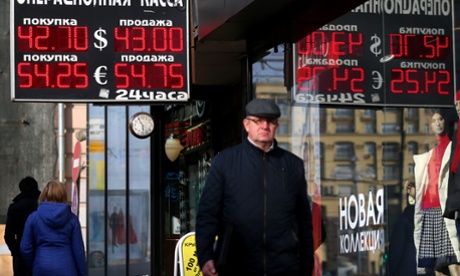
The Russian rouble has fallen to new all-time lows against the euro and the dollar, as tensions simmer in eastern Ukraine.
Ukraine has condemned Russia’s “destructive and provocative” stance after Moscow recognised elections organised by pro-Russian separatists on Sunday, further complicating peace talks.
On Wednesday the rouble fell 0.57% against the dollar to 42.71 and lost 0.66% against the euro. Analysts expect the central bank to announce a policy of a free-floating rouble on Friday.
Deutsche Bank in surprise loss
Germany’s largest lender Deutsche Bank has chalked up a surprise loss, after legal costs reduced its earnings.
The bank lost €92m ($117 million) over June to September, as heavy charges for expected fines and settlements cut into its revenues. The bank faces multiple investigations, from its alleged role in manipulating Libor, misselling mortgage-backed securities in the US and flouting US sanctions against Iran.
On Tuesday the bank announced a management shakeup that will see its chief financial officer, Stefan Krause, move to a newly created post, where he will oversee strategy and cost-cutting. Marcus Schenck of Goldman Sachs has been drafted in to take over the CFO role. In other changes staff have been given new duties to beef up the bank’s IT and internet banking.
The New York Times’ Deal Booksays that the management changes are intended to help the bank cope with tougher regulations and allegations of wrongdoing.
Litigation issues have been a major distraction for Anshu Jain and Jürgen Fitschen, the co-chief executives, as they have tried to defend the bank’s position among global investment banks.
Warm weather shrinks Next's profis forecast
Unseasonably warm weather is making life uncomfortable for the UK’s clothing retailers.
Next issued a profits warning this morning, after balmy weather meant it failed to sell enough winter coats and jumpers in September and October.
In a statement to the City, Next cut its profit forecast for 2014 to a range of £750m to £790m, a 3% reduction on previous estimates. This still adds up to a profit increase of 8-14% for the retailer.
Whilst a cool August meant that the season started well, this was more than offset by much weaker sales in September and October.
Other big retailers are feeling the heat, as investors sell their stocks in anticipation of similar damage to profits.
- Next -3.1%
- M&S -1.7%
- Debenhams -0.7%
More troubled retailers, such as M&S, could be facing even bigger problems.
Retail analyst Nick Bubb said
If Next have been mildly discomfited by the amazingly mild October weather, we suspect that the likes of M&S and Debenhams have had bigger problem.
Updated
The Bank of England will publish a raft of statistics at 9.30, including the latest data on lending.
Michael Hewson of CMC Markets expects the latest data to provide further data of declining home lending.
In the UK we’ve also seen evidence of a slowdown in prices, and in lending as well, and this morning’s latest credit numbers are likely to reinforce that.
Mortgage approvals in September are expected to have slipped back to 62k from 64.2k, while consumer credit and net lending is also expected to have weakened.
Today's agenda: Fed expected to end financial stimulus
Good morning, and welcome to our rolling coverage of the world economy, the financial markets, the eurozone and the business world.
All eyes are on the US Federal Reserve, widely expected to announce the end of its financial stimulus programme later today.
The US central bank is also expected to reinforce previous messages that interest rate hikes will not happen until well into 2015, in an attempt to avoid scaring the markets.
Over the last five years the Fed has pumped almost $4.5 trillion into the US economy, but is now ready to signal an end to its bond-buying programme.
The Fed has already been winding its latest QE3 programme down, from a regular $85bn of quantitative easing a month to a final $15bn.
It has been retreating carefully, to avoid unsettling markets at a time when many parts of the global economy are fragile. When Fed policymakers hinted they might end financial stimulus in 2013, investors threw taper tantrums, selling off equities and dumping foreign currencies.
TD Securities economist Millan Mulraine is expecting a soothing message from the Fed intended to counter market anxieties.
The overall tone of the communique should feel dovish as the Fed counters the implied tightening in monetary conditions resulting from the strong dollar and leans against the potential fallout from the current global growth slowdown and disinflationary impulse.
The Federal Open Market Committee, the Fed’s policy-setting group, is scheduled to release a statement at 2pm EST/ 18.00 GMT on Wednesday.
As well as looking ahead to the Fed, we have several UK stories on our agenda. The Bank of England will publish mortgage approvals and credit data, that are expected to show lending has fallen.
The ONS will publish reports on worklessness and business activity at 9.30.
All that and more...
Updated