European markets hit by Trump concerns
After all the talk of record highs and low volatility, it was almost inevitable that something would turn up to rock the boat. Equally, it was almost inevitable that something would be the latest Donald Trump developments. The newest controversy involved accusations the president had asked former FBI James Comey to drop his investigation into former national security adviser Michael Flynn. That prompted all sorts of disquiet, and even talk of possible impeachment.
Not surprisingly, that sent investors heading for the exits, both for the chaos such a move would cause and also the prospect that even if things did not escalate that far, Trump and the White House would be distracted from their market-friendly tax reforms and infrastructure spending plans. So as Wall Street slumped, European markets followed suit, although the FTSE 100 managed to hold fairly firm, helped by a rise in safe haven gold miners’ shares.
But despite the falls, Chris Beauchamp, chief market analyst at IG, said there was no need to panic:
It says a lot for how quiet markets have been that today’s selloff, which has been rather dramatic relative to the recent past, is being trumpeted in some quarters as the beginning of the next big pullback. There are justifiable reasons for thinking we are due a drop, some of which I have alluded to over the past few weeks - weaker US data, declining participation on indices, and others could all be cited as the culprits. Now is not the time to panic however; the S&P 500 has fallen by 30 points as of 4pm London time, but is still up more than 6% for the year so far. We are not in correction territory just yet, and may not even get there anyway.
US banks are some of the hardest hit this afternoon, having been consistent underperformers for two months now. It looks like investors are already beginning to worry that a June rate hike is looking less likely, while the sight of the words ‘Trump’ and ‘impeachment’ hint at the possibility that regulatory reform is now off the agenda.
In Europe, the final scores showed:
- The FTSE 100 finished down 0.25% or 18.56 points at 7503.47
- Germany’s Dax dropped 1.35% to 12,631.61
- France’s Cac closed 1.63% lower at 5317.89
- Italy’s FTSE MIB fell 2.31% to 21,283.72
- Spain’s Ibex ended 1.79% lower at 10,786.1
- In Greece, the Athens market added 0.04% to 789.08
On Wall Street, the Dow Jones Industrial Average is currently 260 points or 1.24% lower.
On that note, it’s time to close for the evening. Thanks for all your comments, and we’ll be back tomorrow.
And more on the dollar falling:
"I think our dollar is getting too strong, and partially that’s my fault because people have confidence in me.” - D Trump, April. pic.twitter.com/8LI89Aikdq
— Katie Martin (@katie_martin_fx) May 17, 2017
While the Dow Jones Industrial Average, Germany’s Dax and France’s Cac are all down more than 1%, the FTSE 100 is off just 0.2%.
FTSE is on drugs. World is collapsing on Trump impeachment story and FTSE says 'That's nothing mate, you should try Brexit...'
— Ed Matts (@EdMatts) May 17, 2017
Pressure on #dollar coming from #Trump concerns sees #pound sniffing US$1.30 for first time in almost 8 months. #Euro at US$1.115
— Howard Archer (@HowardArcherUK) May 17, 2017
Updated
Dollar loses all its post-US election gains
The US dollar has now lost all the gains it made since Donald Trump was elected president. The dollar index shows:

David Madden, market analyst at CMC markets, said:
The decline in the US dollar has wiped out all the gains it has made since Donald Trump was elected. The speculation about his impeachment is rising and the dollar is falling in tandem. The decline in UK unemployment gave the pound a boost, and the steady inflation rate from the eurozone gave traders a minor reason to buy the respective currencies, but the moves were magnified by the weaker greenback. Make no mistake, the drop in the US dollar is the reason behind in move in the GBP/USD and the EUR/USD.
Updated
Oil jumps as US stocks fall
US crude inventories declined by 1.75m barrels last week, a sign of increasing demand, even though the fall was lower than the expected 2.4m barrel drop.
The news has pushed the oil price higher again, with West Texas Intermediate up 1.6% at $49.48 and Brent crude 1.7% better at $52.54.
European markets have seen their falls accelarate after Wall Street’s slide.
Germany’s Dax is down 121 points and France’s Cac has lost 68 points. The FTSE 100 has fared a little better, falling 26 points. Connor Campbell, financial analyst at Spreadex, said:
After the brief morning distraction of the UK jobs report, focus turned firmly back to Trump’s latest foul-up following the US open.
The Dow Jones set the tone this afternoon, the index plunging more than 200 points as the bell rang on Wall Street. That leaves the Dow at its worst price since April 25th, the day investors first got a sniff of Trump’s tax plan. The dollar fared no better; it slid 1.4% against the Japanese yen and 0.3% against the pound, while remaining at a 6 month low against the euro.
Investors have been shaken by reports that Trump urged the then-FBI chief Comey to drop his investigation into Michael Flynn, the latest twist in the Russia saga that is gradually engulfing the President. There are a couple of reasons as to why this has caused such jittery trading. Firstly, it threatens to delay, or completely derail, Trump’s market-lifting infrastructure and tax policies. Secondly, and more drastically, it could actually lead to impreachment... an eventuality that would completely erase the foundations of the market’s recent record highs.
In the Eurozone the DAX and CAC performed just as badly as their US counterpart, dropping 0.9% and 1.2% respectively. The FTSE, on the other hand, was more resilient; though it did fall by 25 or so points, this still kept it at or around the 7500 mark. The UK index is being somewhat supported by the likes of Fresnillo and Randgold Resources, which both benefited from gold’s 1.6% rise.
Here is the damage to the Dow:

Dow -200pts; most since 21 Mar (-237), 11 Oct (-200) and 29 Sept (-196)
— Mike van Dulken (@Accendo_Mike) May 17, 2017
Lots of red out there today. Only 2 of the Dow 30 stocks are up right now. $UNH $WMT. Biggest Dow losers? Banks. $GS $JPM off more than 2%.
— Paul R. La Monica (@LaMonicaBuzz) May 17, 2017
Banks are among the fallers as the US market decline continues. The S&P 500 banking index is down 1.8% with Bank of America off 2% and JP Morgan 1.7% lower. Meanwhile the Dow is now down 215 points or just over 1%.
With #Dow down 200 & #financials underperforming,watch for the tug of war between the unwinding of crowded trades & the buy on dips strategy
— Mohamed A. El-Erian (@elerianm) May 17, 2017
Meanwhile the VIX volatility index - the fear index - has moved higher after hitting a 24 year low earlier this week. It has jumped 20% to 12.69 in the wake of the latest Trump revelations.
Wall Street opens sharply lower
US markets have made their worst start to the year following the latest allegations about Donald Trump trying to interfere with a federal investigation.
After news of a leaked memo from sacked FBI director James Comey, the Dow Jones Industrial Average has dropped 180 points or 0.88%. The S&P 500 opened 0.8% lower and the Nasdaq Composite down 0.94%. Of course both the S&P and Nasdaq have been at or close to their record highs until now.
it's a good day for gold, up $20 today as Trump's political woes deepen, sending investors for cover into safe havens.
— City Index (@CityIndex) May 17, 2017
Back in the US, and the Dow Jones Industrial Average is now forecast to open around 170 points lower, as investors fret about the latest shennanigans in the White House. But it doesn’t seem to be panic level yet.
Dow off 170 points. Means Wall Street is troubled, but not full blown panicked yet over Trump https://t.co/6vqS717Ish via @LaMonicaBuzz
— CNNMoney Investing (@CNNMoneyInvest) May 17, 2017
Lunchtime round-up
Time for a quick recap.
Britain is facing a new cost-of-living squeeze after wages failed to keep up with rising prices.
Basis pay only rose by 2.1% per year during the January-March quarter, figure released by the Office for National Statistics showed. That’s weaker than CPI inflation, which averaged 2.3% during the quarter, and jumped to 2.7% in April.
Public sector workers face the biggest pressure; their regular pay only rose by 1.3% year-on-year, meaning their real wages are falling fast.
Economists say that the figures show that the slump in the pound since the Brexit vote is now hitting earners. It is likely to dent consumer spending this year.
However, the UK economy is still creating jobs. The unemployment rate has fallen to 4.6%, the lowest since Harold Wilson was running the country in 1975.
Employment is at a record high, too, with 31.95 million people in work. That’s 122,000 more than in October to December 2016 and 381,000 more than for a year earlier. ING called it “astonishing”.
Here’s our news story on the figures:
London has highest jobless rate in UK

Now this might surprise you...
London now has a higher unemployment rate than any other region in the UK.
Unemployment in the capital has risen to 6.1% in the first three months of 2017, new ONS statistics show, up from 5.5% in the previous quarter. The lowest unemployment rate was in the South East, at just 3.5%.

The ONS says:
Allowing for some individual volatility, the overall pattern for the last few years has been for gently falling unemployment rates. The highest unemployment rate in the UK for January to March 2017 was for London at 6.1%. This follows a period of a number of years when the highest unemployment rate was consistently the North East.
Londoners also worked the longest average working week, at 33.7 hours; the lowest was in Yorkshire and The Humber at 31.3 hours.
For the first time since 2012, London now has the highest unemployment rate in the UK
— Andy Bruce (@BruceReuters) May 17, 2017
The latest stunning developments from the Trump White House are likely to weigh on the US stock market today.
The Dow Jones industrial average, and the wider S&P 500 index, are both expected to fall by around 0.75% when trading begins in around one hour.
Should be an interesting US session: overnight trading has brought S&P500 down to the May lows, 2380/82: pic.twitter.com/MoQjBjhp4T
— David Jones (@JonesTheMarkets) May 17, 2017
FXTM Research Analyst Lukman Otunuga says “a feeling of unease” has gripped the markets today, pushing shares down in Asia and Europe.
With the latest bombshell developments in the Trump saga seen as an obstacle that may delay the proposed fiscal spending further, Wall Street should follow the bearish cues from Asian and European markets this afternoon.
Updated
The pound has gained half a cent today, to $1.296, as traders applaud the latest rise in UK employment.
Sterling is also benefitting from the political upheaval on the other side of the Atlantic, following those reports that Donald Trump had pushed former FBI director James Comey to drop investigations into Michael Flynn, former national security advisor.
The pound hasn’t traded over $1.30 since last September.
Chris Saint, senior analyst at Hargreaves Lansdown, says:
The $1.30 level is again coming into sight, with the dollar weighed down by worries that President Trump could find it trickier to forge ahead with his intended economic reforms amid reports of interference into an FBI investigation into links between his campaign team and Russia.
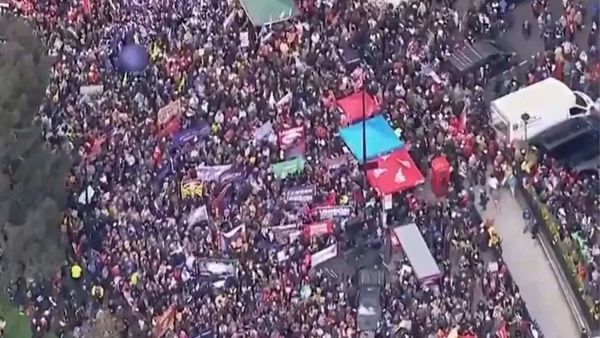
Greek anti-austerity protests turn violent

Over in Greece, clashes have broken out between demonstrators and riot police during protests against the country’s austerity programme.
Violence erupted outside parliament between hooded “anti-establishment” demonstrators throwing rocks and flares, and riot officers, who fired tear gas.
Raw Video: Protesters fire flares at police outside Greek parliament#Greece #Vouli pic.twitter.com/u8xbR8Pqm9
— Derek Gatopoulos (@dgatopoulos) May 17, 2017
Earlier, thousands of strikers had marched through Greece, opposing the latest package of tax rises and economic reforms agreed between Athens and its lenders -- which MPs vote on tomorrow night.
Addressing crowds in Athens’ square of national resistance, the leader of the communist party Dimitris Koutsoumbas said:
“Essentially a class war is underway .. these harsh unpopular measures, the fourth memorandum along with all the previous memorandums, should be thrown in the basket of history.”

As Greek MPs began debating the measures, trade unionists told the Guardian that there will be a massive show of protest culminating with a demonstration outside parliament on Thursday night when the chamber is expected to pass the bill.
“This is the 32nd general strike since 2010 [when the Greek debt crisis erupted] and we are not going to give up,” said Grigoris Kalomoiris who heads the public sector workers’ union, Adedy.
Kalomoiris added:
“For some the pension cuts that these policies will bring will amount to the loss of two pensions while the lowering of the tax [threshold] will mean the loss of a monthly salary. Some of us are not going to accept that without a fight.”
There is major disquiet in the ranks of the ruling Syriza party with leftwing MPS saying they have been “pushed to the limit” by the latest cost-cutting measures. Although no defections are expected – with the prospect of losing power viewed as the biggest incentive now spurring MPs in the governing two-party coalition to endorse the policies – many have privately described the measures as unconstitutional.
“Many [cadres] would like to be out in the streets [protesting] not in parliament supporting these measures,” said one. “But the alternative [default and euro exit] is just not on the cards. Everyone agrees it would be catastrophic.”
The policies, which will see pensions being pared back by another 18%, will not be enforced until 2019 towards the end of the present government’s four-year term in office. Prime minister Alexis Tsipras has argued that counter-measures offsetting losses will effectively neutralise the cuts for those expected to be hardest hit by them.

Britain’s poor productivity and weak pay are inextricably linked, argues the CBI, which represents UK businesses.
To get wages higher, firms need to boost their output -- and the key is to boost research and development spending. UK R&D is equivalent to just 1.7% of gross domestic product today; the CBI is pushing the government to set a target of 3%.
Alpesh Paleja, CBI Principal Economist, says:
“Rising employment continues to reinforce the importance of the UK’s flexible labour market.
“However, weakening productivity and slower pay growth, coupled with rising inflation, will continue to squeeze real household earnings.
“Therefore maintaining the UK’s reputation as a great place to do business, for example by increasing R&D spend to 3% of GDP by 2025, will help boost the UK’s productivity. This is the only sustainable route to higher wages, and better living standards.”
If Britain’s jobless rate is really at a 40-odd year low, why doesn’t it feel like a nation at full employment?
Our economics editor Larry Elliott has highlighted three reasons:
One reason for the weakness of earnings growth is the ferocious squeeze on public sector pay, which – stripped of bonus payments – is rising at just 1.3% a year.
A second factor is that employers are able to buy in cheap labour from overseas. Migration from other EU countries has not fallen off a cliff despite the result of last summer’s referendum: according to the Office for National Statistics, the number of non-UK nationals from the EU working in the UK rose by 171,000 to 2.32 million between the first quarter of 2016 and the first quarter of 2017. This continues a trend, which has seen the number of workers from the other 27 EU countries double since the recession of 2008-09.
Finally, the nature of work seems to have changed. Work by David Blanchflower, Rui Costa and Stephen Machin has shown that earnings growth for the self-employed – who account for 15% of the workforce – has been particularly weak in recent years. People are working flat out in the gig economy but still struggling to make ends meet. The labour market has, for want of a better word, been Uberised.
Labour: Families suffering falling living standards

Here’s John McDonnell, Labour’s Shadow Chancellor, on today’s labour market report:
“These figures bring home the Tories’ total failure to improve the living standards of working families.
“Real wages are lower than they were in 2010 and, after seven years of the Tories, they are now falling again.
“The choice at this election couldn’t be clearer: either a Tory party presiding over a crisis in living standards or a Labour government that will build a Britain for the many, not the few.”
Updated
New productivity figures have also been released this morning, and they’re a shocker.
Productivity across the UK economy shrank by 0.5% in the first three months of 2017, the first fall since the end of 2015.
It’s because the UK economy took on more workers, who worked longer hours, but didn’t deliver a corresponding rise in economic output.
Britain: really depress yourself this morning - look at the dreadful productivity figures pic.twitter.com/cojHEh5YT5
— Chris Giles (@ChrisGiles_) May 17, 2017
The decline fall in real wages is particularly painful for workers, because pay packets hadn’t clawed back all the losses since the financial crisis.


Lib Dems: Brexit vote is hurting workers

The Liberal Democrats are blaming the Brexit vote for the slump in real wages.
Sir Vince Cable, the former business secretary, says workers are paying the price for the plunge in sterling last June.
“This squeeze on living standards is almost certainly caused by the falling pound since the Brexit vote.
“If Theresa May is allowed to pursue her extreme Brexit agenda, we can expect further weakening of the economy and erosion of people’s living standards.
“People don’t have to settle for a bad Brexit deal that will cost jobs and push up prices. A brighter future is possible.
“The Liberal Democrats will give you the final say on the deal, with a chance to reject it and stay in the EU.”
Britain’s wage squeeze threatens to undermine the economic recovery, warns Suren Thiru, head of economics at the British Chambers of Commerce.
If the disparity between pay and price growth continues to increase as we predict, household spending is likely to slow further, weakening overall economic activity.
“The next government must do more to close the skills gap, including improving the transition from education to work by guaranteeing universal experience of work in all schools for under 16s, and delivering a future immigration regime based on economic need, rather than an arbitrary migration target. This will help firms compete on the global stage, boosting UK productivity and growth.”
Dutch bank ING says that Britain enjoyed an “astonishing” jump in employment last month.
The real standout in today’s UK jobs report was the surge in employment growth. The three month on three month average came in well above consensus at 122k, lifted by a huge 340k “single month” increase in jobs – the highest in 2 years.
This is hard to square given recent survey data, which suggests the outlook for hiring is more muted.
But they’re concerned by the fall in real wages, which is likely to prevent an interest rate hike before 2019.
It’s also hard to ignore the fact that wages are now growing at a noticeably slower pace than prices. The key measure of wage growth, which excludes bonuses, came in at 2.1%. When taken together with yesterday’s acceleration in inflation to 2.7%, real wages are now falling. We’ve already seen measures of consumer activity slow through the first quarter.
ING: "Astonishing rise in UK employment won't mask fall in real wages. This already appears to be dampening consumption." No hike before '19
— Katie Martin (@katie_martin_fx) May 17, 2017
Resolution: UK faces worse pay squeeze since Waterloo
The slump in real wages last quarter means Britain is facing its worst decade for pay since the Napoleonic Wars, says the Resolution Foundation.
It fears the situation will get worse this year. Stephen Clarke, their economic analyst, explains:
“Britain kicked off the year with another welcome record on employment, and another big fall in unemployment. This welcome jobs boost will provide a much needed boost to family incomes.
“However, the good news on jobs is not feeding through to positive news on pay growth, which turned negative at the start of the year and looks set to remain below inflation throughout most of 2017.
“Coming so soon after the big post-crisis pay squeeze, this new phase of falling pay means that this decade is set to be the worst in over 200 years for pay packets.”
Here’s Professor Geraint Johnes, Director of Research at the Work Foundation, on today’s jobs figures:
“The latest employment figures indicate remarkably strong performance, with unemployment falling by 53000 over the first quarter of the year to a rate of 4.6%. Indeed, unemployment has fallen in every region except London and the South East. This has been primarily due to a large increase in the number of full-time employees in employment (some 196000 across the UK). The number of part-time employees has meanwhile fallen (by 61000). There has been little change in the number of self-employed workers over the quarter.
“On pay, the data are less encouraging. In the first quarter of the year, the year-on-year growth in total pay amounted to 2.4%. This is below the current rate of price inflation and indicates a renewed squeeze in real pay. The pay data indicate a collapse in wage settlements in the construction industry, and this is significant because much of the employment growth in the last part of 2016 came from that sector. While welcoming the strong employment growth evidenced in the first quarter’s figures, sustaining this into the longer term may therefore prove challenging.”
Unemployment: the key charts
Duncan Weldon of the Resolution Group says some of the charts in today’s labour market report are “astonishing”.
1. The employment rate just keeps getting higher. pic.twitter.com/aqjYSvDRuM
— Duncan Weldon (@DuncanWeldon) May 17, 2017
2. There's been a huge shift away from public sector employment. pic.twitter.com/6rZmv0aZ0u
— Duncan Weldon (@DuncanWeldon) May 17, 2017
3. The picture for real wages is just grim. pic.twitter.com/2B5kZJO59D
— Duncan Weldon (@DuncanWeldon) May 17, 2017
Britain is still creating jobs. It just isn’t paying people enough to protect them from the rising cost of living.
Today’s labour market report shows that the number of people in work in the UK increased by 122,000 in the 3 months to March 2017 to 31.95 million.
Around 200,000 full-time jobs were created, while the number of part time jobs fell by 78,000.
This drove the employment rate to a new record high of 74.8%.

This chart shows how the gap between inflation (2.7% in April) and basic pay growth (2.1% in January-March) has widened, driving real wages into the red.
The gap between UK inflation (2.7% and rising) and wage growth (2.1%) is widening. Real wages falling at fastest rate in 3 years. pic.twitter.com/YmNIKe2Q4m
— Jamie McGeever (@ReutersJamie) May 17, 2017
Including bonuses, wages rose by 2.4% year-on-year, thanks to “bonuses in the finance and insurance sector”.
Updated
UK jobless rate hits 42-year low, but real wages shrink
Breaking! Britain’s unemployment rate has hit its lowest level since 1975.
The jobless rate fell to 4.6% in the January-March quarter, down from 4.7% a month ago, the Office for National Statistics reports. That’s lower than expected, and implies that the jobs market is holding up in the face of Brexit.
But there’s bad news too. Real wages are shrinking, as workers – particularly in the private sector – suffer from rising inflation.
Excluding bonuses, average weekly earnings increased by 2.1% in the quarter, that’s the weakest growth since the three months to July 2016.
That means wages are not keeping pace with inflation -- which was 2.3% in February and March, and 2.7% in April.
The ONS says:
The recent increase in consumer price inflation including owner occupiers’ housing costs has seen the annual rate of real wage growth (excluding bonuses) turn negative for the first time since the 3 months to September 2014.

The pay squeeze is particularly painful for public sector workers.
Private sector regular pay grew by 2.3% in the 3 months to March 2017, while public sector pay grew by 1.3%, compared with the same period a year ago.
More to follow!
Updated
Stand by your desks! UK Unemployment, Employment and Wages data is due at 9:30 am
— Shaun Richards (@notayesmansecon) May 17, 2017
Jobs newsflash: Furniture retailer IKEA has announced it is opening new stores in Sheffield, Exeter and Greenwich.
This will swell IKEA’s workforce by 1,300, to 11,700.
General strike hits Greece ahead of bailout vote
Over in Greece, workers have downed tools as a general strike against austerity gets underway.
Public transport is disrupted, leading to long queues in the capital. Air traffic controllers are holding a four-hour strike, while ferry workers have been on strike since Tuesday.
Unions are protesting against the latest round of pension cuts and tax rises agreed with lenders, in return for Greece’s next bailout loans. Greek MPs will vote on the plan tomorrow night.
It’s not really the weather for protesting, though, or standing in a long line hoping for a bus....


Updated
The UK government is patting itself on the back after finally extricating itself from the Lloyds Banking Group share register.
Britain has sold its final tranche of shares in Lloyds, more than eight years after rescuing the bank during the financial crisis of 2008
Lloyds claims that the taxpayer has made an £900m profit - a point repeated by chancellor Philip Hammond on Twitter.
Please to say Lloyds bailout has now been fully repaid and all taxpayers' money returned. £21.207B paid back on £20.313B injected.
— Philip Hammond (@PhilipHammondUK) May 17, 2017
But it’s not quite as simple as that, as my colleague Jill Treanor explains:
There are a number of ways of calculating the cost of the bailout. The calculations by Lloyds do not include the £3.6bn cost of borrowing funds in the depths of the 2008 crisis, while the Office for Budget Responsibility has used other methodology to show the government will ultimately break even.
It also doesn’t cover inflation, of course, or the other ways in which £20bn could have been used for the public good...
Updated
Shares in cybersecurity firm Sophos have hit a new record high, up 8%, after beating City forecasts this morning.
Sophos posted an operating profit of $38.3m after growing revenues by 10%, with “exceptionally strong” cash flow growth.
That growth could pick up this year, after the WannaCry outbreak refocused everyone’s attention on the threat of cybercrime.
Sophos’s clients include the NHS, which was struck badly by last Friday’s megahack.....
Sophos waters down 'NHS is totally protected' by us boasthttps://t.co/qCTqArFhMW pic.twitter.com/e8h3jPePV3
— Angus Fox (@nuxnix) May 16, 2017
Updated

The gold price has hit a two-week high this morning, as the dollar weakens and investors seek a safe haven for their money.
Gold is changing hands at $1.243 per ounce, the highest since May 3rd.
Analyst: Impeachment talk hits markets.
There’s a ‘risk off’ mood in the City today, says Naeem Aslam of Think Markets, after the New York Times reported that Donald Trump had asked James Comey to end the inquiry into Michael Flynn.
What investors are worried about is that the impeachment could take place over in the US as the odds are showing more than 50 percent for such an event after the New York Times released its article. If such scenario does become a reality, we could literally say good bye to Trump’s reflation trade.
Updated
Anxiety over the unfolding political crisis in America has his European stock markets.
The main indices are all falling in early trading, with Britain’s FTSE 100 dropping back from yesterday’s record high.

It’s not a major selloff, but there’s certainly some jitteriness in the markets today.
Paul Donovan of UBS explains:
The question for markets is “can the current administration get anything done?” if this climate persists. The importance of international investors in US markets hints at overshooting – international investors tend to understand politics less well than domestic investors. This is why market political risk was always higher in the US than in Europe.
Dollar falls after Trump hit by Comey memo
The US dollar has been hit by the latest revelations to strike Donald Trump’s White House.
The greenback has fallen to a six-month low against the euro, sending the single currency over $1.111 for the first time since November. It’s also hit a two-week low against the yen.
Euro at $1.1111
— Jamie McGeever (@ReutersJamie) May 17, 2017
The selloff came after it emerged that Trump had asked James Comey, then head of the FBI, to halt an investigation into Michael Flynn, Trump’s former national security advisor.
According to a memo written by Comey, Trump told him that
“I hope you can see your way clear to letting this go, to letting Flynn go.”
Here’s the full story:
The news sent shockwaves through Washington last night, where politicians were already reeling from the news that the president had shared confidential intelligence with Russia.
Some Democrats are demanding a full investigation into whether Trump has interfered with the judicial process.
John McCain, the Republican senator who ran for president in 2008, said the controversies facing Trump were of “Watergate size and scale”.
The House Oversight committee has now stepped in too, requesting to see ‘any and all communications’ between Comey and Trump.
.@jasoninthehouse requests any and all communications between Former FBI Director Comey and President Trump.
— Oversight Committee (@GOPoversight) May 17, 2017
📄⇩ pic.twitter.com/mOBXjEHUSQ
Investors are becoming concerned that America’s political system could become engulfed by crisis, preventing lawmakers implementing tax or spending plans.
As Mizuho bank put it:
“As reporting intensifies on Trump’s potential mishandling of classified information, and renewed speculations on the rationale of his dismissal of Comey, markets are becoming concerned whether key legislation on tax reforms could be deferred or derailed.”
Citi have also opined....
Flutter of applause please for Citi: "James and the Giant Impeachment"
— Katie Martin (@katie_martin_fx) May 17, 2017
Updated
The agenda: UK employment report
Good morning and welcome to our rolling coverage of the world economy, the financial markets, the eurozone and business.
The squeeze on living standards is a key issue in Britain today, after inflation hit a four-year high on Tuesday.
And today we get a new healthcheck on the UK labour market, which will probably confirm that pay packets are struggling to keep up with the rising cost of living.
The figures will cover the first three months of this year. Economists predict that Britain’s unemployment rate probably remained at 4.7%, the lowest rate in over 40 years, with employment at a record high.
But the real story will probably be found in the wage growth figures. Basic pay is expected to have risen by around 2.2% per year in the quarter - rather less than the 2.7% inflation rate recorded in April.
Analysts at RBC Capital Markets say:
The March labour data are likely to show a third consecutive month with the unemployment rate at 4.7%. That would mean a very modest change in the level of employment on a 3m/3m basis after the large gain of 92k 3m/3m in January and the still impressive +39k last month.
Similarly on the average earnings front, there is limited scope for sharp changes in pay growth rates. Our UK economists are looking for unchanged average earnings growth of 2.3% 3m/y including bonuses and 2.2% 3m/y excluding bonuses. So with the headline figures expected to move sideways broadly speaking, one area of potential interest will be the split between full- and part-time employment. In the last couple of reports there has been a clear shift in favour of full-time work; if repeated this time, it would arguably be a sign that some of the remaining slack in the labour market is being eroded.
The data come out at 9.30am BST.
Also coming up today
It’s a red letter day in the financial crisis, as the UK government finally sells its stake in Lloyds Banking Group, nearly nine years after its bailout.
Property developer British land, estate agent Foxtons, and cybersecurity firm Sophos are all reporting results.
And a general strike is underway in Greece, as workers protest against the country’s austerity programme.
Updated