Federal Reserve keeps interests rates unchanged, says rates could go up later this year
We are going to wrap up this live blog, but first here is a quick summary of what happened today:
- The last time Fed raised interest rates was in 2006
- It turns out that the economists surveyed by WSJ were right, when 54% of them predicted that the Federal Reserve will wait to raise rates
- Federal Reserve will not raise rates this month
- Yellen said rates could be raised at the meeting to be held in October, despite the fact that there is no press conference scheduled for that meeting at this time
- The reasons why the Federal Reserve is not raising rates just yet are concerns about fragile economy (Thanks, China!) and the low US inflation rate
- The Fed would like the US inflation to be closer to 2%
- Potential government shut down played no role in the Fed’s decision
- Bernie Sanders and AFL-CIO praised Fed’s decision to hold off on raising the rates
- The markets stumbled a little after the decision, ending the days just slightly below where they started: Dow Jones was down 0.39%, S&P 500 was down 0.26% and Nasdaq was up 0.1%
- The FTSE 100 index (the largest blue-chip companies listed in London) fell by 42 points, or 0.7%

The US markets have just closed. Here is where they were at:
Stocks retreated from post-Fed highs to end mostly lower: http://t.co/cKpVTvClJ2 pic.twitter.com/it6X2Csgde
— MarketWatch (@MarketWatch) September 17, 2015
MarketWatch also pointed out that “several emerging-markets currencies, including the Mexican peso, Malaysian ringgit and Korean won, traded higher than the dollar after Federal Reserve policy makers left interest rates unchanged Thursday”.
Vermont Senator and 2016 presidential candidate Bernie Sanders had released a statement praising the Fed’s decision.
In it, he says:
It is good news that the Federal Reserve did not raise interest rates today. At a time when real unemployment is over 10%, we need to do everything possible to create millions of good-paying jobs and raise the wages of the American people. It is now time for the Fed to act with the same sense of urgency to rebuild the disappearing middle class as it did to bail out Wall Street banks seven years ago.

AFL-CIO President Richard Trumka echoed similar sentiments in his statement. AFL-CIO is the largest federation of unions in the US.
We are pleased that the Federal Reserve has kept interest rates unchanged. We know the economic recovery still has not reached working families and even a small increase can have devastating effects on our economic stability.
The Federal Reserve is wise to not raise interest rates while inflation is running low and wages are flat. Real wages need to rise with productivity. We hope the Fed will now dedicate its time to producing economic policies that work for all and raise wages to a level that can sustain a family. An out of balance economy that exacerbates the incredible income inequality we see in this country must be fixed to strengthen our families and communities.
Updated
My colleague Rupert Neate has written a news story about today’s decision.
He points out that not all members of the Fed committee agree about when to raise interest rates.
The Fed’s decision was not unanimous – as it normally is – with Jeffrey Lacker, president of the Fed’s Atlanta regional bank, casting a vote for an increase. Lacker had pushed for the Fed to begin raising rates by moving the federal funds rate up by a quarter-point.
Rates are still expected to be raised this year, with 13 of the 17-member committee predicting that the Federal Open Markets Committee (FOMC) will raise rates by at least 0.25 percentage points. However, four policymakers believe that rates should not be raised until at least 2016, including one who pushed out until 2017. In June only two members felt the rate hike should be left unchanged until 2016.
Updated
The conference has now wrapped up.
In the last few minutes, Yellen answered the following questions:
Is Fed contributing to financial inequality in the US?
“The main thing that an accommodative monetary policy does is put people back to work,” says Yellen. “Income inequality is surely exacerbated by high unemployment and a weak job market.”
Has the Fed hurt non-wealthy with low rates? Yellen: "I don't see it that way."
— Paula Dwyer (@paulaEdwyer) September 17, 2015
Did the possibility of government shutdown affect the Fed’s decision?
No, it played no role in the decisions, says Yellen, pointing out that that’s Congress’s job.
“I believe it’s the responsibility of Congress to pass a budget to fund the government and to deal with the debt ceiling so that America pays its bills,” she says.
For Congress to endanger the progress that the US economy has made so far “would be more than unfortunate”, says Yellen.
Yellen says potential Government shutdown played no role in its decision today. That's Congress's job. Next.
— Jana Kasperkevic (@kasperka) September 17, 2015
Could US be stuck in zero-interest rates loop?
Not really, says Yellen.
“I can’t completely rule it out but really that’s an extreme downside risk that in no way is near the center of my outlook,” she says.
Yellen "would be very surprised” if rates are zero forever. That’s not all that reassuring: The Fed has been very surprised frequently,
— Rex Nutting (@RexNutting) September 17, 2015
Fed Yellen: “I would be very surprised" if the Fed were forever stuck at zero rates.
— Michael S. Derby (@michaelsderby) September 17, 2015
Yellen says that statements of the Federal Open Market Committee members have been parsed for clues as to what the Fed is planning.
It is an “unfortunate state of affairs”, she says.

Here is a look at what happened to the S&P 500 today when the Fed announced its decision:
A rough ride, but stocks like the Fed decision. http://t.co/8Za8i1PtiT pic.twitter.com/3I9WCnyyp3
— fastFT (@fastFT) September 17, 2015
Yellen says that slowing in China’s economy has long been expected and that “there are no surprises there”.
“Developments we saw in financial markets in August partly reflected concerns of downside risk to Chinese economic performance and the deftness with which policymakers are addressing those concerns,” says Yellen.
When it comes to markets turbulence, Yellen says they are not responding to it but are analyzing it.
“The Fed should not be responding to up and downs in the markets. It certainly is not our policy to do so,” she says, adding that the Fed does ask what is causing these ups and downs.
Fed Yellen: "The Fed should not be responding to the ups and downs of the markets."
— Michael S. Derby (@michaelsderby) September 17, 2015
“We expect inflation to move back to 2%,” says Yellen. Energy prices have created a drag on inflation, but she views it as transitory.
“In the meantime, the labor market has continued to improve” and is moving closer to full employment which creates upward pressure on inflation, says Yellen.
“We’d like to have a little bit more confidence,” she adds, noting that as labor market improves it helps bolster that confidence.


Yellen says that October remains a possibility for interest rate hike, despite that month’s meeting currently being scheduled with no press briefing.
Every meeting is a meeting where the committee can make a decision, says Yellen. She adds that if the Fed were to raise interest rates in October, it would than call a press briefing.
Oooh. We'll get a bonus briefing if the Fed raises rates without a presser following.
— Daniel Indiviglio (@indiviglio) September 17, 2015
“The situation abroad bears watching,” Yellen says before noting that economic recovery at home has advance at a sufficient rate than an argument could be made for raising interest rates. “The economy has been performing well and we expect it to do so.”
She says that the decision to raise rates will not be based on any specific data.
Key comments from Janet Yellen: 1. "The situation abroad bears close watching." 2. But "Not fundamentally altered our outlook." #stocks #Fed
— Heather Long (@byHeatherLong) September 17, 2015
The monthly jobs report just got even more important. Yellen has just clearly pegged any rate rise to further improvements in the labor market.
“When it has seen some further improvement in the labor market and is reasonably confident that inflation will move back to its 2% objective over the medium term.”
Updated
Yellen begins press conference
Federal Reserve Chair Janet Yellen is prompt, starting the conference at 2:30 pm.
LIVE NOW: Press conference with #FOMC Chair Janet #Yellen: http://t.co/v8ZMdutyPL
— Federal Reserve (@federalreserve) September 17, 2015
Yellen points out that wage growth is still subdued and that inflation remains short of the Fed’s 2% goal.
Updated
For a moment there, the markets stumbled but are now right back up.
The market's reaction so far to the Fed pic.twitter.com/x053OQivXD
— Phil Izzo (@philizzo) September 17, 2015
Ahead of Yellen: Dow, S&P, Nasdaq in the green » http://t.co/V7UtyBB65a pic.twitter.com/KOPmlR30sD
— CNBC Now (@CNBCnow) September 17, 2015
Fed Up campaign, which has spent the last month lobbying the Fed to not raise the interest rates just yet, is definitely happy with today’s decision.
Here is a statement from Ady Barkan, campaign director for Fed Up:
This is a victory for the working families who stepped up with innovative organizing to send the Fed a clear message: Our voices belong in the debate about our economy. With the recovery still far too weak in too many communities, it would have been economically devastating – and immoral – to slow the economy.
We applaud Chair Yellen and the Federal Reserve for resisting the pressure being put on them to intentionally slow down the economy. Weak wage growth proves that the labor market is still very far from full employment. And with inflation still below the Fed’s already low target, there is simply no reason to raise interest rates anytime soon. Across America, working families know that the economy still has not recovered. We hope that the Fed continues to look at the data and refrain from any rate hikes until we reach genuine full employment for all, particularly for the Black and Latino communities who are being left behind in this so-called recovery.
Updated
Chris Williamson, chief economist at Markit, writes that today’s decision is “merely a temporary forestalling of the inevitable” and that the speculations will now shift to December.
The decision will be seen by many as appropriate. Although the domestic economy appears to be in sound health, current worries about slowing growth outside of the US, notably China, and recent financial market turmoil meant the Fed decided on balance that it’s not a good time for the first US rate hike in almost a decade. But the lack of action leaves lingering uncertainty about the outlook for US policymaking, which will no doubt fuel further volatility in the markets.
Here is what the Fed is likely to look for in the coming weeks and months:
- further robust non-farm payroll growth
- whether the economic growth will continue despite China’s slowdown
Looks like the Fed thinks natural unemployment is somewhere around 4.8 to 4.9 percent now pic.twitter.com/jXcaLZ3GxA
— Matt O'Brien (@ObsoleteDogma) September 17, 2015
The Fed wants -"some further improvement in the labor market " -to be "reasonably confident" inflation will reach 2% pic.twitter.com/nrYmZGM0Jh
— Nick Timiraos (@NickTimiraos) September 17, 2015
According to Williamson, “in the absence of any serious derailing of the economy, rates will rise before the year is out” since then it would be difficult for the Fed to again argue that a rate hike is not warranted.
Here is AP’s quick-analysis of the Fed’s decision:
The Federal Reserve is keeping interest rates at historic lows for at least another month.
Pressure had been building as to when the US central bank would hike rates from near-zero after Fed Chair Janet Yellen said in congressional testimony that it would likely be later this year. But Fed officials held off Thursday after a two-day meeting because inflation is running well below their 2% objective and “recent global economic and financial developments may restrain economic activity somewhat.”
It’s extremely rare for Fed officials in their statement to highlight the risks posed by foreign economies. This means that they’re carefully monitoring the aftershocks from a slowdown in China and other emerging markets, in addition to struggles by Europe to increase economic growth.
Fed officials meet again in October and December.
Federal Reserve says it will not raise interest rates
Here is an excerpt from the statement:
To support continued progress toward maximum employment and price stability, the Committee today reaffirmed its view that the current 0 to 1/4 % target range for the federal funds rate remains appropriate. In determining how long to maintain this target range, the Committee will assess progress--both realized and expected--toward its objectives of maximum employment and 2% inflation. This assessment will take into account a wide range of information, including measures of labor market conditions, indicators of inflation pressures and inflation expectations, and readings on financial and international developments. The Committee anticipates that it will be appropriate to raise the target range for the federal funds rate when it has seen some further improvement in the labor market and is reasonably confident that inflation will move back to its 2% objective over the medium term.
The Committee is maintaining its existing policy of reinvesting principal payments from its holdings of agency debt and agency mortgage-backed securities in agency mortgage-backed securities and of rolling over maturing Treasury securities at auction. This policy, by keeping the Committee’s holdings of longer-term securities at sizable levels, should help maintain accommodative financial conditions.
Updated
The consensus on Financial Twitter seems to be that Fed will hold ...
If the #Fed doesn't want to tighten, it could cite Labor Force Participation. http://t.co/3hei4NAPKa #RawDoc pic.twitter.com/h6Zw2OCXul
— Cory Johnson (@CoryTV) September 17, 2015
Larry Summers: This is not the time for a tightening in monetary policy http://t.co/E5JcWIWJ36 #Fed pic.twitter.com/bM77cykO6h
— Financial Times (@FT) September 17, 2015
Wow, the 2-year Treasury yield thinks the Fed's gonna hold. pic.twitter.com/OXqsJO6VAl
— Robin Wigglesworth (@RobinWigg) September 17, 2015
10 minutes and counting ...
With a little over ten minutes to go till Federal Reserve announces whether it will or will not raise rates, there has been little reaction from the US markets.
Here is a quick rundown of what else has happened so far:
- The last time Fed raised interest rates was in 2006
- Earlier today, the Philadelphia Fed’s monthly manufacturing index, which tracks conditions in the region, fell short of forecasts. It dropped to minus 6.0 from plus 8.3.
- The FTSE 100 index (the largest blue-chip companies listed in London) fell by 42 points, or 0.7%.
- The WSJ’s Survey of Economists shows that 46% think the Fed will raise rates today; 54% predict they will wait.
Reminder: you can watch the 2:30 pm press conference here.
WATCH LIVE TODAY: Press conference with #FOMC Chair #Yellen at 2:30 p.m. ET: http://t.co/v8ZMdutyPL
— Federal Reserve (@federalreserve) September 17, 2015
Here is a quick look where the markets stand right now:
Markets are pricing in roughly a one-in-four chance the Fed will lift interest rates today: http://t.co/R3ukfX6abd pic.twitter.com/yrwbNb9CCH
— MarketWatch (@MarketWatch) September 17, 2015
There are about 40 minutes left till the big reveal.
It seems that some people are experiencing a bout of Bernanke melancholy. (Ben Bernanke was Yellen’s predecessor.)
Jim Cramer, host of CNBC’s Mad Money and a co-founder of TheStreet, said this morning that with Bernanke Fed “we would have know for a long time what’s gonna happen”.
We wouldn’t have this uncertainty. We wouldn’t be frozen. The Yellen Fed is just a bunch of people, a cacophony of voices and maybe she reaches some conclusion.
I think a black box Fed we’ve been talking about it really bad for both corporate America and for, yes, financial America, for stocks. And that’s worrisome.
I really don’t like the fact that I actually have to care and know what will happen. But boy, do you ever have to know it.
Cramer went on to say that even average men and women on the street are concerned.
“I haven’t seen anything like this in ages,” he said.

Updated
Zuccotti is not the only place that is seeing some action today - some protesters have also gone to the Fed. They have been spotted holding signs calling for good jobs and full employment.
In August, the US unemployment rate dropped to 5.1%, which according to some Fed officials means that the labor market is approaching full employment.
“Does ‘full employment’ include communities of color?” one of the signs asked today.
Back in July, when Yellen testified before the US Congress she said she is greatly concerned with rising inequality and the impact it had on African Americans and their unemployment, but that there was little she could do about it.
We don’t have the tools to be able to address the structure of unemployment across groups, but a stronger economy generally really does tend to be beneficial to all Americans and that’s what we are working towards.
Protesters outside the Fed meeting. What the Fed decides at 2pm today will have real impacts on people. pic.twitter.com/kHrDJq6el3
— Heather Long (@byHeatherLong) September 17, 2015
Here is another reminder of how long it’s been since the Fed last raised interest rates in 2006:
The last time the #Fed raised rates, "Crash" won best picture, Shakira's "Hips Don't Lie" was #1 that week, and there was no #iPhone.
— janewells (@janewells) September 17, 2015
Updated
Today, 17 September, also marks four years since Occupy Wall Street took over Zuccotti Park in New York. Back in 2011, the movement tried to draw attention to issues like financial inequality, government spending, healthcare costs and the problem of student debt.
To mark their 4th anniversary, some of the activists are returning to Zuccotti today for another day of action.
Today is 4th anniv. of Occupy Wall Street in NYC's Zuccotti Park. Not many ppl out. These two grabbing attention. pic.twitter.com/QP2LgmYzA3
— Aaron L. Morrison (@aaronlmorrison) September 17, 2015
My colleague Suzanne McGee had a piece of advice for the Fed this morning: raise the rates already.
[T]he truth may be that there’s no such thing as the perfect time for the Fed to act, but that the more policymakers stall, the more other, less evident dangers will become more significant. At some point the Fed must step in and raise rates – unless it chooses to simply abdicate this role altogether – and delaying the inevitable may actually create more risk than taking that first small step.
Hello, Jana here, coming at you live from New York, where some traders are apparently passing around Yellen’s horoscope.
Yellen, whose birthday is in August, is a Leo.
“You’re the missing piece of the puzzle today, Leo. As a result, people will look you you for answers. The good news is that you’ll have them at the ready.”
Inbox: Traders are passing around Janet Yellen's horoscope. From Andy Brenner at National Alliance (h/t @kristinapet) pic.twitter.com/fUE6kFvuWu
— Kate Davidson (@KateDavidson) September 17, 2015
There are just two hours to go until the most eagerly anticipated Federal Reserve interest rate decision in many a year, so I’m handing over to Jana Kasperkevic in New York. Goodbye from London, and enjoy the show..... GW
You can get up to speed on tonight’s FOMC meeting with our comprehensive Q&A, by Katie Allen:
Updated
Another reminder of how much has changed since the Federal Reserve last raised rates.
Today's young bankers are studying up, because they’ve never seen a Fed rate hike before. http://t.co/lhrCCsn1Cy pic.twitter.com/23p7Z8Pqqw
— Wall Street Journal (@WSJ) September 17, 2015
UK stock market falls ahead of the Fed
After a anxious day, Europe’s stock markets have just closed. Now traders must simply wait for the FOMC decision.
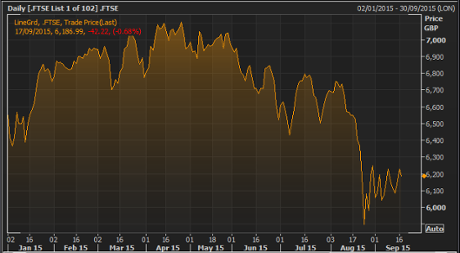
The FTSE 100 index (the largest blue-chip companies listed in London) fell by 42 points, or 0.7%, to extend its recent zig-zag pattern:
Alastair McCaig, Senior Market Analyst at City firm IG, says that European stock markets resembled “rabbits caught in headlights” today.
There’s a feeling that tonight’s decision could be “much ado about nothing”, McCaig adds, with some financial institutions now looking to December for the first hike.
Central bankers such as Janet Yellen have put lots of effort into reassuring the markets that the first rate hike isn’t a huge event.
The most important thing is the future path of borrowing costs, not exactly when the first rise comes, they argue.
But despite that, analysts at Capital Economics believes that the US bond markets could be “rattled”.
They say:
This is not because we expect tighter monetary policy to drive credit spreads a lot higher – again, this has not tended to happen in the past.
Rather it is largely because we think that the Fed will raise the federal funds rate faster and further than discounted in the Treasury market over the next year or two.
A rate hike, when it comes, is going to be a new experience for millions of financial workers worldwide.
Anyone who got their first job on Wall Street since 2009 (or in the City of London, Frankfurt, Tokyo or Shanghai for that matter) has only ever known record low interest rates.
They’ve never had to analyse companies, predict bond spreads or FX moves in an era where the world’s most important central bank is tightening policy. It’s going to be a learning curve....
ICYMI: if the Fed hikes rates today, 1/3rd of traders will be trading it for the first time http://t.co/v4FizrZLvK pic.twitter.com/yv9PS0uHfU
— Callie Bost (@callieabost) September 17, 2015
Three hours to go until the Fed announces its decision.
Janet Yellen will then hold a press conference, 30 minutes later (at 2.30pm EDT or 7.30am BST).
WATCH LIVE TODAY: Press conference with #FOMC Chair #Yellen at 2:30 p.m. ET: http://t.co/v8ZMdutyPL
— Federal Reserve (@federalreserve) September 17, 2015

The International Monetary Fund’s chief spokesman, Gerry Rice, has declined to comment on tonight’s decision.
We respect the independence of the Fed, Rice tells reporters.
Yes, that’s the same IMF which recommended last week that central banks maintain an “accommodative monetary stance”, as global economic growth looks disappointing.
The Washington Post’s Ylan Q. Mui reminds us how much has changed since 2006, the last time US interest rates were raised.
Last time Fed hiked, "the iPhone didn’t exist, Peyton Manning had never played in a Super Bowl and Nintendo first released the Wii." @WSJ
— Ylan Q. Mui (@ylanmui) September 17, 2015
(and for UK readers, Alastair Cook had just played his first test match for England)
On the other hand, the Philly Fed is just one more data point....
Yes, #financetwitter, after months of data interpretation, the Fed just abruptly would cancel its plans to hike based on Philly Fed.
— David Gaffen (@davidgaffen) September 17, 2015
Philly Fed manufacturing survey misses expectations
The Philadelphia Federal Reserve has JUST delivered a blow to hopes of a rate hike today.
The Philadelphia Fed’s monthly manufacturing index, which tracks conditions in the region, has fallen short of forecasts, dropping to minus 6.0 from plus 8.3.
That shows factory activity in the mid-Atlantic area is contracting this month.
Activity in the sector may have suffered from recent volatility in the stock market and international news reports, the Philly Fed suggests.
This is the first negative reading since February 2014, and the lowest since February 2013. A big miss, just as the FOMC is wondering whether to raise borrowing costs.
BREAKING: Philly Fed index comes in at -6.0 (Sept.) vs. 8.3 (Aug.)
— CNBC Now (@CNBCnow) September 17, 2015
It’s the second survey this week to suggest the US factory sector is in a soft patch, after the Empire State report yesterday.
Philly Fed misses sharply to the downside signaling more negative feedback into the economy from financial market turbulence.
— Carl Riccadonna (@Riccanomix) September 17, 2015
Some analysts reckon it lowers the chances of an interest rate rise today.
Kiss your rate hike goodbye if u havent already
— Ashraf Laidi (@alaidi) September 17, 2015
Philly Fled..
— Lorcan Roche Kelly (@LorcanRK) September 17, 2015
Updated
Nearly seven years of record low interest rates have meant fallow times for savers.
With hindsight, they should have bought shares in tech firms like Amazon, Apple and Netflix instead.
$AAPL, $AMZN and $NFLX have soared over 1,000% in 9 years since Fed last raised rates http://t.co/z3zAFmb4P2 pic.twitter.com/psM42KY3yr
— Michelle Coffey (@m_cof) September 17, 2015
JP Morgan analysts like the look of today’s US jobless report (covered an hour ago)
Initial claims decline to 264,000, sends "upbeat signal regarding labor market conditions" - JPM
— James Pethokoukis (@JimPethokoukis) September 17, 2015
The S&P 500 index has fallen by 0.1% in early New York trading.
One stock stands out - Cablevision shares jumped by over 15%, after European telecoms company Altice Group announced a $17.7bn takeover deal.
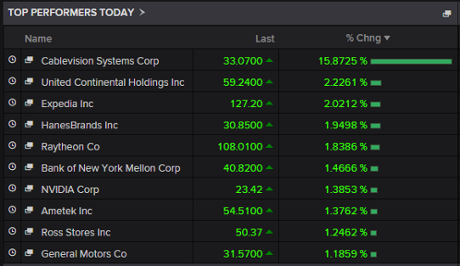
US stock market opens lower ahead of the Fed
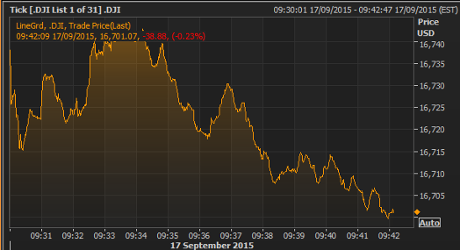
A very cautious open on Wall Street has seen the Dow Jones industrial average dip by 0.25%.
The Dow is down 38 points at 16,701 at pixel time.
Updated
Wall Street is feeling the calm before the storm.....
Unsurprisingly quiet overnight session for the Dow - being forecast to open broadly unchaged at 16,740.
— David Jones (@JonesTheMarkets) September 17, 2015
Carlyle's Rubenstein: Fed won't hike today

Private equity magnate David Rubenstein, the founder of The Carlyle Group, made himself a billionaire by reading the markets. And he says the Fed will not raise interest rates this month.
Speaking on CNBC, Rubenstein argues that the Fed will wait until investors expect a hike before acting. As he put it:
“The Fed is really the central bank of the world. If the Fed raise rates a little bit, it will have an impact all over the world, particularly in emerging markets.
“I think the Fed is sensitive to that, and I think therefore the Fed is likely to wait for another month or two to get additional data and probably telegraph a little bit better than it has now that it’s about ready to do it at a particular time.”
Rubenstein is right that the markets aren’t expecting a hike (it’s a 32% chance, ‘pparently).
The Fed won't raise rates now, David Rubenstein says. Here's why » http://t.co/4P5oPWc8NZ pic.twitter.com/fHpBEuldsY
— CNBC (@CNBC) September 17, 2015
Another gobbet of US economic data -- the number of new housing starts fell by 3% in August.
However the number of building permits -- giving permission to construct a new house -- increased by 3.5% during the month, suggesting the market remains quite robust.
Housing starts slip 3.0% in August after weaker July http://t.co/cX293ABsF3
— MarketWatch (@MarketWatch) September 17, 2015
US jobless claims hits two months low
Here’s something for the Fed to chew on. The number of Americans filing new claims for jobless benefit has hit an eight week low, down by 11,000.
The initial claims total dropped to 264,000 last week, data just released shows, down from 275,000.
That’s the lowest level since mid July, and suggests the US labour market remains robust.
I’m not sure how much attention Janet Yellen pays to Twitter. But if she’s lurking, she should check out the #chartsforJanet hashtag for some helpful advice on today’s decision:
What inflation pressure? #chartsforJanet http://t.co/x9ZvkYXVkx pic.twitter.com/5DV8Y2Mez6
— fastFT (@fastFT) September 17, 2015
"Careful not to jump at shadows." Fed urged to think of the Kiwi experience. http://t.co/NKc9Jxp70D #chartsforJanet pic.twitter.com/Vw0G8Ddl7t
— fastFT (@fastFT) September 17, 2015
Time for Fed to "declare partial victory" on jobs, and hike rates, says BAML. http://t.co/smmycjeBV7 #chartsforJanet pic.twitter.com/fHeXCmWfX0
— Financial Times (@FT) September 16, 2015
"The market has 'tightened' for the Fed already." Hold fire, says CRT. http://t.co/w5PuaqjPUe #chartsforJanet pic.twitter.com/ImQ3aE48n5
— Financial Times (@FT) September 16, 2015
Reuters has caught up with one of the economists who will be smiling if Janet Yellen announces a rate hike today, but blushing if she doesn’t.
Here’s a flavour:
“I joke to colleagues, do I still have a job on Friday if I get it wrong on Thursday?” says Citigroup’s William Lee, adding that no, his pay will not be cut if he blows the call.
Citi goes with a Fed hike and Lee said that investors read research from banks to “stress test” their positions; for that reason, even if he is right that the Fed raises rates but gets the why wrong, “I’m embarrassed.”
If he gets the rate call wrong, he will dissect what he might have missed.
I suspect Ipek Ozkardeskaya of London Capital Group speaks for many in the City today, after months of speculation about today’s FOMC meeting.
Whatever happens. I do not want to hear about #Fed for the next couple of weeks.
— Ipek Ozkardeskaya (@IpekOzkardeskay) September 17, 2015
We’re not expecting any early drama when Wall Street opens in 90 minutes time.
The futures markets shows the Dow falling just 10 points at the open, to 16,729.
Nour Al-Hammoury, chief market strategist at ADS Securities in Abu Dhabi, says:
The long awaited Fed meeting is finally here, but if the Federal reserve delays the hike again their creditability is on the line, but we do not think this is enough of a reason for them to raise rates.
We are looking for a hold with no change in the current policy, but with an option for the hike in either October or December.
Back to the Federal Reserve.... and Bloomberg has pulled together a handy guide to the challenge facing the US central bank today.
If they don’t raise rates today, then it creates the “Yellen Put” -- the notion that the Fed chief will cave in whenever investors get jittery. That’s not good for credibility, and also risks losing the chance to raise rates gradually.
So they should hike? Not so fast! An ill-timed rate rise can hurt the global economy, and suggest the Fed isn’t taking its mandate on inflation seriously
Great resource here on the Fed's highly anticipated decision: http://t.co/3nrBFtQi12 @BloombergBrief #FOMC #Fed pic.twitter.com/XDQa3vMQSp
— Andrew Barden (@abarden) September 17, 2015
Updated

Once the Federal Reserve meeting is over tonight, the financial markets can return to fretting about Greece.
And three days before crucial Greek elections, polls this morning are indicating that Sunday’s vote is going to be the tightest of ballots.
Helena Smith reports from Athens:
The race to find a stable government that can navigate debt-crippled Greece through its worst economic crisis in decades just seems to be getting tighter and tighter.
Throughout the four weeks that have preceded this “express” election, surprise has been the dominating force. Nothing has gone quite to plan, either for leftwing former prime minister Alexis Tsipras’ Syriza party or his conservative challenger New Democracy. For the former (if polls are to be believed) the result has been disappointing; for the latter much brighter than perhaps even New Democrats would have believed.
A new survey conducted on Tuesday and Wednesday this week by Kapa Research and published in today’s Vima gives Syriza the lead but at 0.6% shows the gap between Syriza and New Democracy narrowing even further. Similarly, Tsipras has the edge over his conservative challenger Vangelis Meimarakis – but only just. The poll showed that while 36.5% thought him more suitable for the post of prime minister, 35.1% also favoured Meimarakis – until recently no force to be reckoned with on the political scene.
Once again, the neo-fascist Golden Dawn came in third with 6.7% followed by the socialist democrat Pasok with 5.9%, the communist KKE party with 5.5%, the centrist Potami with 5% and the breakaway far left Popular Unity with 3.5%.
The Independent Greeks party (Anel), Tsipras’ junior party in government has voter support of 3% in the poll – just enough to cross the threshold and get into the 300-seat parliament.
The findings show that crisis-plagued Greece is in for a ride – despite the voter fatigue which also appears to be the other dominant factor in this election.
The stability the country so desperately needs to nourish the political certainty that will allow it to implement the measures – set as the price of being bailed out to the tune of €86bn for a third time since 2009 - may prove to be elusive. Politicians were at pains today to insist that a re-run was out of the question. “There is definitely not going to be a second round of elections,” the former Syriza economy minister Giorgos Stathakis told Skai TV. But with no party set to win a majority and Tsipras ruling out a coalition with New Democracy – forming a government could well be hard.
The undecided, says, analysts will play a crucial role but so, too, will those who have vowed to abstain. Such is the worry over the latter that Syriza – now focusing on first-time voters and women, the majority of undecided – has rolled out posters imploring voters to cast ballots.
“No apohi”, it says, using the Greek word for abstention, adding:
“As long as you abstain others make plans against you.”
The Greek electorate is tired – tired of crisis and tired of the policy options offered by politicians.
After Fed uncertainty put to bed this evening, thank goodness for weekend equally-difficult-to-call Greek election result to keep us amused
— Mike van Dulken (@Accendo_Mike) September 17, 2015
Updated
A glimmer of good news has been spied in Greece, ahead of Sunday’s election. Fewer than one in four adults are officially unemployed, for the first time in over three years:
Unemployment dips below 25% in second quarter #Greece http://t.co/Oqmw7OxYkG pic.twitter.com/uor5Aa5qUn
— Derek Gatopoulos (@dgatopoulos) September 17, 2015
Money has already been flowing out of emerging markets and into the stock markets of advanced economies, in anticipation of higher US interest rates:
European stocks increasingly seen as safe haven as #Fed decision looms http://t.co/5QofsWKwhs pic.twitter.com/t4hrTWuFMs
— Andrew Rummer (@AJRummer) September 17, 2015
Just 32%. That’s the market-implied probability that America gets its first interest rate rise since 2006 today.
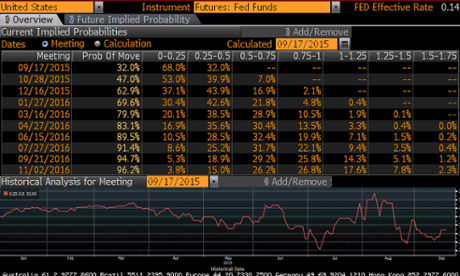
So there could be wild moves if the Fed does hike, as it would not be ‘priced in’.
UBS: rarely has there been such a divide in opinion among econos & investors on what the Fed should do & what the Fed is most likely to do.
— Luke Kawa (@LJKawa) September 17, 2015
City investors are adopting a classic “hold-off-and-see” stance ahead of tonight’s Fed decision, says Mike van Dulken, head of research at Accendo Markets.
Mike adds:
This announcement is all the more important given its potential to include the first rate hike in a decade, signalling the beginning of the end of extraordinarily cheap money and exit from ‘crisis’ mode.
The US dollar has weakened a little this morning, down 0.3% against the euro to $1.1327.
That suggests traders are pricing in ‘no change’ from the Fed tonight.
FX markets relatively subdued ahead of #FOMC. #Dollar selling off slightly since the European open. TM pic.twitter.com/6MlPZRPosB
— IGSquawk (@IGSquawk) September 17, 2015
Moody's: Fed hike is bad for these emerging markets

Brazil, Russia, Turkey and South Africa have most to fear from a US interest rate hike, says rating agency Moody’s in a new report.
It argues that America’s economy could handle a small (0.25%) rise in borrowing costs, but several emerging nations would struggle if their currencies weakened.
Here’s the highlights:
- If the US Federal Reserve raises short-term interest rates by 25bps, Moody’s does not anticipate a significant impact on interest rates or currencies in developed countries.
- Direct impact the US economy from a rate hike will be minimal as the Fed funds rate will rise by only a likely quarter of a point, and further rises will be very gradual. Any rise in borrowing costs will also be minimal, but short-term T-notes, T-bills may go up modestly.
- The impact of a US rate hike on emerging markets will vary. Some have already anticipated a Fed action and have seen large drops in their exchange rates. Currency depreciation does bode well for exports, but can provoke turbulence in financial markets, therefore affecting overall growth.
- The countries most at risk going forward include Brazil, Russia, Turkey and to some extent South Africa, where severe domestic challenges have contributed to exchange rate and financial market instability, and where policy room to buffer external shocks and protect growth is less robust.
Countries most at risk from US rate hike are Brazil, Russia, Turkey, South Africa, which have "severe domestic challenges" - Moody's
— Jamie McGeever (@ReutersJamie) September 17, 2015
With nine hours until the biggest Fed decision in years, Europe’s main stock markets are all subdued.
The FTSE 100, German Dax and French CAC are all in the red, with investors reluctant to take big positions before tonight’s drama.
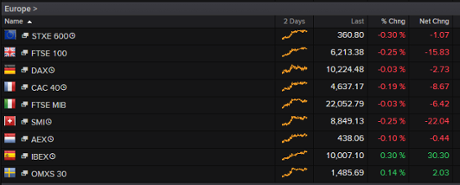
Tony Cross, market analyst at Trustnet Direct, reports that trading is quiet.
The jury remains out as to whether Janet Yellen and her team will be able to push through a rate hike, with yesterday’s downturn in US inflation data being the latest roadblock, but it seems inevitable that if policymakers across the Atlantic do hike rates then equity markets globally will be in for a rough end to the week.

We already have one central bank decision, and it’s a no change.
The Swiss National Bank has left interest rates pegged at between minus 0.25% and minus 1.25%, but warned it could take action to weaken the swiss franc, if needed.
Switzerland introduced negative interest rates last December, to combat the surge of capital into its economy that was pushing the franc uncompetitively high against the euro.
After June's no show, if Yellen's #FOMC don't hike tonight, she will be the financial equivalent of #Wenger in the transfer market
— Joshua Raymond (@Josh_RaymondUK) September 17, 2015
Bloomberg has surveyed 113 economists, and a narrow majority predicted the Fed will not raise rates today.
Bloomberg’s Jon Ferro says the FOMC members must weigh up “the good, the bad and the complete unknown” when they gather today.
The good is the labour market, with the US unemployment rate dropping to just 5.1% in August. The bad is inflation. Data released yesterday showed that consumer prices grew by just 0.2% over the last 12 months, far from the Fed’s target of 2%.
And the unknown factor is the situation in the global economy, the potential ructions from China’s slowdown as it rebalances its economy.
Jon also points out that 15 central banks have hiked rates in the financial crisis, only to reverse course and cut (that includes the European Central Bank in 2011).
Tonights #FOMC decision, latest polls: #Bloomberg: 30% chance of a rate hike #FT: 47% chance of a rate hike #Fed #USD
— Joshua Raymond (@Josh_RaymondUK) September 17, 2015
Economists: It's a very close call

Around half of the top economists in the City and on Wall Street will feel pretty smug when the Fed decision is announced.
The other half may have some explaining to do.
Reuters polled 80 economists from Europe and North America about today’s decision; 45 predicted the Fed will hold, while 35 plumped for a hike.
An earlier poll had shown a slight majority in favour of a rate rise, so it appears that the recent weakish economic data, and August’s market turmoil, has prompted a rethink.
Standard Chartered senior economist Thomas Costerg now expects the Fed to raise in December. Here’s why:
“Fed Chair Janet Yellen has been conspicuously silent, with no significant comments since July’s congressional testimony.”
“We think the recent global market volatility – driven by ongoing concerns about global growth – has raised the bar for a first rate hike near-term.”
Updated
The Fed could potentially decide to leave interest rates unchanged, but make it very clear that a hike is coming soon.
Alternatively, it could increase borrowing costs but then attempt to reassure investors that it will remain cautious.
Kit Juckes of Société Générale, another French bank, explains:
A clear message that a hike is ‘on its way’ is expected, so inaction today will likely only have a significant impact if the message is more dovish than that.
A 25% rate hike would be a surprise to the market (though not to SG Economists) but the biggest surprise of all would be failure to lace any decision with dovish undertones.
And looking ahead, Kit sees the US dollar rising, giving emerging markets another headache.
The first reaction to the policy decision may not tell us much but over the coming months, a sluggish global economy, slowing growth in China and continued monetary policy divergence will dictate currency trends.
There will be further downward pressure on commodities and commodity exporters’ currencies and there will be further upward pressure on the dollar.
French bank BNP Paribas predicts that the Fed will not raise interest rates today.
Analyst Andrew MacFarlane explains (with some bonus US history thrown in):
So we finally arrive at this most pivotal of days which is likely to have major implications around the world; yes, it is Constitution Day in the US, the annual celebration of that fateful day in 1787 when a committee of delegates signed the final draft in Philadelphia. It seems almost fitting that 228 years later, a committee of delegates will today meet at the Federal Reserve to discuss the future of the United States; let’s just hope they don’t have to make 27 amendments as well…
BNP is calling for no change to rates, few changes in the policy statement, and a dovish set of economic and interest rate projections.
Updated
Markets: 30% chance of a rate hike today
There is a 30% chance that the Fed will raise interest rate tonight, according to the Fed funds futures market.
That market, which allows investors to wager on rate moves, also shows that a majority expect rates to rise before Christmas.
Morning Note: 1. FOMC decision day. Economists divided. 2. Bridgewater's Ray Dalio says don't go. 3. Markets say NO pic.twitter.com/4giRglmLxR
— Jonathan Ferro (@FerroTV) September 17, 2015
There’s an edgy mood in Europe’s stock markets this morning.
Investors as nervous, as they simply don’t know for sure which way Janet Yellen and her colleagues on the Federal Open Market Committee (FOMC) will jump tonight.
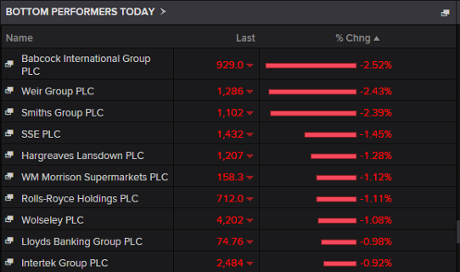
The FTSE 100 index of leading UK shares has dipped by 12 points, or just 0.2%, in early trading. Here’s the biggest fallers:
Updated
Asian stock markets have risen today, on speculation that the Federal Reserve will resist the pressure to hike interest rates today.
Angus Nicholson, of IG’s Melbourne office, explains:
Asian markets are doing well today in cautious positioning ahead of the Fed rates decision, with currency moves in particular reflecting the general feeling that rates will be left unchanged.
The Korean Won, one of the most sold currencies in Asia, is having an impressive day, rising 0.6% against the US dollar.
Japan’s main stock index, the Nikkei, has closed 260 points higher at 18,432,
Nikkei ends up 1.4% at 18432.27 and Yen weakens vs Dollar ahead of the most important #Fed decision in decades. pic.twitter.com/XmqncuXPDj
— Holger Zschaepitz (@Schuldensuehner) September 17, 2015
Introduction: It's Federal Reserve decision day

Good morning.
It’s a historic day. Or rather, it might be.
For the first time since the financial crisis began eight years ago, there’s a genuine chance that America’s central bank will take the plunge and raise interest rates today.
The Federal Reserve’s policy-making committee has an unenviably tricky task at today’s meeting. Is the US economy strong enough to handle the first step towards more normal monetary policy? Or should they leave rates unchanged for yet another month, and repeat the suspense in October?
We find out in almost 12 hours time -- at 7pm BST, or 2pm East Coast time.
And investors across Europe’s and Asia’s financial markets are talking about little else.
Borrowing costs have been pegged at their current record low of zero to 0.25% since December 2008. Rates haven’t actually been raised since June 2006, so this really is a moment.
Fed day. Exciting.
— Duncan Weldon (@DuncanWeldon) September 17, 2015
Hawks on the committee can point to the US unemployment rate; now just 5.1%, the lowest since March 2008.
But Doves can play the (low) inflation card -- prices actually fell by 0.2% month-on-month in August, suggesting little need to hike borrowing costs.
Then there’s the impact that a hike will have on the rest of the global economy. Higher US interest rates will drag capital out of emerging market economies which are already struggling to cope with weakening currencies.
How emerging market economies will be waiting on the #Fed rate decision later on in the day pic.twitter.com/GI3HA4Q2si
— RANsquawk (@RANsquawk) September 17, 2015
Plus there’s the issue of China’s slowdown, which could deliver a shock to the American economy in the months ahead.
The Fed will be desperate to avoid losing credibility by raising rates now, only to cut them if the economy turns south in 2016. But equally, there’s a danger of missing the moment, and having to hike more aggressively next year.
A tough decision, which is why no-one really knows what’s going to happen.
Former Dallas Fed President Richard Fisher, on CNBC: "I think they’ll actually, for the first time in a long time, decide this at the table"
— Ben Leubsdorf (@BenLeubsdorf) September 15, 2015
We’ll be tracking all the build-up to the big decision through the day....
Updated