Despite talk of confidence votes and elections, the Greek government appears to have put off any decision regarding political developments until next week. Our correspondent Helena Smith reports:
After an unusually intense August, the Greek government now appears determined not to act rashly. With European parliaments signing off on the bailout accord and the first aid disbursements looming, prime minister Alexis Tsipras has signaled that any political decision will be put on hold until next week when he has a more thorough overview of the economic situation.
“In the next ten days decisions must be taken so that a road map is on the table,” the government spokeswoman Olga Gerovasili told the municipal radio station Athina 9,84 earlier today.
It would be a “road map” that would take the debt-stricken country through to its first evaluation by international creditors of the measures Athens has agreed to implement in lieu of its third rescue programme.
Asked whether the beleaguered government had set its heart on holding fresh elections, the spokeswoman did not rule out polls at the end of September but prevaricated. “Right now, no decisions have been taken regarding the next steps …. A lot has been heard about what will happen next but I can say with certainty that no decision has been taken about what will happen.”
Aides close to Tsipras said that at this point – with Greece only narrowly “saved” from bankruptcy and euro exit - any move had to be “careful” and “without risk.”
On that note, it’s time to close up for the evening. Thanks for your comments, and we’ll be back tomorrow.
Updated
European markets end lower on China worries
Another slump in the Chinese stock market - down 6% on the day - renewed concerns about the outlook for the world’s second largest economy and pushed commodity prices - metals and oil - lower once more. So despite signs of progress on the Greek bailout, with a number of parliaments voting to back the agreement, investors were in cautious mood once more. By the close of play most markets had fallen back:
- The FTSE 100 lost 24.01 points or 0.37% to 6526.29, with mining shares among the biggest fallers
- Germany’s Dax dipped 0.22% to 10,915.92
- France’s Cac closed down 0.27% at 4971.25
- Italy’s FTSE MIB finished 0.08% lower at 23,389.72
- Spain’s Ibex ended 0.02% down at 10,897.9
On Wall Street, the Dow Jones Industrial Average is currently down 13 points or 0.07%.
The European Central Bank has lowered the emergency liquidity assistance cap for Greek banks to €89.7bn, reports Reuters.
This is said to be in line with a Greek central bank request.
The bailout agreement of course allows for cash to help recapitalise the Greek banks.
#ECB lowering #Greek ELA, but that is to be expected given the bailout agreement and that this is what the Greek's already asked for...
— RANsquawk (@RANsquawk) August 18, 2015
Updated
Here’s Reuters take on the vote in the Spanish parliament to approve the third Greek bailout deal:
Spanish lawmakers voted in favour of a third bailout package for Greece on Tuesday, with the centre-right government voicing misgivings about Greece’s commitment to reforms but using its majority in parliament to approve the rescue.
“There are serious risks, such as execution risks, given the Greekpolitical situation,” Economy Minister Luis de Guindos told parliament in a special session on the deal Greece reached with its creditors, seen as helping it stay in the euro zone.
“This isn’t easy - the path ahead is still long and complex,” de Guindos said.

In a dig at anti-austerity parties such as Podemos that have gained traction in Spain in the past year, De Guindos took aim at the type of “populist siren songs” which he said had pushed Greece to the edge, under the helm of the leftist Syriza party.
Spain faces a general election around November. The country is due to contribute some €10.1bn of the €86bn package for Greece.
Germany’s parliament is expected to give its crucial approval to the bailout deal on Wednesday.
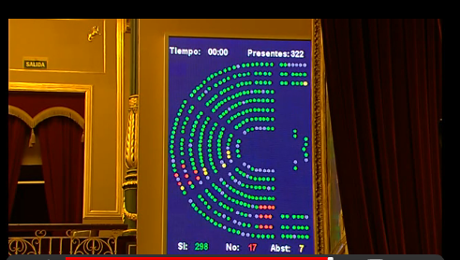
Some Spanish members of parliament railed against the rescue package, saying it did not benefit ordinary people in Greece, although only 20 lawmakers out of 322 voted against it.
Alberto Garzon, leader of the Plural Left alliance, said the bailout obliged Greece to sell off public assets at knock-down prices and allocated too little to economic stimulus measures.
Estonia also backed the Greek deal earlier:
#Estonian parliament @riigikogu approved new bailout for #Greece: 50 for, 37 against, 6 abstaining.
— Raimo Poom (@RaimoPoom) August 18, 2015
6 governing coalition MPs rebelled - 1 voted no, 5 abstained. #Estonia #Greece #bailout #vote #Parliament
— Raimo Poom (@RaimoPoom) August 18, 2015
Here’s the announcement (in Estonian) but the first paragraph translates (according to Google) as:
Parliament approved at an extraordinary session of the European Commission and the Memorandum of Understanding concluded between the Greek draft, Estonia agrees to the Greek political agreement on the program of the third financial endorsement.
Resolution of the Riigikogu “The European Commission and the Hellenic Republic entered into a Memorandum of Understanding between the draft approve” (69 OE), by 50 and by 37 members of the Riigikogu.
The Dutch parliament, which is due to discuss the third Greek bailout on Wednesday amid some reported disharmony among its coalition (£), has conveniently published all the documents related to the deal on its website.
The voting in the Spanish parliament was reportedly as follows:
297 in favour
20 against
5 abstentions
Updated
Spain approves Greek bailout deal
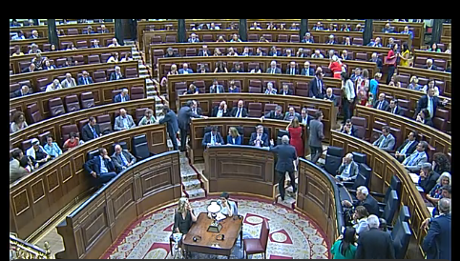
And after the debate, the Spanish parliament has also given its backing to the Greek deal.
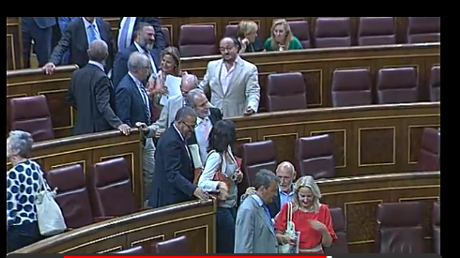
In Spain, parliament is beginning to vote.
Updated
Austria backs Greek bailout deal
Meanwhile:
[BREAKING] Austrian FinMin Schelling: Parl’t Subcommittee Approves Greek Aid - BBG $EURUSD
— Live Squawk (@livesquawk) August 18, 2015
Updated
In China, the central bank has injected $48bn of new capital in China Development Bank, which provides medium and long term financing for major national projects, according to the Xinhua agency.
The move comes amid growing concerns about the outlook for the world’s second largest economy, which prompted a 6% fall on the country’s stock market earlier today.
Updated
While we wait for news of the Spanish vote on the Greek bailout:
#Bundestag to vote on #Greek bailout at 12.05 CET tomorrow. Approval likely, but any extra conditions would increase risk deal won't last.
— Capital Economics (@CapEconEurope) August 18, 2015
Updated
In the US, Wall Street has opened lower in the wake of the 6% slump in Chinese shares, as well as disappointing quarterly figures from Wal-Mart.
The Dow Jones Industrial Average is down around 40 points or 0.2%.
Earlier US housing starts rose 0.2% to a near eight year high in July, another sign of a stronger housing market and a possible interest rate rise next month.
#Housing starts +0.2% to 1.2 mil in Jul. Permits -16.3% to 1.12 mil as NY tax break expires. Housing gradual rebound. pic.twitter.com/zlXkDpMWHu
— Gregory Daco (@GregDaco) August 18, 2015
Even at a seven-plus-year high, housing starts still well below bubble-era levels http://t.co/4bbFguDesF pic.twitter.com/zKhqs1ctSL
— MarketWatch (@MarketWatch) August 18, 2015
Back with the voting on the Greek bailout:
BBG Reporting That Slovenia Is Said To Endorse Greek Aid Package
— Live Squawk (@livesquawk) August 18, 2015
Meanwhile Greece is still in talks with Germany’s Fraport about a €1.2bn deal to operate 14 regional airports, says Reuters, despite earlier reports a deal had been done.
A preliminary agreement was reached last year, and a report in the government gazette today was initially taken to mean the deal was done. But a government official said the announcement was just confirming a commitment to proceed with the plan under the previous terms.
Now this is interesting..... There’s a rumour that Alexis Tsipras might organised summer sessions in the Greek parliament, to help drive through the economic reforms agreed with lenders.
“Summer sessions” sound rather cosy and fun; conjuring up visions of MPs sipping Pimms in deckchairs, perhaps, and occasionally passing the odd law.

The reality is less relaxing, and more Machiavellian. It would mean that just 100 MPs debated the plans, not the full 300 -- and Tsipras could choose which government members turned up.
Kathimerini reports:
The aim of switching Parliament to a reduced summer session, where 100 MPs sit instead of the full 300, would be to allow him to choose which SYRIZA MPs attend the votes, thus removing rebel lawmakers and facilitating the passage of legislation pledged to lenders.
According to sources, a presidential decree ordering Parliament to switch to its summer sessions has been drafted and only requires the signature of President Prokopis Pavlopoulos.
If it happens, Tsipras could force unpopular measures into law, avoiding a confidence vote.
It would clearly be controversial, though, especially given Tsipras’s opposition to the whole notion in the past.
July 2014: #Tsipras accused former govt of using Parliament's summer sessions to 'sell-off Greece's public assets'. https://t.co/HUorQFrIB7
— The Greek Analyst (@GreekAnalyst) August 18, 2015
Reduced summer sessions of parliament are what Tsipras was blasting Samaras about exactly one year ago http://t.co/DBcqF8hZtS #Greece
— Theodora Oikonomides (@IrateGreek) August 18, 2015
Updated

Here are more highlights from the Spanish parliament’s debate on Greece, via the Open Europe thinktank.
First, economy minister Luis de Guindos:
Guindos: Spain has shown solidarity with #Greece. We took part in all three bailouts, despite limited exposure and bad economic conditions.
— Open Europe (@OpenEurope) August 18, 2015
Guindos: Spanish contribution to third Greek bailout will be around €10.15bn. #Greece
— Open Europe (@OpenEurope) August 18, 2015
Guindos says Spanish exposure to #Greece will rise to around €34bn after third bailout.
— Open Europe (@OpenEurope) August 18, 2015
Guindos: Irresponsible policies come with a price, especially for the most vulnerable. #Greece
— Open Europe (@OpenEurope) August 18, 2015
Guindos: We need to move towards fiscal union and, ultimately, towards a political union. #Greece
— Open Europe (@OpenEurope) August 18, 2015
Guindos was followed by opposition Socialist Party’s economics spokesman, Moscoso del Prado, who didn’t hold back his criticism:
Moscoso: The Socialist Party backs the bailout deal, but much more is needed for #Greece and Eurozone to return to growth.
— Open Europe (@OpenEurope) August 18, 2015
Moscoso: Economic situation in #Greece is much worse than six months ago. We think bailout deal must be complemented with humanitarian plan.
— Open Europe (@OpenEurope) August 18, 2015
Moscoso (PSOE): #Greece has made many mistakes, but so did Europe by insisting too much on austerity.
— Open Europe (@OpenEurope) August 18, 2015
Moscoso (PSOE): Euro break-up has been avoided, but we're still lacking a medium and long-term strategy. #Greece
— Open Europe (@OpenEurope) August 18, 2015
Moscoso (PSOE): Debate over Eurozone reform has been led by Hollande and Renzi. You, Mr Rajoy, were absent. #Greece
— Open Europe (@OpenEurope) August 18, 2015
Updated

Spanish finance minister warns of Greek risks
Back to the other main issue, Greece’s third bailout.
Spain’s parliament is now debating whether to support the €86bn loan programme.
And the session began with economy minister Luis de Guindos warning that Athens could fail to meet its side of the bargain.
“There are serious risks, such as execution risks, given the Greek political situation....
De Guindos also took a swipe at anti-austerity parties (such as Spain’s Podemos) who argue against Europe’s policy of austerity. As he put it:
“Populist siren songs only end in mirages.”
Podemos are holding onto third place in the Spanish opinion polls, with a general election due before January.
Summary: UK inflation picks up
If you’re just tuning in, here’s our story on UK inflation inching back into positive territory, by Katie Allen:
Britain’s inflation rate ticked higher last month, heating up the debate over when Bank of England policymakers will start raising interest rates.
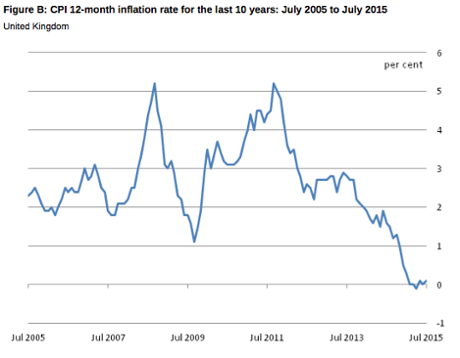
The consumer price index (CPI) measure of inflation edged up to 0.1% in July from zero the month before, defying City expectations for no change and pushing the pound higher.
The Office for National Statistics (ONS) said clothing prices were the main factor behind the rise, as shops offered fewer bargains in their summer sales. There was also some upward effect from airfares, which picked up more than last summer despite sharply lower oil prices.
Those upward factors were only partially offset by falling food prices and cheaper diesel.
“This is the sixth month running that headline inflation has been at or very close to zero. While households will have seen individual prices rise and fall, the overall shopping basket bought by the country remains little changed in price compared with a year ago,” said ONS head of CPI Richard Campbell.
Here’s Katie’s full piece:
And Shane Hickey confirms that regulated rail fares are likely to rise by 1%, in line with RPI inflation. next year:
Following the RPI figure announcement, the passenger watchdog TransportFocus said that while fares are increasing, punctuality is going down for many users.
“The poor performance in the south-east in particular highlights how Network Rail and operators need to deliver a more consistent day-to-day service which passengers can rely on,” the watchdog’s passenger director, David Sidebottom, said.
Wall Street’s finest (?!) also reckon the UK consumer prices index may dip below zero again soon.
Goldman Sachs still expect UK CPI inflation to drop below zero in the coming months. Updated forecasts: pic.twitter.com/Mndn0AVMHA
— Ed Conway (@EdConwaySky) August 18, 2015
Inflation could easily turn negative again this month, predicts Martin Beck, senior economic advisor to the EY ITEM Club:
“July’s uptick in inflation represents something of a false signal. The increase is largely due to clothing prices, with this year’s summer sales seeing less discounting than last year’s, and an increasing pressure on air fares.
Overall, the modest pickup in inflation appears to be largely a function of temporary factors rather than a sign that inflationary pressures are escalating.”
The pound is continuing to climb, in a fillip to UK readers who haven’t taken their summer holidays yet.
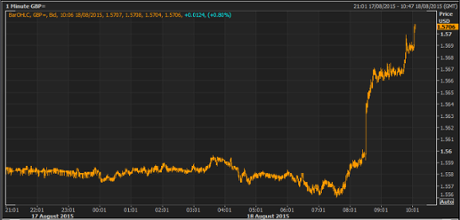
Sterling is up over 1 cent against the dollar now, at $1.571, and also gained one eurocent to €1.418.
Ranko Berich, head of market analysis at Monex Europe, cautions that the Bank of England will still be cautious about raising interest rates:
“While wages are increasing rapidly, this is clearly failing to filter through to inflation. With sterling’s current strength and further fiscal tightness planned for the UK, if the MPC pulls the trigger too early on rate hikes it’s difficult to see how the Bank of England’s 2% inflation target will be reached in any reasonable timeframe.
“Making an assumption that underlying price pressure will suddenly begin to pick up in the coming quarters is an awfully risky call. If the Bank of England has seemed indecisive over rate hikes in recent months, this inflation report is unlikely to give them any reason to get off the fence and act.”

UK house prices continue to outpace the official inflation rate.
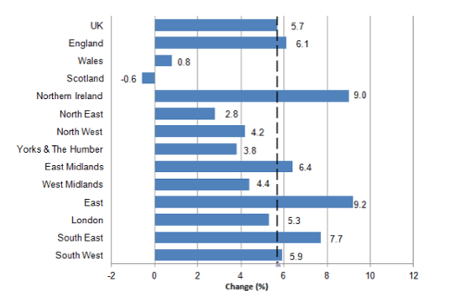
The average house price increased by 5.7% in the year to June 2015, up from 5.6% a month earlier, the Office for National Statistics reports.
The East of England led the way, while price rises in the capital have slipped back:
House prices are still outpacing wages, meaning young people in “Generation Rent” face a major struggle reaching the bottom rung of the ladder.
Richard Snook, senior economist at PwC, warns:
Our recent research into this trend showed that by 2025 there will be more private renters than people owning a home with a mortgage, and that over half of the 20-39 age group will live in private rented accommodation.
Today’s figures show that house prices are growing at more than twice the rate of average earnings, further squeezing affordability for buyers.
At just 0.1%, the UK inflation rate remains well shy of the 2% target which is meant to represent stability.
The prime minister doesn’t sound worried, though:
It's good news that inflation remains low. Low prices and rising wages show our economic plan is giving working people more security.
— David Cameron (@David_Cameron) August 18, 2015
Nick Dixon, Investment Director at Aegon UK, also believes the Bank of England will resist raising interest rates this year:
“Today’s news confirming six months of flat prices will be welcomed by pensioners, with macroeconomics now swinging in their favour as they benefit from the ‘triple lock’ minimum pension increase of 2% per year.
Inflation is being held back by the strong pound and lower oil prices, and is likely to remain minimal in the short term. The inflation figures also raise probability of the first rate hike since 2007 being after Christmas, not before.”
The jump in core inflation, to 1.2%, raises the chances that UK interest rates will rise in early 2016.
Jeremy Cook, chief economist at the international payments company Worldfirst.com, explains:
“Inflation is positive in the UK, and positive for the UK. A period of ultra-low inflation is an obvious benefit for the UK economy – i.e. almost non-existent price rises in goods and services that consumers must buy, such as food and energy – frees up more disposable income elsewhere.
It will also allow people to pay down debt and replenish savings that may have needed to be used during leaner times. This has been the driver of the UK recovery.”
“The key for policymakers is as long as core inflation – prices without these essentials – remain strong, then the Bank of England will continue to look through these headline declines as temporary and not as a reason to adjust their position towards rate hikes. The rise to 1.2% - the highest in 5 months – will flesh out the argument that domestic inflation is building and that the headline figure is only this low due to external factors – commodities and the pound. This is crucial for interest rate hikes and we maintain our calls for a February interest rate increase”
However, there are also some disinflationary forces on the horizon, Jeremy adds:
Oil remains in a downtrend, as do most commodities. Sterling is stronger than it was this time last year by over 7% on a trade weighted basis and last week’s moves by the People’s Bank of China will see lower prices sweep in from the East in the next 6 months. For now however, consumers should take the low inflation as good news and leave the worrying to the men and women of Threadneedle Street [The bank of England]”.
Updated
Royal Bank of Scotland flags up some of the more interesting changes to inflation in the last year:
Micro matters too. CPI at 0.1% but the price of wine and food fall (yay!) while rents and flights rise (boo). pic.twitter.com/6NJZela9MG
— RBS Economics (@RBS_Economics) August 18, 2015
George Osborne must be on holiday, as he’s left the task of commenting on the inflation data to the newly ennobled Jim O’Neill.
Lord O’Neill says low inflation is “great news for working people and family budgets”, but also warned that the global economic situation remains “so uncertain”.
Read Commercial Secretary to the Treasury, Lord O’Neill’s response to today’s #inflation figure: pic.twitter.com/G6DNGXMcxK
— HM Treasury (@hmtreasury) August 18, 2015
Britain’s inflation rate is still close to its lowest level in 50 years, having briefly turned negative back in May:
Food isn’t the only thing keeping the cost of living down. Transport costs are also lower, thanks to cheaper petrol than a year ago.
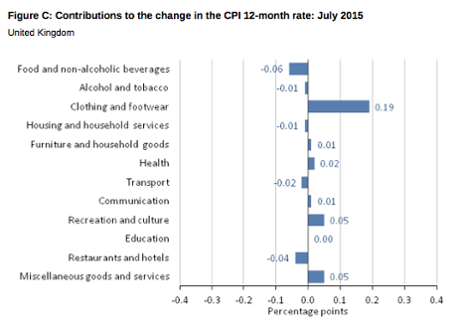
UK inflation: the details
So, why did Britain’s annual CPI inflation rate inch up to 0.1% last month?
The Office for National Statistics says clothing prices fell at a slower rate than a year ago:
Overall clothing and footwear prices fell by 3.4% between June and July this year compared with a larger fall of 5.7% between the same 2 months a year ago. Prices always fall between June and July during the summer sales period.
The biggest downward contribution, once again, came from food and non-alcoholic beverages. Average prices fell by 0.7% between June and July, compared to a 0.2% fall between the same 2 months a year ago.
The downward contribution came from price movements in most sectors – notably in the milk, cheese and eggs sector – where the prices of 2 pint cartons of shop bought milk have fallen. There was a partially offsetting contribution from rising prices in the bread and cereals sector.
Last week, UK grocers agreed to pay guaranteed minimum prices to dairy farmers, after facing criticism for using milk as a weapon in their price wars.
Core inflation at 1.2% and wage growth quite perky. Hard to fret much about UK deflation.
— Duncan Weldon (@DuncanWeldon) August 18, 2015
Negative inflation, more like....
Updated
Inflation data signals higher rail fares

Britain’s rail users can expect fares to rise again next year, thanks to today’s inflation figures.
The Retail Prices Index, used to set regulated ticket prices, rose by 1.0% annually in July.
Before May’s election, the Conservative Party pledged to cap rail increases at RPI, so prices will follow in January.
As we covered earlier, rail fares have been outstripping wages since 2010:
Here are rail costs vs earnings and CPI since 2000: pic.twitter.com/gK3XKu9IlI
— Ed Conway (@EdConwaySky) August 18, 2015
Sterling jumps on back of inflation data
The pound has just jumped by almost half a cent against the US dollar, to $1.565, as the inflation data hit the wires.
One reason: core inflation, which strips out volatile factors like energy and food, jumped to 1.2% last month. That’s a five-month high, suggesting underlying inflationary pressures are building, putting pressure on the Bank of England to raise interest rates.
Pound spikes higher as inflation comes in slightly stronger than expected. +1.2% core YoY price growth pic.twitter.com/fWZMS9P9Lr
— Caroline Hyde (@CarolineHydeTV) August 18, 2015
Updated
UK inflation rises to 0.1%
Breaking: Britain’s headline inflation rate turned positive, just, last month.
The Consumer Prices Index rose by 0.1% in July, compared to a year ago, according to the Office for National Statistics. That is up from 0.0% in June.
Prices did dip by 0.3% month-on-month, though.
More to follow....
Greece eases capital controls (a little)
The Greek government has made some small tweaks to country’s capital control regime, reports Kathimerini:
In legislation published late on Monday, the Finance Ministry now allows the transfer of €500 a month abroad.
It also permits parents to send a lump sum of €8,000 abroad to cover the expenses of children who are studying outside of Greece. The previous limit was €5,000.
Greeks will now be allowed to open bank accounts, which they had not been able to do since capital controls were introduced on June 29, but only for paying bills or servicing loans. They will not be able to withdraw cash from these accounts.
The Open Europe think tank has a handy list of the eurozone governments which must approve the Greek bailout this week, including Spain, Estonia and Austria today:
Which parliaments need to approve 3rd #Greece bailout & how will they vote? I try to lay it out for @OpenEurope http://t.co/hWChDSesjR
— Raoul Ruparel (@RaoulRuparel) August 18, 2015
Here’s the section on Estonia:
An extraordinary parliamentary session has been called for today starting at noon. As with the other Baltic countries which underwent their own significant austerity and internal devaluation programme, sympathy for Greece in Estonia has been limited. However, the reform programme is likely to be seen as sufficient for approval.
There may be trouble ahead. Ratings agency Moody’s has predicted that the threat of a Chinese slowdown, US interest rate hikes, and Greece’s problems will all hold back global growth over the next two years.
Here’s the full story:
Europe’s stock markets are now falling, as the Chinese rout hits confidence in the City.
The FTSE 100 is down 27 points, or 0.4%, at 6522, led by mining stocks such as Antofagasta (-2%).
Today wasn’t a good day to be playing the Chinese financial markets.
As these photos show, share charts were a sea of green (for losses) as the Shanghai composite index plunged by over 6%.


Updated

Today’s UK inflation data, released in around 30 minutes, is particularly important to commuters.
July’s Retail Prices Index (RPI) will be used to set regulated rail fares in 2016. It’s expected to come in at 1% (compared to 0% for the CPI).
The government has pledged to cap rail fare increases at RPI, but that hasn’t deterred unions from protesting this morning - pointing out that regulated fares have increased by 25% since 2010, while the average pay packet grew by just 9%.
Wolfgang Schäuble’s positive comments about Greece hide his true long-term objectives, reckons Alastair Winter, chief economist at Daniel Stewart & Co:
#Schauble may have given up #grexit but more likely tactical to see if #Tsipras will hang himself enough that even #hollande cannot help
— Alastair Winter (@AlastairWinter) August 18, 2015
Kathimerini: Tsipras may resist confidence vote

Yesterday, rumours were swirling that Greece’s prime minister would call a confidence vote soon, having suffered his own rebellions over the bailout deal.
But Greek newspaper Kathimerini now reckons Alexis Tsipras may resist this move, which could trigger elections, while he gets to grips with the measures agreed with lenders.
They write:
Government sources suggested on Monday that Tsipras first wants to discuss with his economic team how the first tranche of Greece’s third bailout, which was passed through Parliament on Friday and then rubber-stamped by eurozone finance ministers, will be disbursed.
Athens is due to receive €26bn of the total €86bn as its first installment but this will be broken into sub-tranches, with €10bn going toward recapitalizing Greek banks.
The prime minister also wants to be briefed on what measures the government will have to adopt over the next few weeks in order to comply with the bailout terms and ensure that there will be no complications when the lenders’ technical teams return in October to review the program’s implementation.
“We cannot put at risk the smooth implementation of the agreement,” said a government source who preferred to remain anonymous.
Tsipras is likely to lose any confidence vote, as left-wing rebels in his party are signalling that they would not back him:
Left Platform's Leoutsakos indicates #Syriza dissidents will not support the government in possible confidence vote ~@MegaGegonota #Greece
— Yannis Koutsomitis (@YanniKouts) August 18, 2015
Steve Wang, chief China economist at Reorient Financial Markets Ltd, believes Chinese investors panicked today and lost faith that Beijing would keep propping up share prices.
Wang said (via Bloomberg):
“Investors ran for the exit when the government failed to step in to support the market.”
#China’s stocks sink most in three weeks on State support concern http://t.co/r239nP5q0I
— Francine Lacqua (@flacqua) August 18, 2015
Chinese stock market dives 6%
The Chinese stock market has suffered another selloff today, as fears of economic slowdown rip through trading rooms.
The main Shanghai index plunged by over 6% in the last hour of trading, the biggest fall in around three weeks.
#CSI300 declines over 6% in late trading in #Shanghai. RO pic.twitter.com/VLurXMM19K
— IGSquawk (@IGSquawk) August 18, 2015
The selloff came after the yuan fell against the US dollar, and data showed that monthly house price growth slowed to + 0.3% in July.
Whatever the reason for the rout, it won’t make investors any less worried about China:
Three new 'tail risks' for BAML. China recession and EM debt crisis at the top. pic.twitter.com/Ps3MeabEkq
— Lady FOHF (@LadyFOHF) August 18, 2015
Schäuble: Give Greece a chance
Wolfgang Schäuble sounded remarkably upbeat in his interview with ZDF last night, arguing that Athens has made significant progress recently.
As he put it:
“In the last weeks, things have moved much more quickly than most of my colleagues would have thought possible.
Let’s hope that this surge forward continues then Greece really has a chance and we have every interest in it succeeding.”
Schäuble’s old sparring partner, Yanis Varoufakis, might raise his eyebrows at such talk.
Yesterday, the ex Greek finance minister deftly filleted the bailout agreement, to show how its financial targets are too ambitious, while its economic reforms remain flawed.

Overnight, Germany’s finance minister did his best to avoid a major rebellion over the third Greek bailout.
Wolfgang Schäuble told German public broadcaster ZDF that MPs should vote for the plan tomorrow.
You’ll remember that Schäuble had pushed the idea of a temporary Grexit at last month’s crisis summit in Brussels, so clearly he must have qualms about the way things turned out.
But still, he told ZDF that:
“I can argue with full conviction, partly because I haven’t taken this decision lightly myself ... that the right thing to do is to vote for this.”
Schäuble added that he’s “sure” that the International Monetary Fund will decide to take part in the programme, something Germany sees as essential. The Fund won’t make that decision until the autumn, though.
Analysts had calculated that up to 120 MPs from the CDU/CSU bloc could defy chancellor Merkel and reject the terms of the deal. Schäuble’s intervention might persuade a few potential rebels to sit tight. We’ll find out tomorrow...
Introduction: UK inflation and Greek bailout votes
Good morning, and welcome to our rolling coverage of the world economy, the financial markets, the eurozone and business.
Greece will move another few steps closer to receiving its third bailout today. The parliaments of Spain and Estonia are both voting on the plan, while a special subcommittee in Austria will also give the thumbs-up, or down, during the day.
That’ll be an entrée before the main event, the Bundestag vote, on Wednesday, where Angela Merkel could face a sizeable rebellion from her own CDU/CSU MPs.
#Greece is almost there: How Europe votes on the 3rd bailout. http://t.co/bPCjmH8eKg
— Holger Zschaepitz (@Schuldensuehner) August 18, 2015
And in the UK, we get the latest inflation data at 9.30am BST. That could show that the cost of living remained flat again, although a dip into negative inflation can’t be ruled out......
The data will help inform the debate on when UK interest rates might rise. Last month, the Bank of England’s monetary policy committee voted 8-1 to leave borrowing costs unchanged.
But one policymaker, Kristin Forbes, has warned that Britain risks a nasty dose of sunburn if it lingers in the warm glow of ultra-low borrowing for too long.
We’ll be tracking all the main events through the day.....