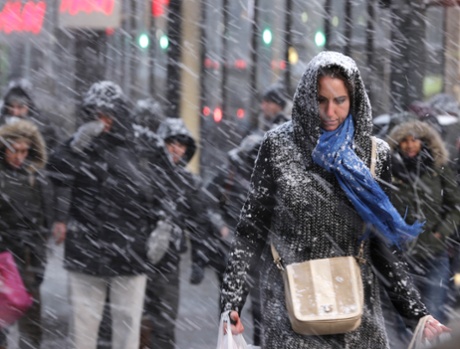
US GDP disappointment sends markets lower
Ahead of the Federal Reserve interest rate decision, the disappointing US GDP data has sent markets tumbling. The weakness in the US economy, if sustained, poses problems for global growth but also means an imminent increase in US borrowing costs is very unlikely. That has hit the dollar, and by extension pushed the euro higher which has undermined European markets. The export heavy Dax has been hit particularly hard, while the FTSE 100 has closed below 7000 for the first time in nearly two weeks. There were also the usual uncertainties surrounding the continuing attempts to avoid Greece defaulting and the forthcoming UK election. The final scores showed:
- The FTSE 100 fell 1.2% or 84.25 points to 6946.28
- Germany’s Dax was down 3.21% at 11,432.72
- France’s Cac closed2.59% lower at 5039.39
- Italy’s FTSE MIB dropped 2.28% to 22,995.63
- Spain’s Ibex ended down 1.97% at 11,378.9
On Wall Street the Dow Jones Industrial Average is currently 135 points or 0.75% lower.
So on that note, it’s time to close up for the evening. Thanks for all your comments, and we’ll be back tomorrow.
Updated
Oil prices are moving higher after US crude stocks rose less than expected last week.
Inventories climbed by 1.9m barrels compared to analysts expectations of a 2.3m barrels increase, suggesting higher than forecast demand. Brent crude is currently up more than 1% at $65.35 a barrel.
Updated
Back to Greece and how are those negotiations going?
State of negotiations on Greece (via @IyerC ) pic.twitter.com/oHdqiqo1UY
— Burnett Tabrum (@BTabrum) April 29, 2015
More US data, this time for housing and this time a little better than expected.
Pending home sales - contracts to buy previously owned US homes - rose to their highest level since June 2013 in March, the third monthly rise in a row. The National Association of Realtors said its sales index rose 1.1% to 108.6 last month, compared to forecast of a1% gain. The association’s chief economist Lawrence Yun said more buyers than usual had entered the spring market:
Demand appears to be stronger in several parts of the country, especially in metro areas that have seen solid job gains and firmer economic growth over the past year,.
But Yun warned:
Demand in many markets is far exceeding supply, and properties in March sold at a faster rate than any month since last summer. This in turn has pushed home prices to unhealthy levels — nearly four or more times above the pace of wage growth in some parts of the country. Simply put, housing inventory for new and existing homes needs to improve measurably to improve affordability.
Earlier, official figures showed German inflation picked up to 0.3% in April, the second month of price growth after deflation in Januaury and February. And Belgium also exited deflation. Looks like the European Central Bank’s policy is working. It launched a £60bn a month quantitative easing programme in March to fight deflation.
Updated
The rollercoaster of US GDP readings continues, says Richard de Meo, managing director of foreign exchange boutique Foenix Partners. He notes that the last four readings have ranged between a fall of 2.1% and a rise of 5%.
Yellen’s assurances that the Fed would simply respond to data in making policy decisions has re-focused investors on US economic indicators, exaggerating market sensitivity to data as interest rate expectations fluctuate accordingly.
Weeks of softer data now capped by disappointing GDP figures have come at a bad time for the dollar, left languishing at eight week lows today in anticipation of a shift in tone from the FOMC tonight.
A dovish tone would see traders nodding in approval and self-congratulation as recent dollar selling becomes justified. However, a status quo from the Fed tonight suggests investors have misread how the softening of US data might affect the dot forecasts. It is difficult to see anything other than an end to the dollar sell-off.
Alastair George, chief strategist at Edison Investment Research, has looked at what this means for the dollar, which hit an eight-week low after the GDP figures. The dollar index, which measures its value against six major currencies, fell for the sixth day in a row to its lowest level since early March.
Q1 US GDP was well below expectations with the economy growing only fractionally in the first quarter. Together with the improving lending trends out of Europe this morning the divergence between the US and eurozone is now stark and it is no surprise that the dollar has breached 1.10 against the euro after this data. Expectations for the first US interest rate increase will only be pushed out further – but on a positive note a weaker dollar will benefit emerging markets where valuations are nowhere near as extended as developed equities.
Updated
So it looks like the eurozone will outperform both the UK and the US in terms of economic growth.
Good news: #Europe now racing to outperform #US in growth terms… a snail chasing a lame duck sort of race…
— Constantin Gurdgiev (@GTCost) April 29, 2015
Looking like eurozone Q1 growth could be about 10-15 times higher than US growth #Euroboom2015
— Mike Bird (@Birdyword) April 29, 2015
Updated
Here’s a useful breakdown of the GDP numbers, courtesy of Marc Ostwald, strategist at ADM Investor Services International.
- Personal consumption - just above forecasts at 1.9% vs. forecast 1.7% and Q4 4.4% - definitely weather impacted, and in some senses weather may have been more of a drag than Q1 2014, last year’s bad weather was severe but short sharp snaps, while Q1 2015 was very protracted
- A big drag from business investment in atructures at -23.1% q/q, both energy/energy related sector (e.g. transport & machinery) and weather related
- Another big drag from net exports - but I would disagree with a dollar strength based rationale, and point the finger rather at the West Coast port strike
- A big add from inventories at 0.74 ppts, which had been signalled by the steep rise in the inventories to sales ratio, which leaves a large overhang for Q2 and implies less immediate potential for a rebound in manufacturing production
- Housing investment was a small positive (but we knew that) at 1.3% q/q
Updated
Paul Ashworth, chief US economist at Capital Economics, said:
Most Fed officials appear to share our view that this is a temporary slowdown, albeit a more severe deceleration than we previously anticipated. Accordingly, while it might delay the timing of the first rate hike, we still anticipate a lift-off later this year.”
The Guardian’s economics editor Larry Elliott writes:
Financial markets had been braced for a slowdown in activity following brutal winter weather but had not been braced for the scale of the decline reported by the Commerce Department in Washington.
After growing at an annual pace of 2.2% in the final three months of 2014, economists had been forecasting a slowdown to 1% in the January to March period of 2015 - a period in which blizzards and a strike affecting West Coast ports stifled activity.
The official data showed that the drop in oil prices had affected investment in the US oil and gas sector but cheaper energy bills had yet to boost consumer spending. Growth in consumer spending slowed to an annual increase of 1.9% in the first quarter, down from 4.4% in late 2014 and the weakest for a year.
Construction output was badly hit by the poor weather, leading some analysts to predict that the US would bounce back quickly in the second and third quarters of 2015 as it did in 2014.
But recent data for retail sales, housebuilding and business investment has not been strong, suggesting that the rebound will be less vigorous this time.
Policymakers at the US Federal Reserve are expected to shrug off the economic slowdown as temporary in their statement following the meeting tonight.
However, while at the start of the year many economists were expecting the first rate hike in June, most now think this is unlikely to happen before September.
The pound hit an eight-week of $1.5415 after the poor US GDP figures.
ING economist Rob Carnell is relatively relaxed about the US GDP figures, which come a couple of hours before the Fed meets to discuss monetary policy.
On initial reflection, this is not so much news, as confirmation of what we already knew about the first quarter. And to be honest, it could have been worse, at least it had a plus sign – just.
Consumer spending was if anything a little better than anticipated at 1.9%, though only by 0.1% or so. Business investment was basically flat from the previous quarter, also in line with expectations, and there was an unhelpful drag from state and local government spending.
Looking forward to the second quarter... we might well expect a positive bounce from the combination of net exports and inventories, perhaps adding half a percent back. Some stronger business investment and consumer spending will also help. So rather than a figure close to zero, we might reasonably look for something quite a bit stronger than 3% in the second quarter.
In a couple of hours, the Federal Reserve will meet to discuss the timing of the first rate hike. No doubt they will discuss this release. But for most of them, the more important question will be, what is future growth going to be like? Though it takes a leap of faith to say that the second quarter will see the bounce we are anticipating, this latest GDP figure provides no reason for undue pessimism. We think the Fed will have to give the economy the benefit of the doubt, and as such, it will be hard for them to categorically rule out a June hike, even though the odds are currently stacked against one.
Updated
Bad weather affected consumers’ willingness to go out and spend at the start of the year, so the shock GDP number could be a blip. Disruption at ports on the West Coast – the labour dispute has now been resolved – and the strong dollar also affected the numbers.
The dollar weakened after the data was released, and the FTSE 100 index in London fell some 30 points, but has recovered somewhat and is now trading at 6982.05, down nearly 50 points, or 0.7%. The Dax in Frankfurt has lost nearly 170 points, or 1.4%, to 11,643.21 while the CAC in Paris is down almost 70 points, or 1.3%, at 5104.01.
Updated
It now looks increasingly likely that Eurozone growth in Q1 will be higher than the UK or US. Who'd have forecast that a year ago?
— Duncan Weldon (@DuncanWeldon) April 29, 2015
Updated
Chris Williamson, economist at financial data provider Markit, says:
A stalling of US economic growth at the start of the year rules out any imminent hiking of interest rates by the Fed. The slowdown looks temporary, as a rebound from the first quarter weakness is already being signalled by forward-looking survey data, but the sustainability of any upturn is by no means convincing yet.
As such, policymakers will probably want to see how the economy performs in the second quarter before passing judgement on whether the time is right to start the process of normalising policy. That leaves September as the first realistic possibility of rates being hiked, providing of course that the economy bounces back in coming months.
Updated
US economic recovery stalls: GDP up 0.2% in first quarter
US GDP is a bit of a shocker: the economy grew at an annualised rate of just 0.2% in the first quarter, the weakest in a year. Wall Street economists were expecting a slowdown to a 1% to 1.2% growth rate, from 2.2% in the previous quarter.
Updated
Euclid Tsakalotos, the Oxford-educated economics professor who now heads up the Greek negotiating team in debt talks, has just made statements saying Greece has to keep to its “red lines” and that any “areas of compromise” should be within the “political plan”.
More from Helena Smith in Athens.
The Greek finance minister has broken his silence issuing a long statement about last night’s incident. Varoufakis said it was his artist wife, Danae, who saved the day.
Contrary to the conjecture that has been heard, it was not an organised attack or attempt at seriously injuring us, provocation or part of the much wider effort to politically “deconstruct” me in recent days.
I have the impression that their goal was not to hurt us, because if they had wanted to hurt us, they had the opportunity and ‘arithmetic’ supremacy to do so. I think their aim was to force me to flee with a few light humiliating swipes. This, however, will never be known because Danae, before the anti-establishment protestors [and before I could stop her], could get to us, stood up and hugged me hard, turning her back towards them so that they would have to hit her before me.”
The finance minister said he attempted to speak to protestors after the incident.
Exharchia, the area where the incident took place in central Athens, is regarded by anarchists and the extreme left as their stomping ground. The protestors were reportedly incensed when the finance minister who lived in the neighbourhood until 2006 showed up to eat there.
A Greek journalist, who spoke to Varoufakis earlier, quotes the finance minister as saying that had he had security with him Exharchia would have gone up in flames.
Updated
Meanwhile Greek bank deposits fell to a ten year low in March, as savers continued to worry about the country’s finances and the continuing impasse over releasing bailout funds.
They dropped 1.36% month on month to €138.55bn from €140.47bn, the sixth monthly fall in a row albeit at a slower pace than in February.
But the European Central Bank has reportedly raised the amount of emergency liquidity available to Greek banks, as reported by Bloomberg. It lifted the cap on Emergency Liquidity Assistance by €1.4bn to €76.9bn, after an increase of around €1.5bn last week.
Back with Greece, and more signs the country’s government is indeed considering calling a referendum, according to statements by deputy prime minister Giannis Dragasakis. Helena Smith reports:
The Greek people will have the last word in the event of negotiations ending in deadlock, the country’s deputy prime minister and chief economics policy maker said this morning.
Speaking to the Kokkino radio station, Dragasakis said he foresaw the country finally sealing a deal with its creditors in the first few days of May. But, he warned, it would only be a “minimum agreement” to unlock rescue funds Greece now desperately needed to avoid default. The difficult work would begin after that.
“Now we are going to a minimum agreement with actions that can be taken immediately,” he said of the package of reforms the Syriza-dominated government is preparing. “But [in the long-term] not just any solution will suffice. The solution has to be viable. After the interim agreement a long discussion about the debt, primary surpluses, investment and growth will follow,” he said adding that the interim accord would be the building block “for an interim space.”
Dragasakis, who is widely seen as a moderate, described the government’s decision to reshuffle its negotiating team “as the result of the experience that we have had so far.”
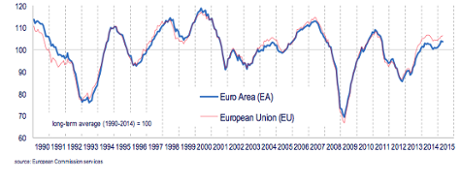
Earlier the European Commission reported that economic sentiment had slipped in April.
The index dipped from 103.9 in March to 103.7 for the eurozone, slightly worse than analysts’ expectations of an unchanged figure. For the EU as a whole the figure was 106.4, up 0.3. The commission said;
The stabilisation of euro-area sentiment resulted from increasing confidence in the services sector being offset by opposite developments in the construction sector and among consumers.
German 10 year bond yields are set for their biggest daily rise since December 2013, according to Tradeweb.
They are currently up around 9 basis points to 0.25%, on the back of hopes for a Greek resolution if the new reforms hit the target, as well as a weak German auction which sold €3.274bn worth of 5 year bonds.
Updated
Still with the UK, and retail sales growth slowed unexpectedly in April according to the CBI.
The business group’s distributive trades index showed a retail sales balance of +12, up from +18 in March but lower than expectations of a rise to +25. But optimism about sales in the coming month rose sharply.
Sales in most sectors rose but grocery sales declined, according to the survey. Barry Williams, chair of the survey, said:
With shopping habits changing so dramatically in the last few years, underlying consumer confidence is hard to read. But both retailers and wholesalers are optmistic there will be a spring in their customers’ steps, and therefore their sales, in the near future.
Howard Archer, chief economist at IHS Global Insight, said:
Despite April’s modestly softer CBI survey, the prospects for retail sales and consumer spending look largely bright: Consumer confidence is relatively elevated, employment is high and rising, inflation is negligible and earnings growth is trending up.
UK consumer confidence falls for first time since December
Consumer confidence in Britain has fallen this month for the first time since December – disappointing news for David Cameron ahead of next Thursday’s general election.
Polling firm YouGov and economics consultancy CEBR said their measure of consumer confidence fell to 113.1 in April from 113.9 in March. That’s more than a point lower than it was this time last year. The news comes after official GDP figures yesterday showed economic growth slowed sharply in the first three months of the year.
With the election just over a week away, the dip in confidence has come at “exactly the wrong time for the government,” said Stephen Harmston, head of YouGov Reports. He added:
As the GDP figures slow down, it is clear that consumers still feel as though the recovery is fragile and that many of them are not feeling it in their wallets.
Italy has sold €6bn of bonds, hitting the top end of its €4bn-€6bn targeted range.
Updated
Extraordinary scene outside the Athens finance ministry this morning, with boss Yanis Varoufakis being mobbed by scores of journalists as he arrived for work.
Word of his encounter with an anarchist group last night has spread fast, as Helena Smith reports.
If Varoufakis has been sidelined, he has definitely not lost the interest of media at home and abroad. Waiting for him as he turned up for work on his powerful motorbike - without a security detail as he has done from his first day in office - the finance minister was assailed by scores of journalists wanting to ask him about his run-in in Athens last night.
Rucksack on back, Varoufakis smiled broadly for the cameras but was uncharacteristically silent - perhaps not wanting to further inflame passions amongst the anarchist bloc and extreme left with which the governing Syriza party has long had ties.
Varoufakis may be Europe’s most vocal anti-austerian but to this day has not signed up to Syriza unlike the new man coordinating Athens’ negotiating team Euclid Tsakalotos, who was shadow finance minister when Syriza was in opposition and is a member of the party’s central committee (both however are university economic professors).
Last night’s incident in Exharcheia - with Varoufakis, his wife and a female friend being rounded on by a group of around 30 masked protestors - has sent tremors through the government with some officials fearing it could be a warning sign of worse to come.
Updated
European stock markets have turned positive. Germany’s Dax, France’s CAC and Spain’s Ibex are all up around 0.2%, while Italy’s FTSE MiB has nearly 0.5% ahead. The FTSE 100 index is up less than 4 points now, at 7035.33.
Independent City analyst Louise Cooper has looked at this morning’s corporate results.
We’ve had a significant update from corporate UK and so what does it tell us? she asks.
If you’re positioned well on the high street, then business is good as Britons are spending. Greggs the baker has reported strong like for like sales, up 5.9%. It talks of a “supportive consumer income environment” which is what Whitbread mentioned yesterday. Greggs is low priced food, sold to the masses. It therefore says something about how confident that demographic is feeling. Investors are pleased and the stock is up 2%.
Next also issued a trading statement with sales +4.1% of which +3.2% are full price. As it gets bigger and is now No 1 in UK women’s clothing market, growth becomes more difficult. Even so its numbers have pleased the market and the stock price is up 3%.
Shares in Home Retail Group - owner of Argos and Homebase - are up 3% on slightly better than forecast earnings. Don’t get too carried away as sales at £5.7bn are still below the £6bn achieved in 2010. And benchmark profits at £135m are almost half the comparable figure in 2010 of £290m. But what I thought was fascinating in the results was the growth and now dominance of digital. Argos: “Internet is now 46% total sales including mobile which grew 38% to represent 25% of total sales.” Wow. If a retailer selling commoditised product is not good at selling online and the logistics of delivery, then it may as well give up now.
If you sell a crap product then nothing is going to help. Cigarette maker BAT: “trading environment remains challenging due to continued pressure on consumers’ disposable income worldwide”. I just think the firm is making excuses and that actually selling a toxic product that kills you is never good business.
Not toxic but unpleasant, Thorntons has issued yet another poor trading performance, barely growing sales. The share price in 1989 was £1.50, now its 83p. Its just horrible chocolate. The rule of retail it to get the product right. I much prefer Lindt which is beyond delicious (and the reason why I need to jog for an hour to burn off the calories).
Greece to present draft reform bill to lenders today
Reuters is also reporting that Greece will present a draft reform bill to its international creditors today, according to government officials – in an effort to show it is serious about its pledges.
However, the bill is not expected to offer major new concessions, beyond those already discussed with creditors. It does include details on measures to clamp down on corruption and tax evasion:
Tax and public administration reforms, a tax on television broadcasting rights and TV ads. Tourists on popular Greek islands will be required to use a credit card for transactions over €70, in a bid to tackle tax evasion.
One official also said Athens would push back plans to raise the minimum wage, a move opposed by creditors.
However, Greece’s deputy labour minister made clear on Mega TV that Athens will not agree to demands for further pension cuts.
The draft bill is set to be debated at a cabinet meeting in Athens on Thursday. Once approved, it would then be debated in parliament.
Updated
Tsipras and German chancellor Angela Merkel agreed in a telephone conversation on Sunday to maintain close contact during the debt talks, a Greek government official has told Reuters. The official was quoted as saying:
During their communication, they expressed their common will for a steady communication throughout the course of negotiations in order to have a mutually beneficial solution soon.
Greece is trying to negotiate a deal that will unlock €7.2bn of bailout funds.
Greek impasse weighs on European stock markets
The Greek impasse is weighing on European stock markets this morning. The FTSE 100 index in London has edged some 8 points higher to 7039.23, a 0.1% gain. The Dax is now down 8 points , or 0.07%, at 11,806.57after opening 0.5% higher. The CAC in Paris has shed nearly 5 points to 5168.54.
Greek prime minister Alexis Tsipras reshuffled the team handling crucial talks with the country’s international creditors on Monday, but the Greek finance minister Yanis Varoufakis denied he had been sidelined.
The European Central Bank has raised the cap on emergency liquidity assistance (ELA) that Greek banks can draw from the country’s central bank by €1.4bn, taking the ELA ceiling to €76.9bn, Reuters reported, citing a banking source.
Mike Coupe has an unshakeable alibi in his fight against two years in an Egyptian jail - from ITV’s business editor, Joel Hills:
I can confirm that on July 15th 2014 Mike Coupe was not in Cairo "seizing cheques," he was in London having breakfast with me. And he paid.
— Joel Hills (@ITVJoel) April 29, 2015
Updated
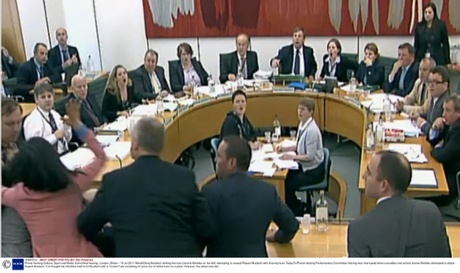
Some more thoughts on Varoufakis’ run-in with anarchists. It is not the first time a wife has leapt to her husband’s defence. Rupert Murdoch’s wife Wendi Deng – a volleyball player in her school days – was hailed as a new national role model in China after she pushed away a British comedian who threw a foam pie at Murdoch while he was being questioned by a UK parliamentary select committee, and then threw the plate at him.
Over in Greece, the government will re-launch public broadcaster the Hellenic Broadcasting Croporation, ERT, and rehire employees – two years after its controversial closure in June 2013.
The previous conservative government’s decision to shut down ERT caused an uproar, both within and outside the country. The relaunch was one of the leftist Syriza party’s main election pledges.
Around 1,500 permanent staff, of the 2,595 previously employed by the broadcaster, will be rehired.
We’ve just spotted another retail story (thanks to retail analyst Nick Bubb). Former Tesco man Tim Mason – its marketing guru who went on to run its doomed Fresh & Easy chain in the US – then re-emerged in the UK as chairman of discount fashion chain Bonmarché when it floated in 2013. He has just stepped down and been replaced by veteran retailer John Coleman.
Bubb asks:
Does this mean that he has a job lined up back in food retail? No doubt all will be revealed in due course...
Coleman, who currently chairs Bonmarché’s remuneration committee, is a former chief executive of House of Fraser and Texas Homecare and previously ran Dorothy Perkins, Top Man and Top Shop.
Ryanair: $5m fraudulently taken from bank account via Chinese bank
Back to corporate news: almost $5m was fraudulently taken from one of Ryanair’s bank accounts, the budget airline said.
Ryanair confirms that it has investigated a fraudulent electronic transfer via a Chinese bank last week.
The airline has been working with its banks and the relevant authorities and understands that the funds – less than $5m – have now been frozen. The airline expects these funds to be repaid shortly, and has taken steps to ensure that this type of transfer cannot recur.
The Irish Times broke the story, reporting that the fraud came to light last Friday and the Criminal Assets Bureau in Dublin was asked to help recover the money with its counterpart agencies in Asia. Ryanair uses dollars to buy fuel for its aircraft and these funds are believed to have been targeted, the newspaper said.
AP: Varoufakis's wife to the rescue from anarchists
The Associated Press has more details of Yanis Varoufakis’s run-in with a group of Greek anarchists last night:
Yanis Varoufakis said Wednesday he and his wife were in the Exarhia district, a neighborhood popular with extreme leftists and anarchists, Tuesday night when a group barged into the restaurant.
The group, who had their faces covered, demanded the minister leave the area and threw glass objects at the couple, Varoufakis said, without either of them being hurt.
He said that when some of the group moved in a threatening manner against him, his wife embraced him so that the potential attackers could not get at him without hitting her first.
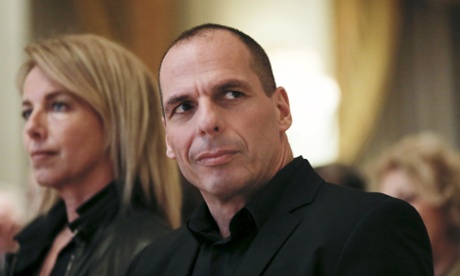
Maybe Danae Stratou should accompany her husband at the next Eurogroup meeting....
Varoufakis attacked by anarchists while dining with wife #Greece (from @AP) http://t.co/BkatPG5IkR
— Derek Gatopoulos (@dgatopoulos) April 29, 2015
Updated
Retail round-up
Several retailers have put out numbers this morning.
Next has posted better-than-expected sales in its first quarter after the early launch of the fashion chain’s summer brochure, which “helpfully” coincided with much warmer weather this month, it said. Temperatures rose as high as 25C in southern England but have dropped in recent days. Total sales for the 13 weeks to 25 April were 4.1% ahead of last year, because of a longer winter end-of-season sale and a bigger mid-season sale in the Next catalogue. The retailer, run by Tory peer Lord Wolfson, is paying a further special dividend of 60p a share on 3 August.
Independent retail analyst Nick Bubb says:
Given the fashion range problems this spring and worries about slowing Directory [catalogue] sales growth, the City will be pleased to see Directory sales looking strong at +7.0 (+9% including the Sale). With tough comps ahead in Q2, Next haven’t changed their full-year guidance and, apart from confirming another 60p special dividend, the statement says nothing else about the outlook.
He adds:
Of the other companies reporting today, Greggs is the best-looking statement.
Greggs, known for its sausage rolls, has credited the popularity of its breakfast meal deals and healthier sandwich ranges for a 5.9% rise in like-for-like sales in the 16 weeks to 25 April. It will pay shareholders a £20m special dividend (20p a share).
Home Retail has seen like-for-like sales growth at Argos and Home for the second year running (Argos is up 0.6% while Homebase is 2.3% ahead). Full-year pretax profits have climbed to £93.8m from £71.2m, with sales up 1% to £5.7bn. The group has rolled out its ‘hub & spoke’ distribution network at Argos, enabling same-day collection of 20,000 products, and has 60 digital Argos stores up and running.
To quote Bubb again:
The Home Retail results are in line, but there is no comment on current trading and only a vague comment about hopes for a better economic outlook after the election. The N Brown finals are, as expected, disappointing, but management express confidence in the future.
Thorntons’ third quarter to 25 April was mixed: despite a good Easter and Valentine’s Day, retail like-for-like sales were only flat over the last 15 weeks (presumably Mother’s Day went less well). Commercial sales fell 6.1%, with one unnamed supermarket customer having reduced orders.
Fashion chain N Brown saw statutory profits before tax fall 21% to £76.3m, with revenues flat at £818m. Chief executive Angela Spindler said:
Step-changing the way the business operates and goes to market in some key areas proved more disruptive than anticipated and this, combined with a weak autumn trading period across the sector, led to a profit performance below expectations. We are, however, improving the sustainability of future profit growth and look to the year ahead with confidence.
Moscovici hails Greek reshuffle
European commission Pierre Moscovici has apparently welcomed the shake-up of Greece’s bailout team.
* EU's Moscovici says reshuffle of Greek negotiating team is a "good sign" - RTRS
— Fabrizio Goria (@FGoria) April 29, 2015
Moscovici says departure of Varoufakis a good signal, pace of talks still not fast enough; Greek negotiating team more coherent ~@livesquawk
— Yannis Koutsomitis (@YanniKouts) April 29, 2015
And in case you missed it, here’s our profile of new head negotiator, Euclid Tsakalotos:
Sainsbury's hits back over CEO's Egypt jail term
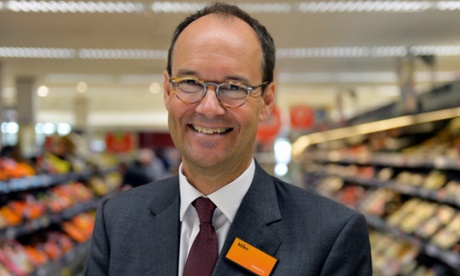
The oddest story of the morning is that Mike Coupe, CEO of supermarket group J Sainsbury, has been sentenced to two years in an Egyptian jail.
A Giza court convicted Coupe of embezzlement after he allegedly tried to seize cheques from an Egyptian businessman, Amr El Nasharty, whom Sainsbury’s worked with back in 1999.
The Times broke the story overnight, saying:
Mike Coupe was forced to attend a court hearing in Giza last Sunday in an attempt to overturn a conviction for embezzlement.
The case relates to claims that last July Mr Coupe tried to seize cheques connected with the collapse of a business it invested in 16 years ago, in contravention of Egyptian bankruptcy law.
Remarkable stuff. And Sainsbury has responded this morning, saying it “strongly refutes” the allegations, saying the cheques bounced and Coupe wasn’t anywhere Egypt on the day in question:
When Mr El Nasharty bought our interest in the Egyptian joint venture we had with him in 2001, he paid us with cheques that were dishonoured. Mr El Nasharty is now claiming that Mike was in Egypt on 15th July 2014 and seized these cheques, which is an impossibility. Mike Coupe was in London carrying out his normal duties that day. In September 2014 Mike Coupe was convicted, without notice of the proceedings against him and in his absence, in an Egyptian Court.
We have taken all necessary steps to appeal against these groundless claims and will continue to do so.
UK house prices jump 1% in April
Reports of the demise of the British housing boom may have been overstated.
According to the Nationwide building society, prices rose by 1% month-on-month in April, and the annual growth rate edged up to 5.2% in April from 5.1% in March.
That’s the biggest monthly increase since last June.
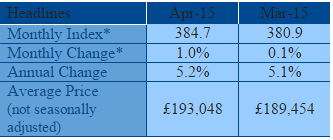
But the market isn’t too rosy, with mortgage approvals around 20% lower than their long-term average:
Robert Gardner, Nationwide’s Chief Economist, says:
“The strength of the economy and relatively subdued pace of activity in the housing market remains something of an anomaly. It is possible that heightened uncertainty ahead of the election is weighing on activity, though there is no compelling evidence from previous UK elections to suggest a strong impact.
And that annual price rise is more moderate than last summer:
Nationwide report annual house price inflation up to 5.2% in April after slowing to 18-month low of 5.1% in March from 11.8% in mid-2014
— Howard Archer (@HowardArcherUK) April 29, 2015
Updated
Will it never end? Barclays has announced it is setting aside a total of £950m to cover the cost of the forex-rigging scandal, and the misselling of payment protection insurance.
Another £800m provision from Barclays for conduct issues (forex) and £150m for PPI
— Jill Treanor (@jilltreanor) April 29, 2015
CEO Antony Jenkins says he’s still cleaning up the mistakes of the past:
Resolving legacy conduct issues is also an important part of our plan to transform Barclays. We are working hard to expedite their settlement and have taken further provisions of £800m this quarter, primarily relating to Foreign Exchange.
Statutory pre-tax profits at Barclays fell by 26%, to £1,337m .
Yanis Varoufakis in anarchist altercation
As if being kicked around by the eurogroup last week wasn’t bad enough, Greek finance minister Yanis Varoufakis apparently ran into trouble with a group of anarchists last night.
The Greek finance minister was out with his wife, installation artist Danae Stratou, when a large group of youths wanted a word. Varoufakis, though, deployed his strongest weapon...and talked his way out of trouble.
Greek Reporter has the details:
The Greek Finance Minister was initially insulted by the group for his political actions and then they both left the restaurant to continue arguing outside of the premises.
There were no reports of violence, but first witnesses reported that the talk was definitely not in a friendly tone. Finally Varoufakis managed to calm the group down and left the area.
#Greece | A group of radicals threatened Varoufakis & his wife at an Athens restaurant late last night. FinMin & Mrs left unharmed.
— Yannis Koutsomitis (@YanniKouts) April 29, 2015
there's a story of a verbal altercation betwn varoufakis & anarchists last night. the gloating comments are 10x worse than the incident.
— Diane Shugart (@dianalizia) April 29, 2015
Kathimerini: Greece working on reform multi-bill
The Greek government is working on a new bill outlining some economic reforms including strengthening tax collection, according to the Kathimerini newspaper overnight.
The move might possibly persuade creditors to hand over some funds. However that seems unlikely, as it’s not expected to include pension reforms or increases to VAT rates -- two key demands from lenders.
Also, the Eurogroup said last Friday that Greece wouldn’t get its aid paid in tranches. It’s all or nothing...
The cabinet is expected to meet Thursday to discuss the details of a reform multi-bill the government is preparing in the hope that it will accelerate the conclusion of negotiations with lenders and the disbursement of further bailout funding.
The government would like to bring the multi-bill to Parliament as soon as possible because it believes this could help secure at least the €1.9bn euros in profits from the European Central Bank’s SMP scheme. However, this will depend on the outcome of the Brussels Group talks, which are due to begin on Wednesday and run through Saturday at the earliest.
Gov’t drafts multi-bill in hope of quick payment of €1.9bn in profits from #ECB's SMP scheme. http://t.co/20UNB4mAGK pic.twitter.com/KR2VPkaC1n
— Holger Zschaepitz (@Schuldensuehner) April 29, 2015
Updated
The Agenda: Greece, US growth figures....
Good morning, and welcome to our rolling coverage of the world economy, the financial markets, the eurozone and business.
Coming up... after yesterday’s surprise drop in UK growth, it’s America’s turn to report GDP data. And economists predict that US growth also slowed, from an annualised rate of 2.2% to just 1% (or a measly 0.25% in pure quarter-on-quarter terms).
A weak reading could give investors a dose of the jitters, as CMC Market’s Michael Hewson explains:
A lower number would raise bigger concerns that it could get revised even lower. This is because US GDP does have a habit of getting revised lower, and any further weakness could well raise additional concerns about how well the US economy is actually doing.
US GDP is released at 1.30pm BST, or 8.30am East Coast time. It sets the scene for the Federal Reserve’s latest monthly meeting, tonight.
Over in Greece, officials will be racing to agree reforms that might satisfy its creditors in time, and scrabbling for funds to meet wage and pensions due at the end of the month.
German inflation data is released at 1pm BST, showing if the European Central Bank’s QE programme is dragging the region away from deflation.
There’s also a new survey of eurozone economic confidence at 10am BST.
A swathe of UK companies are reporting financial results this morning, including Barclays, Next and Home Retail. And Nationwide should be releasing its latest house price data this morning too.
I’ll be tracking all the main events through the day....