
Closing summary
Before closing up for the day, here is a summary of the main events.
- His comments put pressure on other ministers to respond to the suggestion. Germany’s Angela Merkel said the focus should be on the current bailout
- The latest PMI surveys suggested the eurozone is on track to grow by about 0.3% in the first quarter
- Eurozone consumers went out and shopped in January, triggering an unexpected surge in retail sales
- In the US the ADP jobs numbers disappointed, but the ISM non-manufacturing PMI survey came in stronger than expected
Thank you, as always, for reading the blog today and for commenting. Have a good evening, and do come back tomorrow. AM
George Osborne has secured a major victory over the European Central Bank after a court ruled that clearing houses should not be forced to move from London to the eurozone.
Major win for UK & single market that #ECJ struck down @ecb location policy – unfair & had absolutely no place in our modern EU economy
— George Osborne (@George_Osborne) March 4, 2015
The ruling by the general court of the EU is significant for the City of London and it’s status as a major financial centre.
The ECB had argued that clearing houses such as LCH Clearnet, which step in between major banks and financial firms on big deals to guarantee the transactions, should be based in the eurozone as they handle euro-denominated deals.
Jill Treanor has been busy today and writes:
The chancellor took action against the ECB in 2011 and this decision is the first time a European court has ruled in his favour on a significant case. The general court of the EU ruled that the ECB did not have the power to demand such a move.
“This is a major win for Britain and a major win for all those who want to see a European economy that is both open and successful,” said Osborne.
The European court did not scrutinise the legal argument put forward by the UK that the ECB was discriminating against a member country, as it concluded that the ECB did not have the power to make a decision in the first place.
“We have been consistently clear there needs to be a level playing field for all countries in Europe’s single market, whether they are in the eurozone or not. That’s why we brought a legal challenge against the European Central Bank’s utterly discriminatory location policy, and why we welcome today’s ruling from the European court of justice which strikes this policy down,” Osborne said.
The decision comes weeks before the general election on 7 May. If Osborne’s Conservative party wins, it has promised to hold an in-out referendum on continued membership of the EU – which has worried many business leaders.
Yet experts said the ruling made a “Brexit” less likely. “If the ruling had gone against the UK it would have seriously undermined the single market and significantly increased the power of the ECB – and probably would have made ‘Brexit’ more likely,” said the thinktank Open Europe.
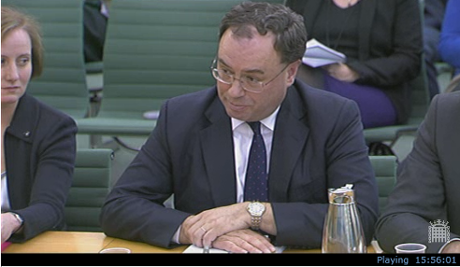
Andrew Bailey, a deputy governor at the Bank of England responsible for prudential regulation has been giving evidence to House of Commons Treasury Select Committee.
He has told MPs that HSBC’s chief executive and chairman will be held “personally responsible” for making the scandal hit bank less complicated.
I am going to hold their feet to the fire, noses to the grindstone.
Bailey has also told the committee that no banks have come to him asking for advice on a British exit from the EU.
In a separate development, the Bank of England is at odds with Europe over the bonus cap.
As the Guardian’s Jill Treanor reports:
The Bank of England remained on collision course with Europe over the bonus cap as a consultation was launched that would rule out the use of top-up payments to side step the clampdown on City pay.
The European Banking Authority ruled in Ocotober that these extra payments should be regarded as variable components of pay, like a bonus, and that banks using them are breaching the ratio set out by the EU to limit bonuses to one times salary or twice if shareholders if approve.
The pan-European banking regulator has begun a three-month consultation that would turn this opinion into formal guidelines. All banking regulators in the EU would then have to comply or risk being taken to the European court of justice.
But the Bank of England’s Andrew Bailey has spoken out against the bonus cap, saying it forces up fixed pay. There is no evidence that his views have changed. The UK’s major banks are among those using these allowances as third payments alongside salaries and bonuses.
Updated
European markets are mainly up this afternoon.
- FTSE 100: flat at 6,889.88
- Germany’s DAX: +0.3% at 11316.57
- France’s CAC: +0.5% at 4893.9
- Italy’s FTSE MIB: +0.3% at 22051.4
- Spain’s IBEX: -0.2% at 10,997
More US data.
In contrast to the earlier ADP jobs numbers, the ISM non-manufacturing PMI survey came in stronger than expected, at 56.9 in February.
Economists polled by Reuters were forecasting 56.5, following 56.7 in January.
Non-mfg #ISM survey registers a solid 56.9 reading in Feb vs 56.7 previously & employment subcomponent rebounds sharply (56.4 vs. 51.6)
— Joseph A. LaVorgna (@Lavorgnanomics) March 4, 2015
Over in Athens, Guardian correspondent Helena Smith reports that EU commission chief Jean-Claude Juncker has caused a stir with comments made to Spanish newspaper El Pais.
Helena writes:
There are some long faces among officials in Syriza after EU commission chief Jean-Claude Juncker warned that Greece’s new prime minister should tell voters he will never be able to fulfil the promises he has made to them.
Juncker appears increasingly to be taking the carrot and stick approach to Greece. When he met the young Alexis Tsipras in Brussels last month, he took the new leader by the hand welcoming him profusively to the European family. But in an interview with the Spanish daily El Pais today he took an altogether new line, speaking bluntly about the need for Tsipras to come clean with Greeks over his inability to stick with the anti-austerity programme he had pledged to them.
“He must explain that some of the promises upon which he was elected will not be honoured,” Juncker told the paper. “The elections don’t change the EU treaties. We could be more flexible, but Tsipras’ victory doesn’t give him the right to change everything.”
Syriza isn’t commenting on it - officially, yet - but insiders are clearly upset. Juncker, a self-declared philhellene who has frequently said Greece will never leave the eurozone under his stewardship, is widely seen as Athens’ greatest ally. “We are learning to take the criticism on the chin but it still hurts,” said one.
Wall Street opens lower

Wall Street has opened down following those disappointing ADP jobs numbers.
- Dow Jones: -0.7% at 18,066.39
- S&P 500: -0.4% at 2,098.62
- Nasdaq: -0.7% at 4,428.12
Updated
Merkel: we need to focus on second Greek bailout, never mind a third

Spain’s economy minister Luis de Guindos has set the cat among the pigeons with his comment that Greece will need a third bailout.
German chancellor Angela Merkel and EU commission chief Jean-Claude Juncker have been forced to bat away suggestions of another rescue at a press conference in Brussels.
Merkel:
I think we now have all our hands full to make this [second Greek bailout] succeed.
Juncker:
We are going to focus on implementing what was agreed in the eurogroup. It is premature to talk about a third programme. That is speculation that is best avoided.
Something tells me de Guindos might be in the dog house at Monday’s meeting...
#Merkel at press conference with #Juncker at EU Commission: We are doing all we can to ensure second bailout for #Greece is a success
— Kathimerini English (@ekathimerini) March 4, 2015
#Merkel: This is not the time to talk about a third bailout program for #Greece
— Kathimerini English (@ekathimerini) March 4, 2015

Over in the US, the ADP jobs report has disappointed expectations.
Private sector employers created 212,000 jobs in February, lower than the 220,000 forecast in a Reuters poll. The figure for January was revised up however, to 250,000 jobs from 213,000 jobs.
ADP monthly gain is lowest since May 2014
— zerohedge (@zerohedge) March 4, 2015
Paul Dales, senior US economist at Capital Economics said the disappointing number for February did not necessarily mean the closely watched non-farm payroll figures would be similarly disappointing on Friday.
The 212,000 rise in US ADP private employment in February, down from 250,000 in January, suggests that the risk to our forecast that official payrolls rose by 230,000 are tilted towards the downside. This survey isn’t reliable enough, however, to lead us to revise our forecast.
In recent months ADP’s initial estimate has underestimated the increase in official payrolls. Admittedly, in months when the weather has been worse than normal, the ADP survey usually overestimates payrolls. This is because while workers only make it into the official payroll count if they were paid in the working week containing the 12th of the month, they are still recorded as employed by the ADP if weren’t paid.
The harsh weather in recent weeks therefore means there is a chance that the official payrolls figure will be lower than the ADP reading. But since the weather wasn’t too bad in the week containing the 12th February, we think this risk is small. We’re sticking with our forecast that official payrolls rose by a healthy 230,000 last month.
Germany: third Greek bailout not on agenda next week
Eurozone finance ministers will not be discussing a third rescue package for Greece when then meet on Monday, a spokesman for the German finance ministry has said.
A discussion about a third bailout package for Greece is not on the agenda for the eurogroup meeting on Monday.
Not that anyone has actually said it will be on the agenda at Monday’s meeting ... but Spain’s economy minister Luis de Guindos said earlier today that ultimately, Greece will need a third bailout.
Germany is clearly keen to play down the prospect of another Greek rescue, which would not be a popular prospect in Europe’s largest economy.
Greek PM Alexis Tsipras is drumming up some publicity ahead of next week’s eurogroup meeting:
This Saturday, read my interview in @SPIEGELONLINE #Greece pic.twitter.com/nIVDPZ3Dqk
— Alexis Tsipras (@tsipras_eu) March 4, 2015
Back in the UK, the outgoing chief executive of Standard Chartered has described a 30% slide in profits as “clearly disappointing”.
Peter Sands is waiving his bonus for 2014 and the bank has announced plans to further cut costs. Shares in the bank are up 3.7% this afternoon, on the news that Standard Bank did not cut the dividend.
The Guardian’s Jill Treanor reports:
Profits fell to $4.2bn (£2.7bn) – due in part to a 32% rise in bad debt charges, extra compliance costs, a $300m (£196m) fine from the US authorities for breaches of money-laundering rules and continuing problems with its Korean arm.
The emerging markets-focused bank issued its results after last week’s dramatic boardroom clearout which will also see the chairman, Sir John Peace, and four other directors leave.
After 13 years at the bank, Sands moved to allay fears that it needed to embark on a major fundraising exercise to bolster its capital levels and said that despite the fall in profits, the bank held its dividend at last year’s level of 82 cents a share.
Sands and four other executive directors on the board will forgo their bonuses, but Andy Halford, who became finance director in August, will take his payout. Details will be released on 16 March and Sands said the size of payments was irrelevant.
He declared that the executive directors were not taking bonuses in order to “show leadership”.
However, the total bonus pool is only down 9% – less than the fall in overall profits. Sands said 98% of Standard staff were based outside the UK and working in markets where they risked being poached by rivals.
Greece could learn a thing or two from Ireland, according to Irish Prime Minister Enda Kenny.
Ireland left its bailout package behind in 2013 and has been hailed as a poster-child for reform and economic recovery.
Speaking to CNBC on the sidelines of a conference in Dublin, Kenny said Ireland had gone beyond the demands of its creditors.
For Greece, there’s a lesson from Ireland.
Obviously, we respect and understand the difficulties that apply in Greece from a humanitarian point of view. Greece needs time and space and Europe is giving Greece that time and space.
We didn’t stick by the rules in the sense that we built a relationship with the troika and actually made better propositions than they were making themselves. We made progress.
Now, we’re able to buy out the IMF loans and borrow money in the international markets at historically low rates.
Difficult though it has been for our country, the benefits are starting to be seen after a four-year period. I’ve said that to the Greek prime minister myself - here’s a lesson from one small country that you can take some reflection on in terms of building your own economy for the future.
Updated
Spain: Greece will need another bailout
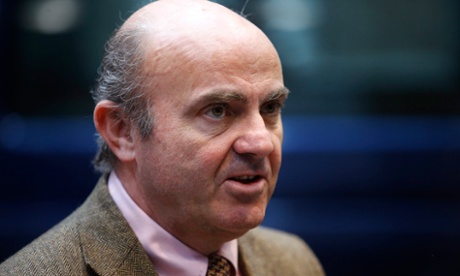
Spain’s economy minister is happily wading in on the Greek debate again today after getting in to a bit of hot water earlier in the week.
Luis de Guindos is sticking to his guns, repeating his comment that Greece will need a third rescue in the region of €30-50bn.
De Guindos told a conference in Barcelona that Europe would use the four-month bailout extension secured by Greece to assess what progress has been made, and what the next move should be.
We have given ourselves these four months to one, see what the real situation is, to see how Greece has met conditions and to try and establish what happens next ... which is fundamentally a third rescue.
He added that ministers at next week’s eurogroup meeting would consider Greece’s liquidity needs and debt maturities.
De Guindos comment earlier in the week that the eurozone was working on a third rescue package for Greece ruffled a few feathers.
In response, a spokeswoman for eurogroup chief Jeroen Dijsselbloem insisted that finance ministers were not discussing a third bailout.
Greece pushes through T-bills sale
Athens has managed to sell €1.138bn (£825m) of six-month Treasury bills, allowing it to refinance a maturing issue.
It was a test of the county’s ability to raise funds as at critical time for Greece.
It passed the test, but the funds came at a higher cost. At 2.97%, the yield was up from 2.75% in a previous sale in February.
#Greece successfully sells 1.14bn euro worth of 26-week T-bills at yield of 2.97% - up from 2.75% last month
— Helena Smith (@HelenaSmithGDN) March 4, 2015
#Greece sold 26-Week T-bills Uniform Yield at a pricey 2.97% vs 2.75% on Feb 4.
— Holger Zschaepitz (@Schuldensuehner) March 4, 2015
Jump in eurozone retail sales

Consumers in the eurozone did their bit to boost the flagging economy in January.
The volume of retail sales jumped 1.1% in the single currency bloc in January compared with December according to statistics office Eurostat. It was a much bigger increase than the 0.1% growth predicted by economists.
The bumper month pushed the annual rate of growth in sales to 3.7%, again much stronger than the 1.9% forecast.
Yesterday’s surprisingly strong number out of Germany had given a hint the eurozone figures would be good, but it’s welcome nevertheless.
The strongest growth in retail sales in January was in Portugal (+6.8%) and Germany (+2.9%).
EU retail sales figures up by much more than expected at 1.1% (expected to be up by only 0.1%).
— Alex Forrest (@_alexforrest) March 4, 2015
More reaction to the UK services PMI now, which revealed a slight slowdown in growth in February.
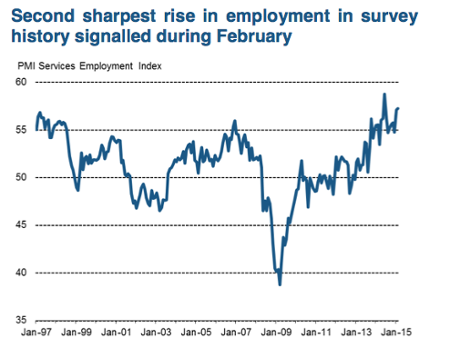
The detail of the survey was more positive than the headline number suggested, with employment, new business and optimism among firms all up at a stronger rate than January.
Vicky Redwood, chief UK economist at Capital Economics:
The slight deterioration in February’s CIPS/Markit report on services is a bit of a disappointment, but hardly a disaster. Contrary to expectations of a rise, the headline business activity index dipped from 57.2 in January to 56.7.
But this reversed only part of the previous month’s rise and left the index still consistent with decent quarterly growth of services output of just below 1%. And the drop looks likely to be temporary, given that the new business, business expectations and employment indices all rose.
What’s more, there has been plenty of other evidence that the economic recovery has been gaining pace again, such as the rises in February’s manufacturing and construction PMIs already released.
Rob Wood, chief UK economist at Berenberg bank:
Despite a small dip, the UK services PMI points to strong growth. The services PMI fell to 56.7 in February from 57.2, below consensus expectations for a rise. Some correction had been on the cards given the large jump in the index last month, so it is hardly anything to start worrying about or pinning ‘UK slowing’ statements on.
At 56.7, the survey continues to point to strong, probably above trend growth. That reading is above the pre-crisis average, pointing to a rapid pace of expansion.
Notwithstanding today’s headline disappointment on the PMI, the economy seems to be growing faster and tightening more than the Bank of England had factored in. For that reason, we look for the first BoE rate hike in Feb 2016 and we expect them to hike rates faster than the market expects, with rates reaching 1.5% by the end of 2016, which would still be an extremely low level and supportive of growth.
Jeremy Cook, chief economist at World First:
Data from the UK services sector remained solid in February and continues the belief that any dip in fortunes seen towards the end of last year was merely a blip.
The services sector continues to add jobs, with February’s additions coming at the second highest rate on record. Higher wages are also being seen for sector participants which is a necessary and welcome reaction to tightness in the labour market and competition between companies.
This competition is also helping rebuild inflation - albeit slowly - within the sector. Should this continue, then the pressure on the Bank of England to raise rates will only increase from the UK’s largest and most valuable sector.
Taking the recent run of PMIs together, Q1 GDP is forecasted at 0.6% with potential for an upside surprise.
Continued growth in the UK services sector - accounting for three quarters of the economy - suggests the chancellor is not in store for a nasty shock in the run-up to the election.
According to Markit, it puts the economy on course for solid growth of 0.6% in the first quarter, following 0.5% growth in the fourth quarter of 2014.
The first estimate of first-quarter growth will be published by the Office for National Statistics on 28 April.
At that point there will only be a little over a week until the general election - nice timing for George Osborne to shout about accelerating growth (and that long-term economic plan of his).
UK all-sector PMI edged higher to 57.0 in Feb. On course for +0.6% GDP rise in Q1. Near-record job growth also seen. pic.twitter.com/t6zJ7MWNqn
— Chris Williamson (@WilliamsonChris) March 4, 2015
UK services sector growth slows in February
The Markit/CIPS PMI survey for the UK has disappointed City forecasts.
The headline index came in at 56.7 in February, down from 57.2 in January. But with anything above 50 signalling growth, it is still a pretty decent result.
The detail of the February composite services PMI for the eurozone shows that bailout countries Spain and Ireland continue to enjoy the fastest expansion.
- Ireland: 60.7
- Spain: 56
- Germany: 53.8
- Eurozone: 53.3
- France: 52.2
- Italy: 51
Howard Archer, chief European economist at IHS Global Insight, says a number of factors are helping to breathe some life into the eurozone’s stuttering economy.
The much more competitive euro, sharply reduced oil prices and ECB stimulus seems to be increasingly fostering a more favourable growth environment, and it is notable that overall business and consumer confidence across the eurozone rose for a second successive month in February to be at seven-month high.
The marked retreat in the euro to recently hit an 11-year low of US$1.1098 is very helpful for eurozone competitiveness and growth prospects while much reduced oil prices are helping companies’ margins as well as consumers’ purchasing power.
Furthermore, markedly lower oil prices should be helpful overall to global growth prospects, which would benefit eurozone exports in tandem with the weaker euro.
The eurozone services sector PMI increased to 53.7 in February from 52.7 in January.
Eurozone growth hits seven-month high on PMI measure
Markit’s composite PMI for the eurozone - measuring services and manufacturing activity across the region - indicates the fastest economic growth in seven months in February.
The composite headline index increased to 53.7 in February from 52.7 in January.
Markit’s chief economist Chris Williamson says this puts the eurozone economy on course for 0.3% growth in the first quarter.
#Eurozone PMI at 7-month high in Feb. Signals +0.3% GDP in Q1. Job creation at 3½-year high http://t.co/1o3JkWKxlH pic.twitter.com/rjc5GOF2Xd
— Chris Williamson (@WilliamsonChris) March 4, 2015
Services growth slows in Italy but quickens in France and Germany
The remaining eurozone services PMI’s are starting to roll in and reveal mixed fortunes.
Headline indices:
- Italy drops to 50 in February from 51.2 in January
- France rises to 53.4 in February from 49.4 in January
- Germany rises to 54.7 in February from 54 in January
European markets rise in early trading
Investors across Europe have a spring in their step this morning, with all major indices up slightly.
- FTSE 100: +0.1 at 6,897
- Germany’s DAX: +0.2% at 11,308.95
- France’s CAC : +0.6% at 4,897.36
- Italy’s FTSE MIB: +0.2% at 22,024.76
- Spain’s IBEX: +0.5% at 11,068.4
Greece’s ATG index is up 0.4% at 864.99.
Standard Chartered bosses waive bonuses

Bosses at Standard Chartered have revealed they will not take a bonus following a sharp fall in profits at the Bank last year.
Standard Chartered board directors waive bonuses as profits slump by more than a quarter for 2014
— Jill Treanor (@jilltreanor) March 4, 2015
Shares have jumped in early trading despite the profit fall, as the dividend was held at the 2013 level rather than cut.
It is top of the FTSE 100 leader board, up 5%.
Last week Standard Chartered revealed a boardroom clearout, with the chairman, chief executive, and four other directors heading for the door. (Read our full story here).
We will have more on the results soon.
The detail of Markit’s Spanish services PMI survey shows that despite the drop in the headline number, there were some positives.
New orders rose at the fastest pace in seven months, while jobs in the sector were created at the fastest rate since November 2007, before the eurozone’s meltdown.
Andrew Harker, senior economist at Markit and author of the report said:
The Spanish service sector maintained its recent run of growth in February, and there were several causes for optimism within the underlying data.
Companies took on extra staff at a solid pace, and one that was the strongest since November 2007. Moreover, business sentiment improved to the highest in 11 years, signalling that companies expect recent growth to be sustained in the near- term at least.
Chris Williamson, Markit’s chief economist, said the survey suggested the Spanish economy overall is on course for growth of 0.7% in the first quarter.
Still-elevated all-sector PMI of 56.0 in Feb means #Spain looks set for 0.7% GDP growth in Q1 pic.twitter.com/lbbB2ATDJM
— Chris Williamson (@WilliamsonChris) March 4, 2015
Spanish services PMI disappoints
The headline index measuring acticvity in Spain’s services sector fell to 56.2 in February from 56.7 in January.
It’s not a big fall, and still indicates the sector is growing (anything above 50), but the number is lower than economists were forecasting.
Meanwhile overnight in China, the HSBC/Markit services PMI suggested activity grew modestly in February. New orders rose at the fastest pace in three months.
The headline index picked up to 52 from 51.8, where anything above 50 indicates expansion, so no horror stories there.
Concerns over the health of the world’s second largest economy persist however, after growth in 2014 of 7.4% was the slowest in 24 years. A further slowdown to about 7% growth is expected this year.
China February HSBC services PMI edges up to 52.0 as orders improve http://t.co/pxgz5I13rF
— Reuters Business (@ReutersBiz) March 4, 2015
The agenda: eurozone services PMIs
Good morning, and welcome to our rolling coverage of the world economy, the financial market, the eurozone, and business.
The main data out this morning are the February services PMI surveys from around Europe.
Spain will get us out of the blocks at 8.15am (UK time), followed by Italy, France, Germany and the eurozone overall.
At 10am, we will get January’s eurozone retail sales figures, which follow surprisingly strong numbers from Germany yesterday.
Michael Hewson, chief market analysts at CMC Markets, is optimistic:
We have seen some silver linings in this week’s European economic data so far and today’s services data could well add to those with improvements expected in the latest Spain, Italy, France and Germany services PMI’s for February.
In the wake of yesterday’s blow out German retail sales numbers, we are expecting a similarly positive improvement from the broader eurozone January retail sales numbers as well, with a rise of 2.5% expected.
At 9.30am Markit will publish the UK services PMI, and markets will be looking for a strong performance for a sector that accounts for about three quarters of the UK economy.
Later on in the US we have the latest ADP employment survey and ISM non-manufacturing index.
And of course, we will bring you all the latest developments from Greece, ahead of next week’s eurogroup meeting.